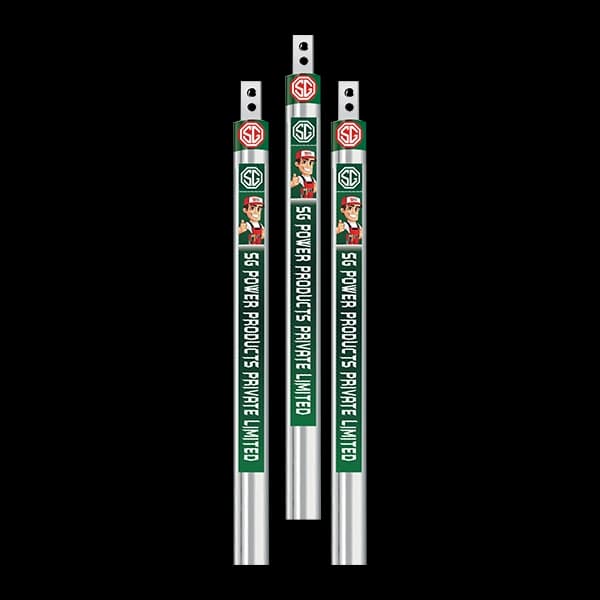
SG Power Products Pvt. Ltd is a chemical earthing electrode manufacturer and chemical earthing electrode supplier in Noida, India. We make TRUESAFE GI, copper bonded and pure copper earth electrodes to IS 3043, in standard, pipe in pipe and strip in pipe construction. Many buyers search for us as chemical earthing rod manufacturers or a chemical earthing rod supplier; the product is the same sealed, conductive-filled electrode. For over 15 years, we have supplied EPC contractors, utilities, railways and industrial plants across India, in bulk and for project orders. Our factory in Duhai Industrial Area, Ghaziabad, also makes UL listed copper bonded ground rods under UL File No. E511876.
9 variants: GI, copper bonded and pure copper, each in 3 constructions
Designed to IS 3043, made in an ISO 9001:2015 certified facility; custom lengths and diameters on request
UL listed manufacturer: our copper bonded ground rods are certified by UL to UL 467 and CSA C22.2 No. 41 (UL File No. E511876)
Datasheet, test report and inspection record with every dispatch
Complete earthing package from one manufacturer: electrodes, backfill compound, pit covers, clamps, strips and exothermic welding
Pan-India dispatch, including remote project sites
A chemical earthing electrode is a sealed metal pipe, filled with a conductive crystalline mix, that is installed in a bore and surrounded by an earth enhancing compound. It gives fault and lightning current a low and stable path into the ground, needs no watering, and lasts longer than conventional pipe or plate earthing. It is also called a chemical earth electrode or a maintenance-free earthing electrode.
Each SG Power electrode has three parts:
GI, copper bonded steel or pure copper, which carries the current and resists corrosion.
A crystalline conductive mix (or an inner pipe or strip) sealed inside the pipe.
A clamp, lug or strip at the top for connecting the earthing conductor.
In the Indian market, "chemical earthing rod" and "chemical earthing electrode" usually mean the same product: a filled, sealed pipe installed with backfill compound. The word "rod" is used loosely by buyers, contractors and tender documents. International specifications often call the same product a chemical grounding electrode or grounding rod.
| Term buyers use | What it normally means | SG Power product |
|---|---|---|
| Chemical earthing rod | Filled, sealed pipe electrode installed with backfill compound | Chemical earthing electrode (this page) |
| Chemical earthing electrode | Same as above | Chemical earthing electrode (this page) |
| Maintenance-free earthing electrode | Same as above | Chemical earthing electrode (this page) |
| Copper bonded earthing rod | Solid steel rod with bonded copper, driven into the ground | Copper bonded earth rods |
| GI earthing rod | Solid galvanised steel rod, driven into the ground | GI earth rods |
If your tender or bill of quantities says "chemical earthing rod", check the construction, material, length and diameter it specifies. If it describes a pipe with conductive filling and backfill compound, it is a chemical earthing electrode. If it describes a solid rod that is driven in, see our earthing rods.
A chemical earth electrode works by increasing the contact area with the soil and keeping that contact moist and conductive all year:
The electrode is placed in a bore, usually 2 m to 3 m deep.
Earth enhancing compound, a carbon- or graphite-based conductive mix, is mixed with water and fills the gap between the electrode and the soil.
The compound sets around the electrode, lowers the resistance of the surrounding zone and holds moisture.
The conductive core inside the electrode carries current along its full length.
Fault or lightning current flows from the earthing conductor, through the electrode and compound, into the soil, keeping touch and step voltages within safe limits across the earthing system.
Because the compound does not wash out like salt and charcoal, the earth resistance stays low through dry seasons. For the full process, see our guide What Is Chemical Earthing?
Chemical earthing electrodes are grouped in two ways: by the material of the outer pipe, and by the construction inside it.
| Material | Construction | Best for |
|---|---|---|
| GI (galvanised iron) | Hot-dip galvanised steel pipe | Budget projects, low-corrosion soil, temporary or short-life sites |
| Copper bonded | Steel pipe with copper molecularly bonded to it | Most industrial, utility and solar projects; long life at moderate cost |
| Pure copper | Solid copper pipe | Highly corrosive soil, coastal sites, critical installations such as data centres |
| Construction | How it is built | Typical use |
|---|---|---|
| Standard | Single pipe filled with conductive mix | General earthing of panels, buildings and equipment |
| Pipe in pipe | Inner pipe inside the outer pipe, with conductive mix between them | Higher fault current: substations, transformers, DG sets |
| Strip in pipe | Metal strip inside the pipe, with conductive mix around it | High fault current and lightning protection, larger contact area |
We make all nine combinations of material and construction. Each is also sold under the names buyers commonly search for.
| Product | Material | Construction | Also called |
|---|---|---|---|
| GI earth electrode, standard | GI | Standard | GI chemical earthing rod |
| GI earth electrode, pipe in pipe | GI | Pipe in pipe | GI pipe in pipe chemical earthing |
| GI earth electrode, strip in pipe | GI | Strip in pipe | GI strip in pipe chemical earthing |
| Copper bonded earth electrode, standard | Copper bonded | Standard | Copper bonded chemical earthing rod |
| Copper bonded earth electrode, pipe in pipe | Copper bonded | Pipe in pipe | Copper bonded pipe in pipe chemical earthing electrode |
| Copper bonded earth electrode, strip in pipe | Copper bonded | Strip in pipe | Copper bonded strip in pipe chemical earthing electrode |
| Copper earth electrode, standard | Pure copper | Standard | Copper chemical earthing rod |
| Copper earth electrode, pipe in pipe | Pure copper | Pipe in pipe | Copper pipe in pipe chemical earthing electrode |
| Copper earth electrode, strip in pipe | Pure copper | Strip in pipe | Copper strip in pipe chemical earthing electrode |
Every material is made in six nominal bores (40, 48, 58, 76, 88 and 115 mm), five lengths (1, 1.5, 2, 3 and 6 m) and three pipe wall classes (standard, Class B and Class C). Custom lengths, diameters and terminals are made to order for bulk projects. See the full model list and part numbers below.
Every SG Power chemical earthing electrode has a part number that shows its material, nominal bore and length. Quote the part number together with the pipe wall class in your enquiry or bill of quantities, and we will confirm the construction (standard, pipe in pipe or flat in pipe) on the datasheet.
| Part of the code | Meaning | Example: CBE76SG300 |
|---|---|---|
| Prefix | GIE = GI, CBE = copper bonded, PCE = pure copper | CBE: copper bonded |
| Number | Nominal bore in mm: 40, 48, 58, 76, 88 or 115 | 76: 76 mm nominal bore |
| SG | SG Power | SG |
| Last digits | Length code: 100 = 1,000 mm, 150 = 1,500 mm, 200 = 2,000 mm, 300 = 3,000 mm, 600 = 6,000 mm | 300: 3,000 mm (3 m) |
The part number is the same for every wall class, so always add the class to your order: for example, CBE76SG300, Class B.
A hot-dip galvanised steel pipe with a sealed conductive filling. The economical choice for dry, non-corrosive soil and for budget or short-life projects.
Outer pipe: hot-dip galvanised steel
Best for: dry, neutral soil; buildings; temporary and construction power
Choose Class B or Class C wall for corrosive soil or a longer design life
Construction: standard, pipe in pipe or flat in pipe. Wall class: standard, Class B or Class C. Designed to IS 3043.
View GI earth electrodes| Nominal bore | 1,000 mm | 1,500 mm | 2,000 mm | 3,000 mm | 6,000 mm |
|---|---|---|---|---|---|
| NB 40 mm | GIE40SG100 | GIE40SG150 | GIE40SG200 | GIE40SG300 | GIE40SG600 |
| NB 48 mm | GIE48SG100 | GIE48SG150 | GIE48SG200 | GIE48SG300 | GIE48SG600 |
| NB 58 mm | GIE58SG100 | GIE58SG150 | GIE58SG200 | GIE58SG300 | GIE58SG600 |
| NB 76 mm | GIE76SG100 | GIE76SG150 | GIE76SG200 | GIE76SG300 | GIE76SG600 |
| NB 88 mm | GIE88SG100 | GIE88SG150 | GIE88SG200 | GIE88SG300 | GIE88SG600 |
| NB 115 mm | GIE115SG100 | GIE115SG150 | GIE115SG200 | GIE115SG300 | GIE115SG600 |
All GIE models are available in standard, Class B and Class C wall thickness.
A steel pipe with copper molecularly bonded to its surface. The steel gives strength; the copper gives conductivity and corrosion resistance. The right choice for most industrial, utility and solar projects.
Outer pipe: steel with molecularly bonded copper
Best for: substations, transformers, solar plants, telecom, industrial plants
Pipe in pipe and flat in pipe models for higher fault current
Construction: standard, pipe in pipe or flat in pipe. Wall class: standard, Class B or Class C. Designed to IS 3043.
View copper bonded earth electrodes| Nominal bore | 1,000 mm | 1,500 mm | 2,000 mm | 3,000 mm | 6,000 mm |
|---|---|---|---|---|---|
| NB 40 mm | CBE40SG100 | CBE40SG150 | CBE40SG200 | CBE40SG300 | CBE40SG600 |
| NB 48 mm | CBE48SG100 | CBE48SG150 | CBE48SG200 | CBE48SG300 | CBE48SG600 |
| NB 58 mm | CBE58SG100 | CBE58SG150 | CBE58SG200 | CBE58SG300 | CBE58SG600 |
| NB 76 mm | CBE76SG100 | CBE76SG150 | CBE76SG200 | CBE76SG300 | CBE76SG600 |
| NB 88 mm | CBE88SG100 | CBE88SG150 | CBE88SG200 | CBE88SG300 | CBE88SG600 |
| NB 115 mm | CBE115SG100 | CBE115SG150 | CBE115SG200 | CBE115SG300 | CBE115SG600 |
All CBE models are available in standard, Class B and Class C wall thickness.
A solid copper pipe with no steel to expose. The highest conductivity and the best resistance to aggressive soil, for sites where service life matters more than price.
Outer pipe: high-purity copper
Best for: coastal, saline or chemically contaminated soil; data centres; critical installations
Consider site security: copper has a high scrap value
Construction: standard, pipe in pipe or flat in pipe. Wall class: standard, Class B or Class C. Designed to IS 3043.
View pure copper earth electrodes| Nominal bore | 1,000 mm | 1,500 mm | 2,000 mm | 3,000 mm | 6,000 mm |
|---|---|---|---|---|---|
| NB 40 mm | PCE40SG100 | PCE40SG150 | PCE40SG200 | PCE40SG300 | PCE40SG600 |
| NB 48 mm | PCE48SG100 | PCE48SG150 | PCE48SG200 | PCE48SG300 | PCE48SG600 |
| NB 58 mm | PCE58SG100 | PCE58SG150 | PCE58SG200 | PCE58SG300 | PCE58SG600 |
| NB 76 mm | PCE76SG100 | PCE76SG150 | PCE76SG200 | PCE76SG300 | PCE76SG600 |
| NB 88 mm | PCE88SG100 | PCE88SG150 | PCE88SG200 | PCE88SG300 | PCE88SG600 |
| NB 115 mm | PCE115SG100 | PCE115SG150 | PCE115SG200 | PCE115SG300 | PCE115SG600 |
All PCE models are available in standard, Class B and Class C wall thickness.
| Wall class | Wall thickness | When to choose it |
|---|---|---|
| Standard | 2.0 mm | Normal soil and standard design life |
| Class B | 2.6 mm | Corrosive soil or a longer design life; recommended for GI on long-life projects |
| Class C | 3.2 mm | The most corrosive soil, the longest design life and the highest mechanical strength |
A heavier wall gives more metal to lose before the electrode is weakened, so it extends service life in the same soil, most of all for GI.
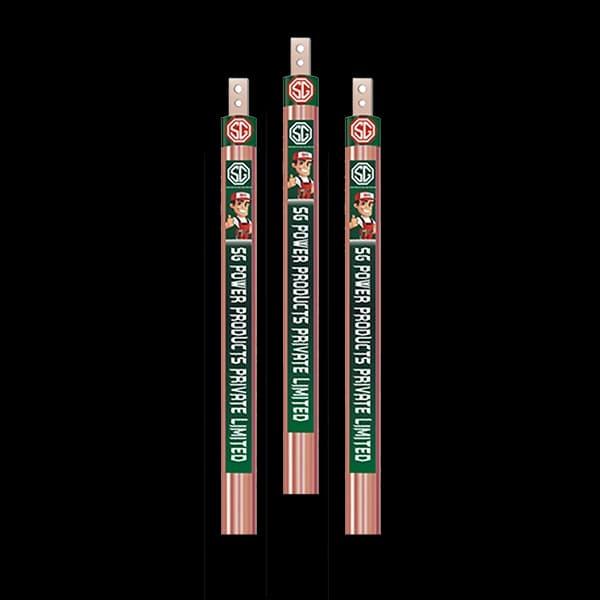
Our pure copper chemical earthing electrode is a 40 mm diameter, high-purity copper electrode for industrial earthing where the highest conductivity and corrosion resistance are needed. It comes in 2 m and 3 m lengths, carries high fault current without overheating, and needs minimal maintenance once installed with earth enhancing compound.
| Parameter | Specification |
|---|---|
| Product | Chemical earthing electrode (also called copper chemical earthing rod) |
| Material | Pure copper, high purity |
| Diameter | 40 mm |
| Part numbers | PCE40SG200 (2 m), PCE40SG300 (3 m) |
| Length | 2,000 mm (2 m) and 3,000 mm (3 m) |
| Construction | Standard, pipe in pipe or flat in pipe |
| Colour and finish | Copper |
| Application | Industrial earthing |
| Certifications | CE, ISO, RoHS, CPRI |
| Warranty | 1 year |
| Pack size | 1 piece |
High conductivity: pure copper gives the lowest electrode resistance of any common earthing material.
Corrosion resistant: suits corrosive, coastal and chemically aggressive soil.
Thermal stability: handles fault current surges without damage to the electrode.
Long life: durable copper construction for a long service life.
Low maintenance: no watering when installed with earth enhancing compound; only periodic testing.
Reliable protection: gives fault current a safe path to ground and helps limit dangerous step voltage.
| Item | Detail |
|---|---|
| Supply capacity | 1,000 pieces per day |
| Delivery time | About 1 week |
| Packaging | Carton box or bag |
| Market | All India, plus export |
| Samples | Available for evaluation on bulk enquiries |
| Minimum order quantity | 100 |
See the full copper earth electrode range for other sizes and constructions.
Copper bonded is the best choice for most projects, because it gives high conductivity and long life at a moderate cost. Choose GI when the budget is tight and the soil is not corrosive, and pure copper when the soil is highly corrosive or the site is critical.
| Factor | GI | Copper bonded | Pure copper |
|---|---|---|---|
| Conductivity | Moderate | High | Highest |
| Corrosion resistance | Low to moderate | High | Highest |
| Mechanical strength | High | High (steel core) | Lower |
| Service life | Shorter | Long | Longest |
| Initial cost | Lowest | Moderate | Highest |
| Lifecycle cost | Higher (replacement) | Low | Low |
For a detailed comparison, read Copper Bonded vs GI Earth Electrode.
A chemical earth electrode gives lower and more stable earth resistance than conventional pipe or plate earthing, needs no watering and corrodes less. Conventional earthing costs less at first, but its resistance rises in dry weather and the salt and charcoal backfill corrodes the electrode.
| Feature | Chemical earth electrode | Conventional pipe or plate earthing |
|---|---|---|
| Electrode | Sealed GI, copper bonded or copper pipe with conductive core | Open GI pipe or GI or copper plate |
| Backfill | Earth enhancing compound | Salt, charcoal and soil |
| Earth resistance through the year | Low and stable | Rises in dry seasons |
| Watering | Not needed | Regular watering needed |
| Corrosion | Low | High, because of salt |
| Maintenance | Periodic testing only | Watering, refilling and replacement |
| Installation space | Narrow bore | Large pit for plates |
| Initial cost | Higher | Lower |
| Lifecycle cost | Lower | Higher |
The values below are our standard range. Custom values are made to order. For every model and part number, see Models and Part Numbers above.
| Parameter | Specification |
|---|---|
| Brand | TRUESAFE |
| Design standard | IS 3043; electrode materials to IEC 62561-2 |
| Materials | GI, copper bonded steel, pure copper |
| Construction | Standard, pipe in pipe, strip in pipe |
| Length | 1,000, 1,500, 2,000, 3,000 and 6,000 mm; custom lengths on request |
| Diameter (nominal bore) | Nominal bore 40, 48, 58, 76, 88 and 115 mm; custom diameters on request |
| Pipe wall class | Standard, Class B or Class C for every size |
| Part number series | GIE (GI), CBE (copper bonded), PCE (pure copper) |
| GI coating | Hot-dip galvanised |
| Conductive filling | Crystalline conductive mix, sealed at both ends |
| Terminal | Clamp, lug or strip connection for the earthing conductor |
| Recommended backfill | SG Power earth enhancing compound |
| Documents | Datasheet, test report, inspection record |
For copper bonded sizes, coating and uses in more detail, read Copper Bonded Earth Electrode: Types, Specifications and Uses. For company details needed for vendor registration, see About SG Power.
Low, stable earth resistance: the conductive core and compound keep resistance low in every season.
Maintenance-free: no watering, salt or charcoal refills; only periodic testing.
Corrosion protection: sealed construction and non-corrosive backfill extend service life.
Compact installation: a narrow bore instead of a large plate pit, useful on crowded sites.
High fault current capacity: pipe in pipe and strip in pipe designs for substations and lightning protection.
Consistent quality: in-house manufacturing and a three-level check before dispatch.
Single-source supply: electrodes, compound, covers, clamps and conductors from one manufacturer.
| Sector | Typical application | Suggested electrode |
|---|---|---|
| Power utilities and substations | Transformer neutral, equipment and fence earthing | Copper bonded pipe in pipe or strip in pipe |
| Railways and metro | Signalling, traction and station earthing | Copper bonded or copper, to RDSO requirements |
| Solar power plants | Inverter, module structure and lightning earthing | Copper bonded or GI strip in pipe; gel earthing compound for dry, sandy sites |
| Industrial plants | Panels, motors, DG sets, process equipment | GI or copper bonded |
| Telecom towers | Tower, shelter and equipment earthing | Copper bonded |
| Data centres and hospitals | Clean earth for IT and medical equipment | Copper or copper bonded |
| Commercial and residential projects | Main building earthing, lift and pump earthing | GI or copper bonded |
| Lightning protection | Earth termination of down conductors | Copper bonded strip in pipe |
Measure soil resistivity at site with a four-pin (Wenner) test; this sets how many electrodes you need.
Know the fault level and duration to size the electrode and conductor.
Set the target earth resistance from the project specification, for example below 1 ohm for substations or below 5 ohms for buildings.
Check corrosion conditions: coastal, chemical or waterlogged soil calls for copper bonded or copper.
Choose material and construction to balance budget and service life.
Work out the number and spacing of electrodes; parallel electrodes are usually spaced at least twice their length apart.
Plan connections and accessories: compound, clamps, earthing strips, earth pit covers and exothermic welding.
Not sure how many electrodes your site needs? Share your soil resistivity and target resistance and our engineers will work it out.
Procurement teams comparing chemical earthing rod manufacturers should check these ten points before placing a bulk order:
| # | Check | What to ask for |
|---|---|---|
| 1 | Standards compliance | IS 3043 design, and the standard named on the datasheet |
| 2 | Test reports | Short-circuit, material and coating test reports; ISO 9001 certificate |
| 3 | Material quality | Galvanising thickness, copper bonding thickness, copper purity |
| 4 | Fault current rating | A rating matched to your system fault level and duration |
| 5 | Filling and sealing | Conductive filling along the full length, sealed at both ends |
| 6 | Manufacturer or trader | In-house production, factory inspection allowed |
| 7 | Product range | All materials and constructions, plus compound and accessories |
| 8 | Project references | Similar projects for utilities, railways or EPC contractors |
| 9 | Delivery capability | Stock of standard sizes, lead time for bulk, dispatch to site |
| 10 | Lifecycle value | Service life and replacement cost, not just the unit price |
Buying from a direct manufacturer rather than a trader gives you better quality control, traceability by batch and access to custom sizes.
The chemical earthing electrode price depends mainly on material, size and construction. Copper costs most, GI least, and pipe in pipe or strip in pipe costs more than standard. Prices also follow copper and steel market rates, so we quote per project.
| Price factor | Effect on price |
|---|---|
| Material | GI lowest, copper bonded moderate, pure copper highest |
| Length and diameter | Longer and wider electrodes cost more |
| Construction | Pipe in pipe and strip in pipe cost more than standard |
| Coating thickness | Thicker copper bonding or galvanising costs more |
| Quantity | Bulk and project orders get better rates |
| Accessories | Compound, cover, clamp and conductor add to the per-pit cost |
| Delivery location | Freight to remote sites adds to the landed cost |
Indicative ex-works prices for bulk orders. Final rates depend on quantity, construction and the copper and steel market on the date of the quotation.
| Size | GI | Copper bonded | Pure copper |
|---|---|---|---|
| 1 m (about 3 ft) | Depends on LME Price | Depends on LME Price | Depends on LME Price |
| 2 m (about 6.5 ft) | Depends on LME Price | Depends on LME Price | Depends on LME Price |
| 3 m (about 10 ft) | Depends on LME Price | Depends on LME Price | Depends on LME Price |
For reference, public B2B listings in Delhi NCR in October 2026 show roughly ₹1,085 to ₹11,999 per electrode for common sizes. Very low prices usually mean a thin coating, a short length or no conductive filling, so compare the specification, not just the price.
Share your bill of quantities for a project-wise chemical earthing rod price.
Technical documents: datasheet and drawings for approval before order.
Test reports: material and performance test reports for each batch.
Quality control: a three-level check of raw material, production and final product before dispatch.
Inspection: third-party or client inspection at our factory on request.
Traceability: batch marking linked to test records.
Procurement and vendor registration teams can verify these details before approving a chemical earthing electrode manufacturer.
| Item | Detail |
|---|---|
| Legal entity | SG Power Products Pvt. Ltd (private limited company) |
| CIN | U29309DL2019PTC345063 |
| GST number | 09ABBCS4952J1ZZ (manufacturer) |
| Import Export Code (IEC) | ABBCS4952J |
| Quality management | ISO 9001:2015 certified, covering chemical earthing electrodes, copper bonded rods, earth pit covers, earthing compound and lightning arresters |
| UL certification | UL File No. E511876: copper bonded grounding rods (models SGPCBR-1403, 1703, 2003 and 2503; 14, 17, 20 and 25 mm) listed to UL 467 Edition 11 (US, category KDER) and CSA C22.2 No. 41:22 (Canada, category KDER7). UL Certificates of Compliance dated 2 July 2024. The listing covers ground rods, not chemical earthing electrodes. |
| Manufacturing facility | Plot No. 695-696, Duhai Industrial Area, Meerut Road, Ghaziabad, Uttar Pradesh 201206 (the address on the UL certificate) |
| Environmental compliance | RoHS (Directive 2011/65/EU) for chemical earthing electrodes, copper bonded rods, earth pit covers, earthing compound and lightning arresters |
| Team | 101 to 500 employees, with an in-house R&D department |
| Quality testing | In-house quality testing facility |
| Warehousing | Large warehouses for ready stock of standard sizes |
| Export | Supplied to Kenya and Saudi Arabia |
| Buyer ratings | 4.3 out of 5 on Google (68 reviews); 4.2 out of 5 on IndiaMART (131 reviews), IndiaMART TrustSEAL verified |
Every SG Power chemical earthing electrode goes through eight stages at our own facility:
Raw material inspection: steel or copper pipe and strip checked for size, wall thickness and composition.
Cutting and forming: pipes cut to length and the terminal prepared.
Coating: hot-dip galvanising for GI, or molecular copper bonding for copper bonded electrodes.
Coating check: thickness measured on samples from each batch.
Filling: the pipe is filled with conductive crystalline mix along its full length, with the inner pipe or strip for pipe in pipe and strip in pipe models.
Sealing: both ends sealed so the filling stays dry and intact.
Final testing: dimensional, visual and continuity checks, with records kept by batch.
Marking and packing: batch marking for traceability and packing for safe transport to site.
As a direct chemical earthing electrode manufacturer, we make every electrode ourselves and control coating thickness, filling and sealing, the three things that decide how long a chemical earthing rod lasts.
Project experience: for over 15 years, we have supplied Indian Railways, L&T, NTPC, BHEL, Tata, Adani Power and the Airport Authority of India.
Industrial clients: Siemens, Aditya Birla Group, Hindalco Industries, JSW Steel, JK Cement, Ratnamani Metals & Tubes, Amazon and Jubilant FoodWorks, among others.
Certified quality: ISO 9001:2015 certified manufacturing, UL listed copper bonded ground rods (UL File No. E511876) and RoHS-compliant products.
Complete range: three materials in three constructions, plus custom sizes.
In-house manufacturing and R&D: control over material, filling, sealing and testing, with an R&D team for custom designs.
Supply capacity: large warehouses with ready stock of standard sizes and capacity for bulk orders.
Pan-India delivery and export: by road, air and sea, including remote project sites and overseas projects.
Trusted by buyers: rated 4.3 out of 5 on Google and 4.2 out of 5 on IndiaMART.
Single-source earthing package: electrodes, earth enhancing compound, pit covers, earthing clamps, strips and lightning protection.
We supply in bulk and for projects only, directly from our factory. As a chemical earthing electrode supplier to EPC contractors, utilities, railways, solar developers and government tenders, we offer:
Quotations against tender specifications and bills of quantities
Datasheets and drawings for client and consultant approval
Factory inspection before dispatch
Phased deliveries to match the project schedule
Dispatch across India, including the North-East and other remote sites, and export by sea and air (recent markets include Kenya and Saudi Arabia)
Our head office is in Noida, so project sites in Delhi NCR get the shortest lead times. We also dispatch bulk orders to every state.
| Region | Cities we supply |
|---|---|
| Delhi NCR | Delhi, Noida, Ghaziabad, Gurugram, Faridabad, Greater Noida |
| North India | Lucknow, Kanpur, Agra, Varanasi, Jaipur, Ludhiana, Amritsar, Jalandhar, Patna |
| West India | Mumbai, Ahmedabad, Pune, Surat, Vadodara, Rajkot, Nagpur, Nashik |
| Central and East India | Bhopal, Indore, Raipur, Ranchi, Kolkata |
| South India | Hyderabad, Bangalore, Chennai, Coimbatore, Kochi, Madurai, Vizag |
Measure soil resistivity, then bore the hole to the electrode length plus an allowance.
Place the electrode vertically in the centre of the bore.
Mix the earth enhancing compound with water to a slurry and pour it around the electrode.
Backfill with the excavated soil and compact it.
Connect the earthing conductor by exothermic weld or a rated bolted clamp.
Fit an earth pit cover over the top.
Measure and record the earth resistance against the design value.
For a full step-by-step guide with a cross-section diagram, read What Is Chemical Earthing? How It Works, Types and Installation.
Test the earth resistance with an earth tester using the fall-of-potential (three-point) method, as described in IS 3043. On existing systems with many connected earths, a clamp-on tester can be used without disconnecting the electrode.
| When to test | Why |
|---|---|
| At commissioning | Confirms the design value is met |
| Every year, in the dry season | Shows the highest resistance of the year |
| After a lightning strike or major fault | Checks connections and the electrode |
| After construction work nearby | Checks for damaged conductors |
Keep a log of each pit's readings so that rising trends are spotted early.
Send us your project details, such as electrode type, quantity, soil resistivity, target earth resistance and delivery location. Our engineers will reply with a techno-commercial offer, datasheets and a suggested earth pit design.