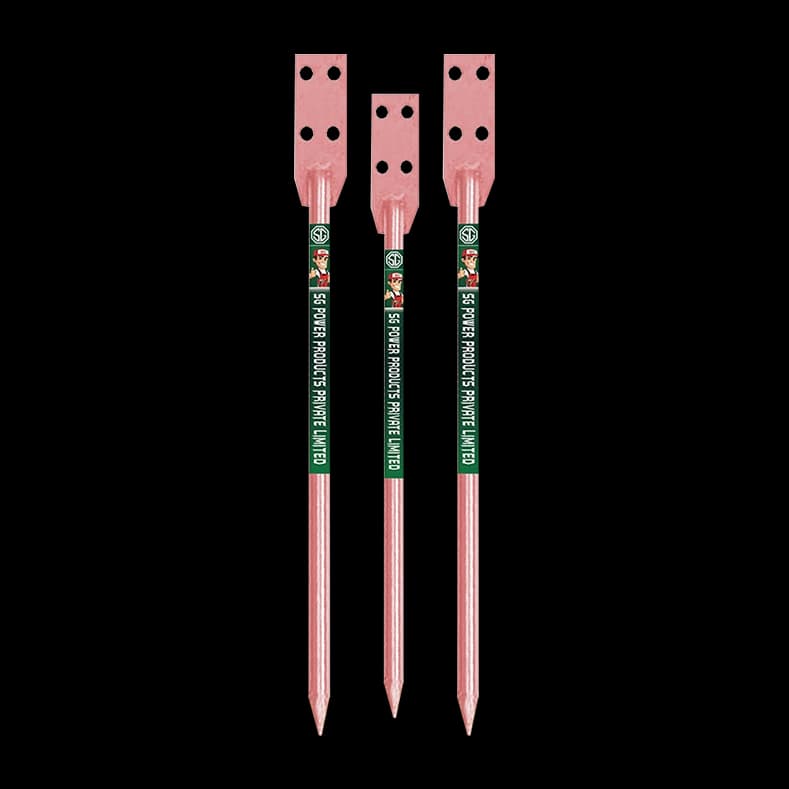
Every electrical installation is only as safe as its connection to the earth. When insulation fails, a cable is damaged or lightning strikes a structure, fault current needs a path into the ground that is fast, low in resistance and dependable year after year. SG Power Products Pvt. Ltd. manufactures copper bonded earthing rods that provide exactly that path, combining a high-tensile steel core with a 250-micron layer of 99.9% pure electrolytic copper.
From our base in Noida, Uttar Pradesh, we supply copper bonded earthing rods to power utilities, EPC contractors, solar developers, telecom operators, railways, metro projects, factories and builders across India. Whether you need a handful of rods for a single building or bulk quantities for a substation grid, we focus on consistent quality, correct sizing and on-time dispatch. For projects where the specification calls for third-party certified grounding, we also manufacture UL listed copper bonded rods, certified to UL 467 and CSA C22.2 No. 41 under UL File No. E511876.
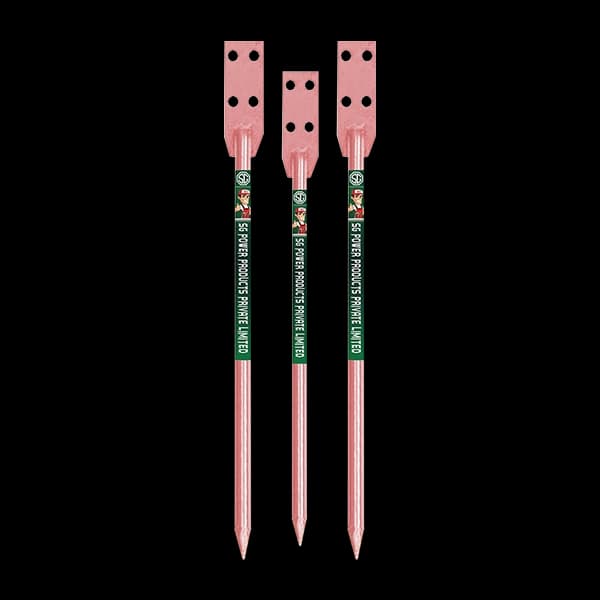
A copper bonded earthing rod is a ground electrode made from a steel rod with a permanent copper coating fused to its surface. It is driven vertically into the soil and connected to the earthing conductor of an electrical system or a lightning protection system. Its job is simple but critical: carry fault and surge currents into the general mass of earth so that equipment and people stay safe.
The design draws on the strengths of two metals. Steel provides the stiffness needed to drive the rod several metres into compact or stony ground without bending. Copper provides high conductivity and strong resistance to soil corrosion. The result is an electrode that performs like copper at the surface, while costing far less than a solid copper rod and handling far better on site.
You may also hear these rods called copper bonded ground rods, copper clad steel earth rods or copper earthing electrodes. Whatever the name, a quality copper bonded rod always has its copper bonded to the steel at the molecular level, not simply slipped over it as a loose sleeve.
Performance in the ground depends on what happens in the factory. Our manufacturing process concentrates on the details that decide how long a rod will last once it is buried.
We use high-tensile, low-carbon steel with a typical tensile strength of 580–600 N/mm², straightened so the rod stays true while it is driven.
The steel is thoroughly cleaned and prepared so that copper bonds evenly along the full length of the rod.
Copper of 99.9% purity is deposited on the steel by electro-deposition, building a uniform layer of 250 microns (0.25 mm) as standard. Thinner 100–200 micron options are available on request for specific project budgets.
The ends are roll-threaded rather than cut, so the copper layer remains continuous over the thread and the joint does not become a weak point for corrosion.
One end can be pointed to make driving easier in hard soil.
Rods are checked for coating thickness, straightness and bonding integrity. A bend test confirms that the copper does not crack or peel when the rod is flexed.
Different sites need different connection arrangements, so we offer copper bonded earthing rods in three common configurations:
Roll-threaded at both ends for joining with couplers. These are the first choice where deep driving is needed to reach low-resistivity soil.
View copper bonded earth rodsFitted with a flat palm or lug at the top, so the earthing strip or cable can be bolted on directly. Ideal for quick, neat connections in earth pits.
View rods with palmSupplied with a suitable rod clamp for connecting copper tape, strip or cable, saving time on site and ensuring a firm, low-resistance joint.
View rods with clampSupplied with a suitable rod clamp for connecting copper tape, strip or cable, saving time on site and ensuring a firm, low-resistance joint.
View rods with clampCopper bonded ground rods listed by UL to UL 467 (US) and CSA C22.2 No. 41 (Canada), with a minimum 254-micron copper coating and the UL mark on every rod. Specified for data centres, oil and gas, and projects built to US or multinational standards.
View UL listed copper bonded rodsThe rods on this page are solid copper bonded, GI and copper rods that are driven straight into the ground. A chemical earthing rod is different: it is a sealed pipe filled with a conductive compound, installed in a bore with earth enhancing backfill, and it needs no watering. As chemical earthing rod manufacturers, we make these in GI, copper bonded and pure copper, in standard, pipe in pipe and strip in pipe constructions.
An earthing system rarely gets attention until something goes wrong. A rod that corrodes, loses its copper layer or develops high contact resistance can quietly push earth resistance above safe limits. When a fault then occurs, protective devices such as MCBs, MCCBs, RCCBs and relays may trip late or not at all. Exposed metal parts can rise to dangerous voltages, sensitive electronics can be damaged and the risk of fire grows.
A well-made copper bonded earthing rod keeps its cross-section and its conductive surface for decades. That stability is what keeps earth resistance close to its design value through the monsoon, the dry summer months and every season in between. In short, the rod you choose today decides how safe your installation will be ten or twenty years from now.
Copper's conductivity of about 100% IACS gives a low-impedance path, helping fault currents clear quickly and keeping step and touch voltages low.
The pure copper surface resists soil corrosion far better than zinc-coated GI rods, so performance stays stable over time.
Molecular bonding means the copper will not slip, peel or crack when the rod is driven, bent or cut.
The steel core allows deep driving with manual or power hammers, even where the ground is hard.
Threaded ends and copper alloy couplers let you join rods to reach moist, low-resistivity soil layers.
A design life of 30 years or more in normal soil conditions (site dependent) means fewer replacements and less digging.
You get copper surface performance at a fraction of the material cost of a solid copper rod.
Because the rod is mostly steel, its scrap value is low, a real advantage at remote telecom and solar sites.
| Parameter | Specification |
|---|---|
| Core material | High-tensile, low-carbon steel |
| Coating | 99.9% pure electrolytic copper, molecularly bonded |
| Copper thickness | 250 microns standard; 100–200 microns on request |
| Diameters | 1/2", 5/8", 3/4", 1" |
| Lengths | 1.0 m, 1.2 m, 1.5 m, 2.0 m, 2.4 m, 3.0 m |
| End finish | Roll-threaded both ends, or pointed one end |
| Extension | Copper alloy couplers |
| Reference standards | UL 467, IS 3043:2018, IEEE 80, BS 7430, BS EN 62561-2 |
| Design life | 30+ years in normal soil (site dependent) |
Custom diameters, lengths and coating thicknesses can be produced for project-specific requirements.
Selecting the right rod is about more than picking a diameter. Before you order, consider these factors:
Soil resistivity: Measure it on site, typically with the Wenner four-pin method. Dry, rocky or sandy soil usually needs longer rods, more rods or earthing backfill compound.
Earth resistance target: Substations and power plants often aim for 1 ohm or less, while industrial, commercial and telecom sites commonly work to 2–5 ohms, depending on the design.
Fault current: Higher fault levels call for larger cross-sections and more electrodes, sized according to IEEE 80 or IS 3043.
Driving depth: Where moist soil lies deep, choose threaded rods that can be coupled and extended.
Coating thickness: For aggressive soils or a long design life, 250 microns is the safer choice.
Connection method: Decide between clamps, a palm-type rod or exothermic welding, and plan for an inspection pit.
Certification required: If the project specification follows the NEC, a US-based standard, or an owner’s global standard that asks for listed grounding electrodes, choose a UL listed copper bonded ground rod and quote its UL file number in your submittal. For specifications based only on IS 3043, a standard copper bonded rod is usually enough.
Our technical team can help you work out rod size, quantity and spacing from your soil data and project requirements.
Copper bonded earthing rods are used wherever a stable, low earth resistance is essential for safety and equipment protection:
Ground grids that carry high short-circuit currents and limit step and touch potential.
Earthing of transformers, tower footings and HT/LT panels.
Earthing of module structures, inverters, combiner boxes and lightning arresters in ground-mounted and rooftop projects.
Earthing of turbine foundations and lightning down conductors.
Low-resistance earthing for BTS shelters, antennas and tower lightning protection.
Clean, stable earthing for servers, UPS systems and sensitive electronics.
Protection for motors, control panels, DG sets and process equipment.
Earthing of traction substations, signalling and station infrastructure.
Static discharge and lightning protection for tanks and pipelines.
Earthing for distribution boards, lifts and lightning protection in hospitals, malls, offices, hotels and apartments.
GI (galvanised iron) rods have a lower upfront price, but their zinc coating wears away in most soils within a few years. Once the steel starts to corrode, the effective cross-section shrinks and earth resistance creeps upward. A typical GI rod lasts about 5–10 years, compared with 30 years or more for a copper bonded earthing rod.
Over the life of a project, copper bonded rods usually work out cheaper once replacement, labour and downtime are counted. Solid copper rods match them on conductivity, but cost far more, attract theft and tend to bend when driven into hard ground.
For a full comparison on corrosion, soil suitability, service life and lifecycle cost, read our guide to copper bonded vs GI earth electrodes.
Uniform 250-micron coating, molecular bonding and rolled threads on every rod.
1/2" to 1" diameter and 1 m to 3 m length, with custom sizes on request.
Rods, couplers, clamps, backfill compound, exothermic welding powder, earth pit covers and lightning arresters from a single source.
Reliable supply for substation, solar, railway and metro orders.
Delivery from Noida to project sites across the country.
Guidance on rod selection, quantity estimation and earthing design queries.
Factory-direct rates for contractors, dealers and project buyers.
One of the few Indian makers with copper bonded ground rods listed by UL (File No. E511876) for both the US and Canada. See our UL listed copper bonded rod range.