


As one of the growing lightning protection system manufacturers and suppliers in the country, SG Power offers three product families on this page:
ESE Lightning Arresters – Thunder Guard, Thunder Shield, Storm Shield and Storm Guard models based on Early Streamer Emission technology
Conventional Lightning Arresters – copper bonded, GI and pure copper Franklin-type rods with multi-spike heads
Accessories for Lightning Protection Systems – GI masts, base plates, down conductor fittings and connection hardware
Every product is backed by technical datasheets, drawing references and support from our engineering team in Noida, Uttar Pradesh.
Table of Contents
- What Is a Lightning Protection System and How Does It Work?
- Our Lightning Protection System Products
- ESE vs Conventional Lightning Arrester: Which Should You Choose?
- Standards and Testing for Lightning Protection Systems
- Applications of Lightning Protection Systems
- How to Select the Right Lightning Protection System
- Why Choose SG Power as Your Lightning Protection System Manufacturer?
- Lightning Arrester Price in India
- Frequently Asked Questions
- Request a Quote
What Is a Lightning Protection System and How Does It Work?
A lightning protection system is an engineered network that captures a lightning strike at a chosen point and conducts its current safely to earth. Under IEC 62305, an external LPS has three working parts, and each must be sized and connected correctly for the system to perform.
Air termination system – the lightning arrester, air rod or ESE air terminal mounted at the highest point of the structure. It offers the strike a preferred point of attachment.
Down conductor system – copper, copper bonded or GI strips and cables that carry the current from the air terminal to ground level along the shortest, straightest route, with a test joint for periodic measurement.
Earth termination system – earth electrodes, copper bonded earth rods and backfill compound that spread the current into the soil at low resistance, ideally 10 ohms or less.
These are supported by equipotential bonding of roof metalwork and by surge protection devices (SPDs) on incoming power, data and solar lines, which handle the internal side of protection.
When a thundercloud builds charge, the field near the roof rises sharply. The air terminal launches an upward leader that meets the downward leader from the cloud. The stroke attaches to the terminal, flows through the down conductors and is dispersed by the earthing system, leaving the structure, its occupants and its equipment unharmed. An arrester alone does nothing; the whole chain from rod to earth pit must be continuous and low in impedance.
Our Lightning Protection System Products
1. ESE Lightning Arrester (Early Streamer Emission)
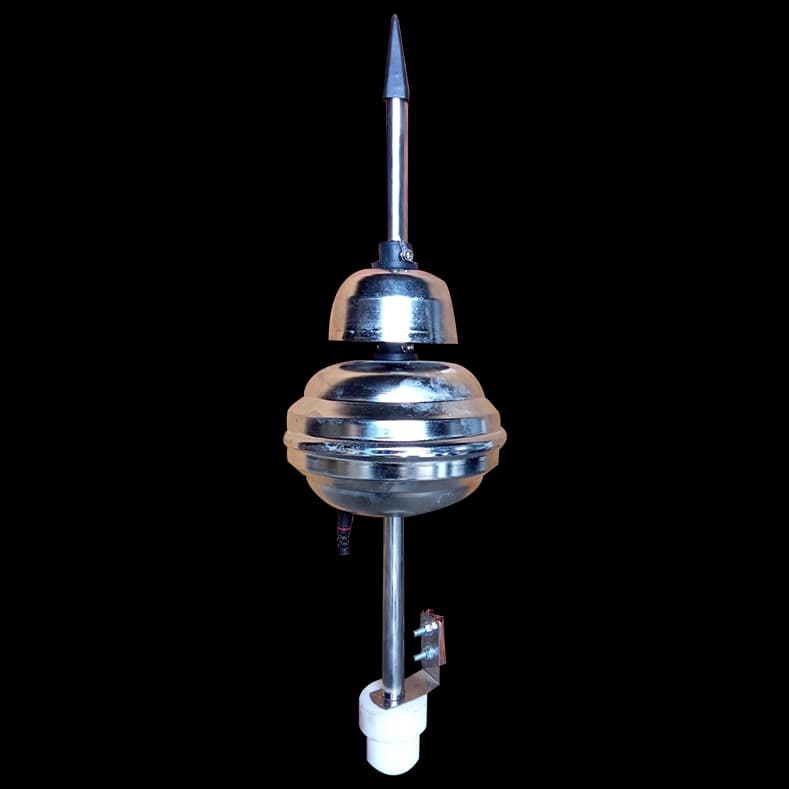
An ESE lightning arrester is an active air terminal. As the electric field rises before a strike, its head triggers an upward streamer earlier than a plain rod would. This early interception gives a much larger protection radius, so one ESE unit can often replace many conventional rods on a large roof, cutting the number of masts and down conductors.
SG Power manufactures four ESE models: Thunder Guard™, Thunder Shield, Storm Shield and Storm Guard. Our flagship Thunder Guard™ carries the following specification:
| Parameter | Thunder Guard™ ESE Lightning Arrester |
|---|---|
| Make / Type | SGPL / ESE (Early Streamer Emission) |
| Rod diameter | 22 mm |
| Length | 350 mm |
| Head needle | 30 mm |
| Material | Stainless steel SS 304, suitable for moist environments |
| Radius of coverage | Up to 107 m |
| Triggering time | 60 µs |
| Weight | 2.4 kg (approx.) |
| Applicable standard | IEC 62305 |
| Testing | CPRI tested |
The SS 304 body resists corrosion in coastal, humid and industrial atmospheres, and the maintenance-free design suits remote solar plants and telecom sites. Protection radius, dimensions and test data differ by model, so always take values from the specific model's datasheet when designing.
Best for: high-rise buildings, factories, warehouses, airports, solar power plants, telecom towers, hospitals and open sites where one terminal must cover a wide area.
2. Conventional Lightning Arrester (Franklin Rod Type)
A conventional lightning arrester is a passive, pointed air rod following the Franklin principle. It protects a cone-shaped zone beneath it, defined by the protection angle, rolling sphere or mesh method of IEC 62305-3. It is simple, economical and proven, and is widely specified in government, railway and PWD tenders.
SG Power supplies three variants: Copper Bonded, GI (galvanized iron) and pure Copper lightning arresters. Sample specification of our copper bonded model:
| Parameter | Copper Bonded Lightning Arrester (CBLA14SG050M) |
|---|---|
| Make | SGPL |
| Core material | High tensile low carbon steel, copper bonded |
| Main rod diameter | 14 mm |
| Length | 500 mm |
| Spike configuration | 5 spike |
| Base plate | Copper bonded, 100 × 100 mm |
| Applicable standard | IEC 62305 |
Other diameters, lengths and base plate options are available on request. Copper bonded arresters combine the strength of steel with the conductivity and corrosion resistance of copper. GI arresters are the budget choice for low-risk structures, while solid copper arresters offer the highest conductivity for critical installations.
Best for: residential buildings, schools, small commercial blocks, water tanks, chimneys, rooftop solar and structures designed with a mesh or multiple-rod layout.
3. Accessories for Lightning Protection System
A lightning arrester performs only as well as the parts that hold it up and connect it to earth. SG Power manufactures the supporting hardware for a complete installation.
| Parameter | GI Mast |
|---|---|
| Material | Galvanised iron (GI), standard grade |
| Mast diameter | 48 ± 2 mm |
| Length | 6 m and 3 m options, single-piece pipe |
| Base plate | 300 × 300 × 6 mm |
| Use | Raising ESE and conventional arresters above roof equipment |
ESE vs Conventional Lightning Arrester: Which Should You Choose?
The right choice depends on roof size, building height, budget and the standard named in your tender. ESE wins on wide, open areas; conventional rods win on cost and on projects that specify the IEC 62305 mesh method.
| Feature | ESE Lightning Arrester | Conventional Lightning Arrester |
|---|---|---|
| Working principle | Active: early upward streamer | Passive: Franklin rod point |
| Protection area | Large radius (Thunder Guard™ up to 107 m) | Small cone below each rod |
| Units per large roof | Usually one or a few | Many rods plus roof mesh |
| Down conductors | Fewer required | More required |
| Initial cost per unit | Higher | Lower |
| Installation | Single mast, quicker | More rods, clamps and tape |
| Typical material | SS 304, copper | Copper bonded steel, GI, copper |
| Best fit | Large plants, solar parks, towers, campuses | Homes, small buildings, tender-specified mesh designs |
For many large sites, the lower count of masts, down conductors and earth pits makes an ESE system cheaper overall despite the higher unit price. Our engineers can compare both layouts for your drawing before you buy.
Standards and Testing for Lightning Protection Systems
Our lightning protection products are designed in line with the international and Indian codes that consultants and approving bodies use:
IEC 62305 (Parts 1–4) – general principles, risk assessment, physical protection of structures, and protection of electrical systems
IS/IEC 62305 – the Indian adoption of the IEC series, now referenced in the National Building Code
IEC 62561 – requirements and tests for LPS components, including conductors and earth electrodes
IS 3043 – code of practice for earthing, used for the earth termination side
CPRI testing – our Thunder Guard™ ESE arrester is tested at the Central Power Research Institute
Ask us for datasheets, drawings and test certificates with your quotation so your consultant can approve the submittal quickly.
Applications of Lightning Protection Systems
SG Power supplies lightning protection for projects across India, including:
Industrial – factories, refineries, chemical plants, warehouses and cold storage
Power and renewables – solar parks, rooftop solar, wind farms, substations and DISCOM networks
Infrastructure – railways, metro stations, airports, ports, bridges and highways
Telecom and IT – mobile towers, data centres and control rooms
Commercial and institutional – malls, hotels, hospitals, schools and office towers
Residential and heritage – high-rise apartments, villas, temples and water tanks
How to Select the Right Lightning Protection System
Assess the risk – use the IEC 62305-2 risk assessment to set the required lightning protection level (LPL I to IV).
Study the structure – note height, roof area, shape, rooftop equipment and nearby taller buildings.
Choose the air terminal – ESE for wide coverage with fewer masts; conventional rods or mesh for smaller roofs or where the tender specifies them.
Plan down conductors – at least two per terminal, routed straight, with test joints at a reachable height.
Design the earthing – target 10 ohms or less, using copper bonded rods or chemical earth electrodes with backfill compound.
Add surge protection – install SPDs on main panels, solar inverters and data lines.
Check documents – compare datasheets, test reports and warranty before you place the order.
The earthing side of the system uses our copper bonded earth rods, chemical earthing electrodes, earth enhancing compound, conductors and strips and exothermic welding for permanent joints.
Why Choose SG Power as Your Lightning Protection System Manufacturer?
Buyers comparing lightning protection system manufacturers and suppliers in India look for more than a low price. Here is what SG Power brings to your project:
Complete LPS range from one source – ESE and conventional arresters, GI masts, conductors, earth electrodes, backfill compound, earth pit covers and exothermic welding
Clear technical data – published specifications, drawings and downloadable datasheets for each model
Tested quality – SS 304 and copper bonded materials, IEC 62305 based design and CPRI-tested ESE terminals
Project experience – supply to railways, metro, DISCOMs, renewable energy and EPC contractors
Engineering support – help with layout, protection radius checks and product selection
Pan-India supply – dispatch from Noida, Uttar Pradesh to sites across India, with bulk and tender quantities supported
Competitive pricing – direct-from-manufacturer rates for distributors, contractors and end users
Learn more about SG Power, or send your drawing for a layout check.
Lightning Arrester Price in India
Price depends on type, model, material, protection radius, mast height and quantity, so we quote per project rather than publish a fixed rate. Share your drawing and requirement for a direct-from-manufacturer quotation.
| Item | What Sets the Price | Price |
|---|---|---|
| ESE lightning arrester | Model, protection radius and mounting height | Price on request |
| Conventional lightning arrester | Copper bonded, GI or copper; rod diameter, length and spike count | Price on request |
| GI mast and accessories | Mast length, base plate and fittings | Price on request |
* Prices are indicative. For the latest price, contact SG Power.
Frequently Asked Questions
Our Satisfied Clients

Project Location - Karnataka
Power infrastructure project with advanced electrical solutions.

Project Location - Kanheri Hills
Defence sector electrical and protection systems.

Project Location - Hyderabad
Airport infrastructure and electrical safety solutions.

Project Location - Pune
Metro rail electrical installations and grounding systems.

Project Location - Ajmer
State electricity distribution network solutions.

Project Location - Jodhpur
Power distribution and earthing solutions.

Project Location - Bangalore, Noida
Heavy electrical and industrial power systems.

Project Location - Odisha
Steel industry electrical infrastructure solutions.

Project Location - Nashik, Chhattisgarh
Defence-grade electrical protection systems.

Project Location - Lucknow, Jabalpur
Telecom infrastructure and grounding systems.

Project Location - Ghaziabad
Government electronics and power systems.

Project Location - Sambalpur
Aluminium industry electrical safety solutions.

Project Location - Srinagar
Military-grade electrical infrastructure.

Project Location - Kerala
Railway electrification and protection systems.

Project Location - Rajasthan
Cement industry electrical solutions.

Project Location - Haryana
State power distribution infrastructure.

Project Location - Noida
Industrial electrical and safety systems.

Project Location - Khavda, Bikaner
Large-scale construction and power projects.

Project Location - Noida
Private electricity distribution systems.

Project Location - Chhattisgarh
Thermal power plant electrical solutions.

Project Location - Shahjahanpur
Power generation and infrastructure systems.

Project Location - Gurugram
Aviation electrical infrastructure solutions.

Project Location - Noida
Smart city electrical and infrastructure systems.
Request a Lightning Protection System Quote
Call +91 8929722150 or email enquiry@sgpower.co.in with your building height, roof area and the protection level your consultant has specified. We dispatch ESE and conventional arresters, GI masts and accessories to sites across India from Noida, Uttar Pradesh.