
Copper Bonded Earth Electrode: Types, Specifications and Uses
Types of copper bonded earth electrode explained, with what each specification means, how to read a datasheet and where each type is used.
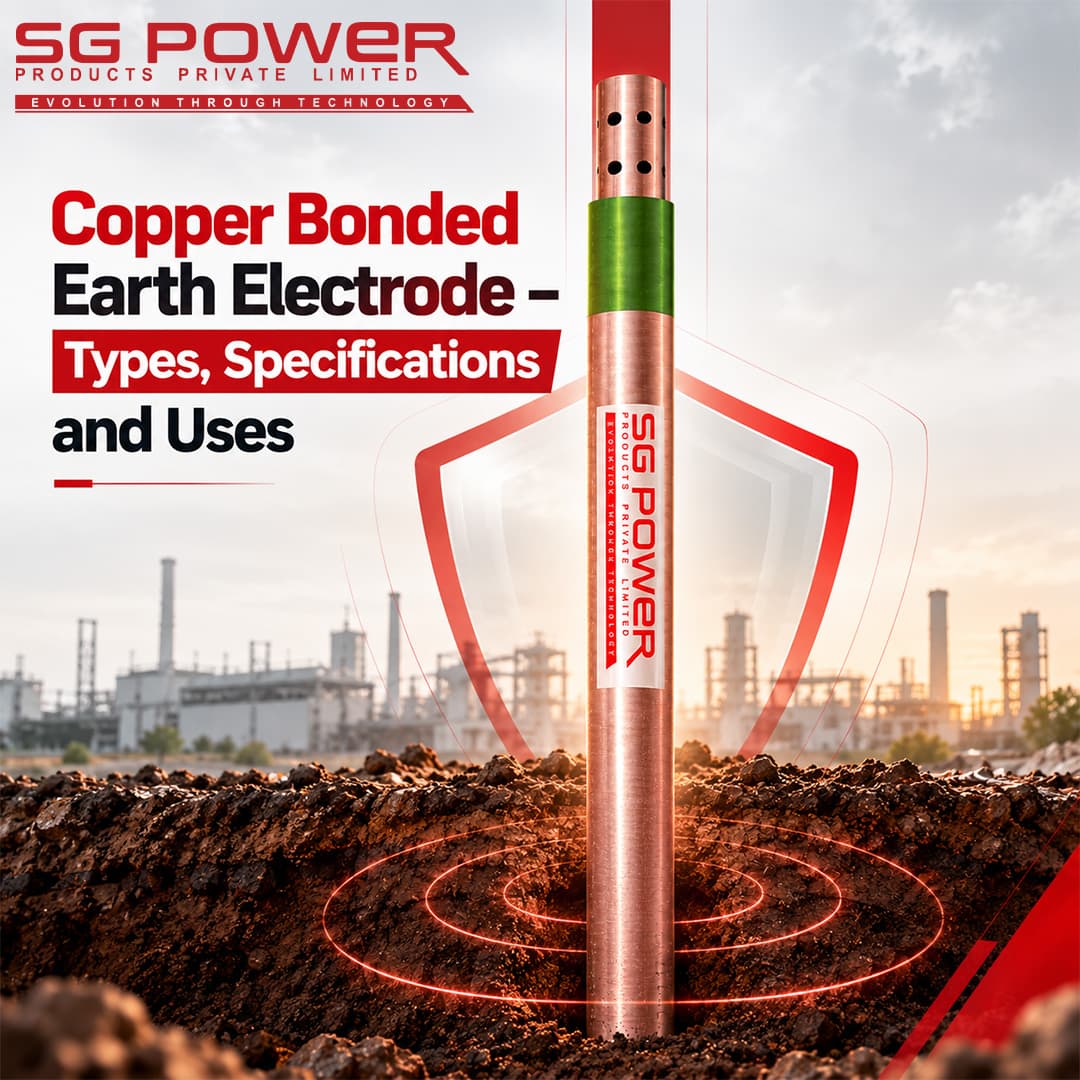
The types of copper bonded earth electrode, their specifications and their uses are not always clearly explained, even though copper bonded earth electrodes are among the most widely specified earthing electrodes on Indian industrial, utility and commercial projects. Datasheets from different manufacturers can look very different, and terms like "pipe in pipe," "Class B" or "250 microns" often appear without explanation. This guide covers the types of copper bonded earth electrodes, what each copper bonded earth electrode specification means, how to read a datasheet and where each type is used, so engineers can specify them correctly and procurement teams can compare offers on a like-for-like basis.
Key Takeaways
The two main types of copper bonded earth electrode are driven earth rods and pipe-type chemical electrodes. Pipe-type electrodes are further divided into Standard, Pipe in Pipe and Strip in Pipe constructions.
The most important specifications are diameter, length, pipe class, copper bonding thickness, internal conductor, filling, end sealing, terminal size, fault current rating and design standard.
Copper bonding thickness and fault current rating are the two specifications most often missing or unclear on datasheets. Always ask for them in writing.
For procurement, compare offers on lifecycle cost and documentation, not unit price alone. A cheaper electrode with thinner copper or no test reports often costs more over the life of the installation.
Copper bonded electrodes suit most industrial, utility and commercial projects. GI may be enough for low-corrosion, low-budget sites, and pure copper may be justified for critical installations.
What Is a Copper Bonded Earth Electrode?
A copper bonded earth electrode, also called a copper bonded earthing electrode or copper bonded grounding electrode, is an earthing electrode with a steel core and a layer of copper permanently bonded to its surface. The steel gives strength, while the copper gives high conductivity and corrosion protection, so fault and surge currents are dissipated safely into the ground.
The word "bonded" matters. In a properly bonded electrode, the copper is metallurgically joined to the steel, typically by an electrolytic process, so it will not peel or slip during installation. This is different from a loosely plated or sleeved product, where the copper can separate from the core and expose the steel. Terms such as copper plated, copper clad and copper bonded are sometimes used loosely in product listings, so always ask how the copper is applied and how thick it is.
What Are the Types of Copper Bonded Earth Electrodes?
The two main types of copper bonded earth electrode are copper bonded earth rods, which are driven directly into the ground, and copper bonded pipe electrodes, which are installed in an earth pit with backfill compound. Pipe electrodes are further divided into Standard, Pipe in Pipe and Strip in Pipe constructions, depending on what sits inside the outer pipe.
Type 1: Copper Bonded Earth Rod
This is a solid steel rod with a copper layer, driven vertically into the ground, often in coupled sections to reach greater depths. Rods need little excavation and suit sites where the soil allows driving and where deeper, lower-resistivity soil layers can be reached. SG Power also supplies copper bonded earthing rods.
Type 2: Copper Bonded Pipe Electrode (Chemical Earthing)
This is a copper bonded pipe filled with conductive compound, sealed at the ends and installed in a bored or excavated earth pit surrounded by backfill compound. This maintenance-free form is the most common on Indian projects because it gives low, stable resistance without periodic watering. An earth pit cover protects the connection and gives access for testing. It comes in three constructions:
1. Standard. A single copper bonded pipe is filled with conductive compound. It is the simplest and most economical construction.
2. Pipe in Pipe. An outer pipe has a smaller inner pipe inside it, with conductive compound packed between them. The second pipe adds internal conductive area.
3. Strip in Pipe. A conductive strip, often pure copper, runs through the centre of the pipe and connects to the terminal, giving a continuous conductor along the full length.
| Type | Installation | Internal conductor | Typical use |
|---|---|---|---|
| Copper bonded earth rod | Driven into the ground | Solid rod | Sites where driving is possible and deeper soil layers are more conductive |
| Standard pipe electrode | Earth pit with backfill | None (compound only) | Commercial buildings, residential projects, general low-voltage (LV) installations |
| Pipe in Pipe electrode | Earth pit with backfill | Inner pipe | Substations, industrial plants, higher fault levels |
| Strip in Pipe electrode | Earth pit with backfill | Central strip | Heavy industry, telecom, data centres, demanding sites |
Read more about each construction on the Standard, Pipe in Pipe and Strip in Pipe product pages.
What Do Copper Bonded Earth Electrode Specifications Mean?
Every copper bonded earth electrode datasheet should state ten key specifications: diameter, length, pipe class, copper bonding thickness, internal conductor, filling, end sealing, terminal size, fault current rating and design standard. Each one affects performance, service life or compatibility with your design, so it is worth understanding what each means before comparing products.
| Specification | What it means | Why it matters | What to check |
|---|---|---|---|
| Diameter | Outer diameter of the electrode, usually in mm | Larger diameter means more surface area in contact with backfill | Common sizes include 40, 50 and 80 mm; match to design requirement |
| Length | Overall length of the electrode | Longer electrodes reach deeper, often more conductive soil | Common lengths are 1, 2 and 3 m; deeper is usually better in dry topsoil |
| Pipe class | Wall thickness grade of the steel pipe | Thicker walls give more mechanical strength and corrosion margin | Indian pipe classes under IS 1239 are Light, Medium and Heavy (often marked A, B and C); check that the class is stated |
| Copper bonding thickness | Thickness of the copper layer, in microns | The main factor in corrosion resistance and service life | Should be stated in microns and backed by a test report |
| Internal conductor | Inner pipe or strip, if any, and its material and size | Adds internal conductive area and a direct current path | Confirm material (copper or GI) and dimensions |
| Filling | Compound inside the electrode | Keeps resistance low and stable | Should be a crystalline conductive mix, not loose filler |
| End sealing | Whether ends are sealed | Keeps the compound in place over the service life | Both ends should be sealed |
| Terminal size | Size and holes of the connection terminal | Must suit your earthing conductor and lugs | Check dimensions and hole size against your conductor |
| Fault current rating | Current the electrode can carry for a stated time, e.g. kA for 1 second | Must exceed the system's prospective fault current | Rating and duration should both be stated |
| Design standard | Standard the electrode is designed or tested to | Confirms design basis and supports approval | IS 3043 in India; ask for test reports for any other standard claimed |
A Closer Look at Copper Bonding Thickness
Copper bonding thickness is one of the most important specifications, and one of the most commonly missing. A thicker copper layer takes longer to corrode through, so it directly affects how long the electrode protects the steel core. International standards for copper bonded earth rods, such as UL 467, commonly call for a minimum copper thickness of about 250 microns. For pipe electrodes, always ask the manufacturer to state the thickness in microns and provide a test report.
A Closer Look at Fault Current Rating
The fault current rating tells you how much current the electrode can carry for a stated time without damage, for example 25 kA for 1 second. Both numbers matter. An electrode rated for 25 kA for 1 second is not the same as one rated for 25 kA for 0.5 seconds. Always compare the rating with your system's prospective fault current and the protection clearing time.
Standards You Will See on Copper Bonded Electrode Datasheets
Datasheets often refer to one or more standards. This table explains what each one covers, so you can check whether a claim is relevant to your project.
| Standard | Issued by | What it covers | Relevance |
|---|---|---|---|
| IS 3043 | Bureau of Indian Standards | Code of practice for earthing, including electrode types and installation | Main design reference for earthing in India |
| IEC 62561-2 | International Electrotechnical Commission | Requirements and tests for conductors and earth electrodes in lightning protection systems | Relevant where the electrode forms part of a lightning protection system |
| IEEE 80 | Institute of Electrical and Electronics Engineers | Guide for safety in AC substation grounding | Relevant for substation earth grid design |
| UL 467 | UL Standards & Engagement (USA) | Grounding and bonding equipment, including copper bonded earth rods | Often cited for copper bonded rods; ask for a listing or test report |
If a datasheet claims compliance with any of these, ask for the certificate or test report that supports it.
How Do You Read a Copper Bonded Earth Electrode Datasheet?
To read a copper bonded earth electrode datasheet, check the construction, size, pipe class, copper bonding thickness, filling, terminal, fault current rating and design standard, then compare each one against your design. A real example makes this easier. Here is how the specifications of SG Power's Pipe in Pipe copper bonded earth electrode, Model CBE40SG100, translate into design information.
| Datasheet entry | What it tells you |
|---|---|
| Copper Bonded Electrode, Pipe in Pipe | Steel core with bonded copper; inner pipe adds internal conductive area |
| Diameter 40 mm, length 1 m | A compact electrode suited to bored pits; longer lengths reach deeper soil |
| Class B pipe | Medium wall thickness for mechanical strength |
| Crystalline conductive mix, sealed ends | Stable resistance, no watering; compound protected over service life |
| Terminal 25 x 5 x 75 mm, 2 holes of 10 mm | Check this suits your conductor size and lugs |
| Up to 25 kA for 1 second | Compare with your system's prospective fault current and clearing time |
| Designed to IS 3043 | Design basis aligned with the Indian code of practice for earthing |
If any of these entries is missing from a datasheet you are comparing, ask the manufacturer for it in writing before approving the product.
Datasheet Checklist
Use this checklist when comparing copper bonded earth electrodes from different manufacturers.
1.Is the copper bonding thickness stated in microns?
2.Is the fault current rating stated with both current and duration?
3.Is the pipe class or wall thickness stated?
4.Are the internal conductor material and size stated?
5.Is the filling described, and are both ends sealed?
6.Does the terminal suit your conductor?
7.Is the design standard stated, with test reports for any standard claimed?
8.Are model numbers given for each size, so you can specify exactly?
For a complete vendor evaluation checklist covering test reports, manufacturing capability, project references and delivery, see our guide to choosing a copper bonded earth electrode supplier.
Want to see a complete datasheet?Ask our engineers for datasheets for other sizes.
7 Common Mistakes When Specifying Copper Bonded Earth Electrodes
Most earthing problems start at the specification stage, not on site. These are the mistakes engineers and buyers most often make, and how to avoid them.
1. Comparing on price alone. Two electrodes of the same size can have very different copper thickness and service life. Compare copper bonding thickness before comparing price.
2. Ignoring the fault current duration. A rating of 25 kA means little without the time it applies for. Check both numbers against your protection clearing time.
3. Sizing without soil data. Choosing an electrode size or quantity without soil resistivity measurements often leads to earth resistance that misses the design target.
4. Treating all "copper" electrodes as the same. Copper plated, copper bonded and pure copper electrodes perform very differently. Confirm which one is being offered.
5. Mismatching the terminal and connection. Check that the terminal suits your earthing conductor and connection method, such as exothermic welding or bolted lugs.
6. Leaving backfill out of the BOQ. A pipe electrode relies on backfill compound for good soil contact. Include it in the bill of quantities with the electrodes.
7. Accepting standards claims without proof. Any claim of compliance with IS 3043, IEC 62561-2 or UL 467 should be backed by a test report or certificate.
What Should Procurement Teams Include in an Enquiry or Tender?
Incomplete enquiries are one of the main reasons offers from different vendors cannot be compared fairly. Including these details in every enquiry or tender for copper bonded earth electrodes gets you comparable offers and avoids surprises at delivery.
| Item to specify | Why it matters for procurement |
|---|---|
| Electrode type and construction | Standard, Pipe in Pipe and Strip in Pipe are priced differently; leaving this open invites mismatched offers |
| Diameter, length and pipe class | Fixes the physical size so offers are like-for-like |
| Minimum copper bonding thickness (microns) | The main driver of service life; unspecified thickness often means thinner copper |
| Fault current rating and duration | Ensures offers meet the engineering design |
| Internal conductor material and size | Copper and GI internals differ in cost and performance |
| Terminal size | Avoids site modifications to connect the earthing conductor |
| Backfill compound quantity per electrode | Often left out of offers, then added later as an extra |
| Required documents | Datasheet, test reports and certificates needed for vendor approval |
| Inspection requirement | Whether pre-dispatch or third-party inspection is required |
| Delivery schedule and site location | Affects price, stock availability and logistics |
Comparing Offers on Lifecycle Cost
The lowest unit price is rarely the lowest total cost. When comparing offers, procurement teams should also consider:
1. Replacement risk. An electrode that corrodes early must be dug out and replaced, adding excavation, labour and downtime costs.
2. Maintenance cost. Maintenance-free electrodes avoid recurring watering and salt treatment across every earth pit.
3. Documentation. Offers without test reports can delay vendor approval and project schedules.
4. Supply risk. A manufacturer with ready stock and bulk capacity reduces the risk of delays on time-bound projects.
Where Are Copper Bonded Earth Electrodes Used?
The main uses of copper bonded earth electrodes are in earthing systems that need good conductivity and long-term corrosion resistance at a reasonable cost. That covers most power, utility, transport, industrial and commercial projects. The construction chosen usually depends on the fault level and the importance of the installation.
| Application | Why copper bonded suits it | Typical construction |
|---|---|---|
| Substations and switchyards | High fault levels and long design life; electrodes often form part of an earth grid | Pipe in Pipe or Strip in Pipe |
| Power distribution transformers | Many earth pits across a network; corrosion resistance reduces replacements | Standard or Pipe in Pipe |
| Solar PV plants | Large sites with many pits, lightning exposure and long asset life | Standard or Pipe in Pipe |
| Railways and metro | Traction, signalling and station earthing need reliable, durable performance | Pipe in Pipe or Strip in Pipe |
| Telecom towers and data centres | Surge and equipment protection need a stable, low-resistance path | Strip in Pipe or Pipe in Pipe |
| Heavy industry | High fault currents and harsh soil conditions | Pipe in Pipe or Strip in Pipe |
| Commercial buildings and hospitals | Moderate fault levels, need for low maintenance | Standard |
| Lightning protection systems | Must handle repeated surge currents | Depends on the structure's protection level |
Which Type of Copper Bonded Earth Electrode Should You Choose?
The right type depends mainly on the fault level, the site conditions and how the electrode will be installed. Use this quick guide as a starting point, then confirm the final choice using site soil resistivity data and your electrical design.
| If your site has... | Consider |
|---|---|
| Moderate fault level, normal soil, cost-sensitive project | Standard pipe electrode |
| High fault level, substation or switchyard | Pipe in Pipe electrode |
| Heavy industry, telecom or a need for a continuous copper core | Strip in Pipe electrode |
| Drivable soil with more conductive layers deeper down | Copper bonded earth rod |
| Many earth pits across a large site | Standard or Pipe in Pipe, depending on fault level |
For a full step-by-step selection process covering soil resistivity, fault level, target resistance and electrode spacing, see our guide to selecting a copper bonded earth electrode.
When Is a Copper Bonded Earth Electrode Not the Best Choice?
A copper bonded earth electrode is not the best choice when a GI electrode meets the requirement at lower cost in non-aggressive soil, when a critical installation in highly corrosive soil justifies pure copper, or when rocky ground or very high soil resistivity calls for a different installation approach.
| Situation | Better option | Why |
|---|---|---|
| Dry, non-aggressive soil and a tight budget | GI earth electrode | Lower cost where corrosion risk is low |
| Highly corrosive soil on a critical installation | Pure copper earth electrode | Maximum corrosion resistance |
| Rocky ground, hard to excavate | Driven copper bonded rods or bored installation | Less excavation needed |
| Very high soil resistivity | More or longer electrodes, backfill or an earth grid | No single electrode solves this alone |
For a full comparison of materials, see our earth electrode guide. For a detailed comparison, read Copper Bonded vs GI Earth Electrode: Which Is Better for Your Project?
Frequently Asked Questions
Conclusion
For engineers, specifying the right copper bonded earth electrode comes down to choosing the right type for the site, understanding what each specification means and confirming the rating against the system design. For procurement teams, it comes down to writing a complete specification into the enquiry, insisting on documented proof of copper thickness and fault rating, and comparing offers on lifecycle cost rather than unit price. With both in place, projects get electrodes that perform as designed and avoid the most common earthing failures.
Need Help Specifying a Copper Bonded Earth Electrode?
SG Power's application engineers can review your soil data, fault level and target earth resistance and recommend the right electrode type and size. Explore our copper bonded earth electrode range or contact our team.