
Copper Bonded vs GI Earth Electrode: Which Is Better for Your Project?
Copper bonded vs GI earth electrode compared on corrosion, soil, service life and lifecycle cost, with guidance on which to specify for your project.
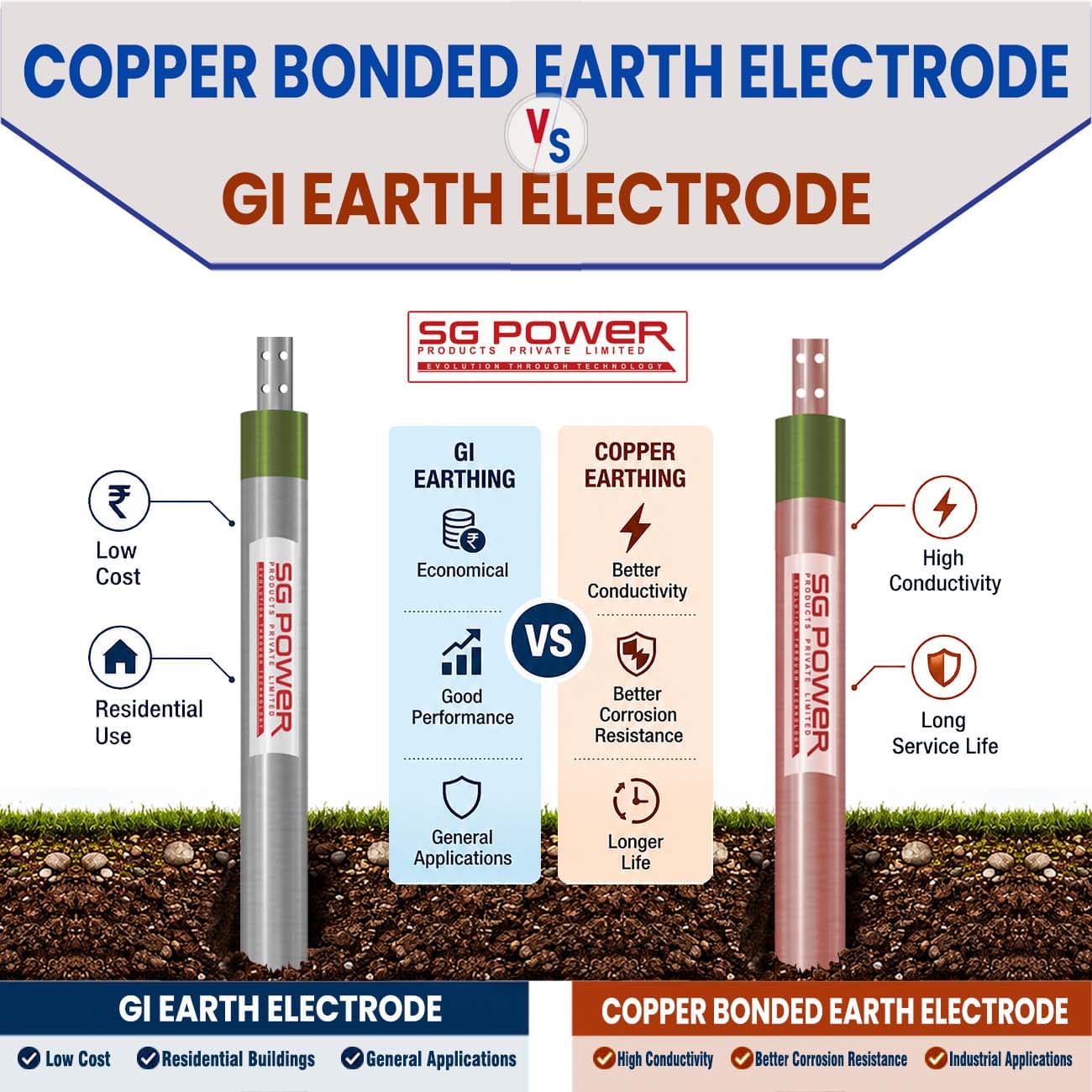
Published: 28 September 2026 | Written by: SG Power Technical Team
Copper bonded vs GI earth electrode is one of the most common decisions on Indian earthing projects, and it is often made on purchase price alone. Both are widely used, both can be installed as maintenance-free chemical earthing, and at first glance the GI option looks cheaper. But the two perform very differently in corrosive soil, over a long design life and when the cost of replacement is included. This guide answers which earth electrode is better for your project by comparing them on construction, corrosion, soil suitability, service life and lifecycle cost, so engineers can specify the right electrode and procurement teams can justify the choice.
Key Takeaways
The main difference between copper bonded and GI earth electrodes is how the steel is protected: copper forms a durable barrier, while the zinc on GI protects the steel by slowly corroding away first.
Electrode material has only a small effect on the earth resistance you measure on day one. Its main effect is on how long that resistance stays stable, and how long the electrode lasts.
GI can be the right choice for dry, non-aggressive soil, short design lives and tight budgets.
Copper bonded is usually the better choice for moist, saline, acidic or industrial soils, long design lives and critical installations.
Compare the two on lifecycle cost, not purchase price. A single early replacement often cancels out the saving from choosing GI.
What Is the Difference Between Copper Bonded and GI Earth Electrodes?
The difference between copper bonded and GI earth electrodes lies in how the steel is protected from corrosion. A copper bonded electrode has a copper layer bonded to a steel core, which acts as a durable barrier. A galvanised iron (GI) earth electrode has a zinc coating that protects the steel by corroding first. Once the zinc is used up, the steel begins to corrode.
How the protective layer works on each electrode
Cross-section comparison: a copper barrier layer versus a sacrificial zinc coating. Not to scale.
| Feature | Copper Bonded Earth Electrode | GI Earth Electrode |
|---|---|---|
| Core material | Steel | Steel (mild steel pipe) |
| Protective layer | Copper, bonded to the steel | Zinc, applied by hot-dip galvanising |
| How the layer protects | Barrier: copper resists corrosion in most soils | Sacrificial: zinc corrodes first to protect the steel |
| What happens as it ages | Copper layer remains largely intact in most soils | Zinc is gradually consumed, then the steel corrodes |
| Key specification to check | Copper bonding thickness in microns | Zinc coating thickness or mass |
| SG Power range | Copper bonded earth electrodes | GI earth electrodes |
Both types are available as pipe-type chemical earth electrodes in Standard, Pipe in Pipe and Strip in Pipe constructions, filled with conductive compound and installed with backfill compound. For a detailed explanation of these constructions and specifications, see our guide to the types of copper bonded earth electrode.
How Do Copper Bonded and GI Earth Electrodes Compare on Performance?
Copper bonded earth electrodes outperform GI mainly on corrosion resistance and service life, especially in aggressive soils. GI electrodes have the lowest purchase price. On day-one earth resistance, the two are much closer than many buyers expect, because soil resistivity and electrode size have far more influence on resistance than the electrode's surface material.
| Criterion | Copper Bonded | GI | What it means for your project |
|---|---|---|---|
| Surface conductivity | High | Moderate | Copper gives a better contact surface, but soil resistivity usually dominates the measured resistance |
| Corrosion resistance | High | Low to moderate | The biggest practical difference between the two |
| Stability of resistance over time | High | Declines as the coating is consumed | Affects whether the design value is still met years later |
| Mechanical strength | High (steel core) | High (steel pipe) | Similar; both handle installation well |
| Fault current handling | As rated by the manufacturer | As rated by the manufacturer | Always check the stated rating and duration for each product |
| Service life | Long | Shorter, especially in aggressive soil | Drives replacement cost |
| Purchase price | Moderate | Lowest | GI costs less up front |
| Lifecycle cost | Usually lower | Usually higher where replacement is needed | The fairer basis for comparison |
Why Electrode Material Matters Less for Day-One Resistance Than You Might Think
Earth resistance is mainly determined by the soil resistivity around the electrode, the electrode's length and diameter, and how well the electrode contacts the soil through the backfill compound. Changing the surface material from zinc to copper has a relatively small effect on the resistance measured at commissioning. Where the material makes a big difference is over time: as a GI coating corrodes, the electrode's effective surface and contact can degrade, and resistance can drift upward. A copper bonded electrode tends to hold its performance for much longer.
How Does Soil Affect the Choice Between Copper Bonded and GI?
Soil corrosivity is the single most important factor in choosing between copper bonded and GI earth electrodes. In dry, sandy, non-aggressive soil, a GI electrode can perform well for many years. In moist, saline, acidic or chemically contaminated soil, the zinc coating is consumed much faster, and copper bonded becomes the more reliable and economical choice.
| Soil or site condition | Corrosion risk for GI | Recommended electrode |
|---|---|---|
| Dry, sandy, well-drained soil | Low | GI is often sufficient |
| Normal agricultural or mixed soil | Moderate | Copper bonded for long design lives; GI for short-term or budget projects |
| Clay or waterlogged soil with a high water table | High | Copper bonded |
| Coastal or saline soil | High | Copper bonded |
| Acidic soil | High | Copper bonded |
| Industrial sites with chemical or effluent contamination | High | Copper bonded, or pure copper for critical installations |
| Low soil resistivity (often more corrosive) | Moderate to high | Copper bonded |
As a general rule, soils with low resistivity tend to be more corrosive, because the same moisture and dissolved salts that help conduct current also accelerate corrosion. Measuring soil resistivity, typically with the Wenner four-pin method, gives you useful information for both the earthing design and the choice of electrode material.
Not sure how corrosive your site's soil is? Share your soil resistivity data with SG Power's engineers, and they can recommend a suitable electrode material.
Can You Mix Copper Bonded and GI Electrodes in the Same Earthing System?
Mixing copper bonded and GI electrodes in the same interconnected earthing system is generally best avoided. When copper and zinc-coated steel are connected in moist soil, they can form a galvanic cell that makes the zinc and steel corrode faster. If both materials must be used, the earthing designer should assess the risk and specify precautions.
This is a common problem on sites that are extended over time, where new copper bonded electrodes are connected to an existing GI earthing network. Before mixing materials, check the design with a qualified earthing engineer.
How Do You Compare Copper Bonded and GI on Lifecycle Cost?
To compare copper bonded and GI earth electrodes fairly, calculate the total cost over the project's design life, not just the purchase price. That total includes the electrodes, installation, backfill, any replacements needed during the design life, and the downtime and disruption each replacement causes.
Use this method to build a like-for-like comparison:
Set the design life. Use the design life of the installation, for example the expected life of the substation, plant or building.
Estimate the service life of each option in your soil conditions, using manufacturer data and experience from similar sites.
Count the number of installations needed. If an electrode's service life is shorter than the design life, it will need replacing at least once.
Add the cost of each installation. Include the electrode, backfill compound, excavation, labour, connections and earth pit cover.
Add the cost of each replacement. Include removal of the old electrode, re-excavation, re-testing and any downtime or shutdown cost.
Compare the totals. The option with the lower total cost over the design life is the better value.
| Cost element | Copper Bonded | GI |
|---|---|---|
| Electrode purchase price | Higher | Lower |
| Installation cost (first time) | Similar | Similar |
| Replacements during design life | Fewer or none in most soils | More likely, especially in aggressive soil |
| Cost of each replacement | Excavation, labour, re-testing and downtime | Excavation, labour, re-testing and downtime |
| Risk of unplanned earthing failure | Lower | Higher as the coating is consumed |
| Total cost over design life | Usually lower for long design lives | Usually lower only for short design lives in non-aggressive soil |
On most industrial and utility projects, a single replacement of a GI electrode, including excavation, labour and downtime, is enough to cancel out its lower purchase price.
When Is a GI Earth Electrode the Better Choice?
A GI earth electrode is the better choice when the soil is dry and non-aggressive, the design life is short, the installation is not critical, and budget is the main constraint. In these conditions, the extra cost of copper bonding may not be recovered over the life of the installation.
Dry, non-aggressive soil where corrosion rates are low.
Temporary or short-life installations, such as construction power, site offices or temporary substations.
Low-criticality installations, such as small residential or commercial buildings, where an earthing failure has limited consequences.
Tight capital budgets, where the design life and soil conditions allow a lower-cost electrode.
Projects already standardised on GI, where adding copper bonded electrodes would create a mixed-metal system.
When Is a Copper Bonded Earth Electrode the Better Choice?
A copper bonded earth electrode is the better choice when the soil is corrosive, the design life is long, the installation is critical, or the cost of replacing an electrode would be high. In these conditions, its longer service life usually makes it the lower-cost option over the life of the project.
Corrosive soil, including moist, clay, saline, coastal, acidic or chemically contaminated ground.
Long design lives, such as substations, power plants, solar farms and railway infrastructure.
Critical installations, where an earthing failure could cause serious safety, equipment or downtime consequences.
Hard-to-access locations, where replacement would be expensive or disruptive, such as under paved areas or inside operating plants.
Lightning protection and surge earthing, where stable, long-term performance is essential. See our lightning protection range.
Projects where specifications or tenders require copper bonded electrodes.
Copper Bonded or GI: Quick Decision Guide
When deciding on GI vs copper bonded earthing, use this table as a starting point, then confirm the choice using site soil data and your electrical design.
| Project type | Recommended electrode | Why |
|---|---|---|
| Substations and switchyards | Copper bonded, Pipe in Pipe | Long design life, high fault levels, critical |
| Solar PV plants | Copper bonded | Long asset life, many pits, lightning exposure |
| Railways and metro | Copper bonded | Long design life, critical safety systems |
| Heavy industry and chemical plants | Copper bonded, or pure copper for highly corrosive soil | Aggressive soil and high consequences of failure |
| Telecom towers and data centres | Copper bonded | Stable, low resistance needed for surge protection |
| Commercial buildings and hospitals | Copper bonded, or GI in dry, non-aggressive soil | Depends on soil and design life |
| Small residential buildings | GI in non-aggressive soil | Lower cost, lower criticality |
| Temporary installations | GI | Short design life |
What Should You Specify for Each Type?
Whichever material you choose, specify the protective layer clearly, because it is the main factor in service life and the detail most often left out of offers.
| Item to specify | Copper Bonded Earth Electrode | GI Earth Electrode |
|---|---|---|
| Protective layer | Minimum copper bonding thickness in microns | Minimum zinc coating thickness or mass, and the galvanising standard |
| Core | Steel grade and pipe class | Pipe class, for example under IS 1239 |
| Internal conductor | Inner pipe or strip material and size | Inner pipe or strip material and size |
| Fault current rating | Current and duration | Current and duration |
| Design standard | IS 3043, the Bureau of Indian Standards code of practice for earthing | IS 3043 |
| Documents | Datasheet and test reports | Datasheet and galvanising test certificate |
For a full tender checklist, see the procurement section of our guide to the types of copper bonded earth electrode.
5 Common Mistakes When Choosing Between Copper Bonded and GI
Choosing on purchase price alone. The lower price of GI often disappears once a single replacement is included.
Ignoring soil conditions. Specifying GI for coastal, clay or contaminated sites without checking corrosivity leads to early failures.
Expecting copper to fix high resistance. Switching material rarely solves a high resistance problem. Longer electrodes, more electrodes, backfill compound or an earth grid are usually the answer, as explained in our earth electrode selection guide.
Mixing metals without a design check. Connecting copper bonded and GI electrodes in the same system can accelerate corrosion of the GI.
Leaving the coating unspecified. An offer that does not state copper thickness or zinc coating cannot be compared fairly with one that does.
Frequently Asked Questions
Conclusion
The choice between copper bonded and GI earth electrodes comes down to soil, design life and the cost of failure. For engineers, that means assessing soil corrosivity and the importance of the installation before selecting a material. For procurement teams, it means comparing offers on lifecycle cost and insisting that the protective layer is clearly specified. GI still has a place on dry, non-aggressive, short-life and budget projects, but on most industrial, utility and infrastructure projects, copper bonded is the better long-term choice.
Need Help Choosing Between Copper Bonded and GI?
SG Power manufactures both copper bonded and GI earth electrodes, so our application engineers can recommend the right one for your soil, fault level and design life without bias towards either. Explore our full earth electrode range or contact our team.