
SG Power Products Pvt. Ltd. is a copper bonded earth electrode manufacturer in India producing TRUESAFE™ copper bonded earth electrodes designed to IS 3043 and rated for fault currents up to 25 kA for 1 second. As a direct copper bonded earth electrode supplier to EPC contractors, utilities and industrial plants, we support projects from specification and variant selection through to documentation, inspection and delivery.
For over 15 years, SG Power has worked as a copper bonded electrode manufacturer and copper bonded electrode supplier on projects for Indian Railways, L&T, NTPC, BHEL, Tata, Adani Power and the Airport Authority of India, across power, rail, renewable energy, defence and heavy industry.
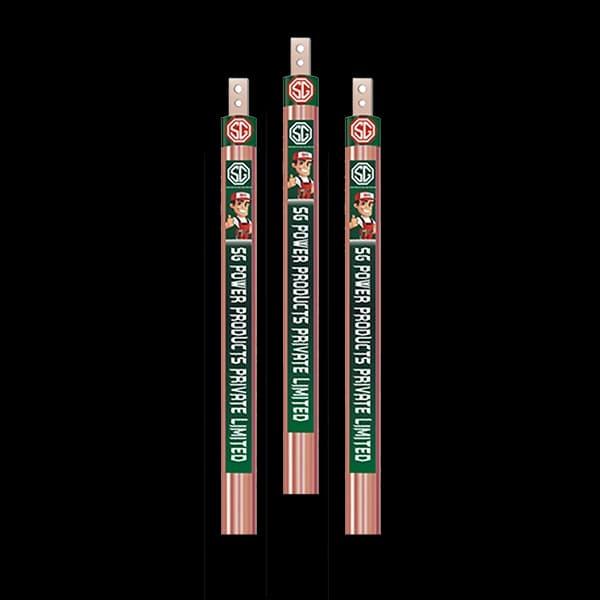
A copper bonded earth electrode, also called a copper bonded grounding electrode, is a type of chemical earthing electrode consisting of a steel pipe with a copper layer bonded to its surface. The steel core provides mechanical strength, while the copper layer provides high conductivity and corrosion resistance in the soil.
SG Power copper bonded electrodes are filled with a crystalline conductive mix that lowers and stabilises earth resistance, and have sealed ends to protect the internal compound over the service life. The electrode forms the earth-termination point of the electrical earthing system, dissipating fault current and lightning surge current into the ground.
A copper bonded earth electrode provides a low-impedance path between the electrical system and the general mass of earth. Under fault or surge conditions, current flows through the earthing conductor to the electrode, where the copper layer and conductive compound dissipate it into the surrounding soil. This limits touch and step voltages on equipment and structures and allows protective devices to operate correctly.
The earth resistance achieved depends on three factors: the conductivity of the electrode, the electrode-to-soil contact (improved by backfill compound), and the soil resistivity at the site. For this reason, electrode selection and quantity should always be based on site soil resistivity data rather than a fixed rule.
There are three types of copper bonded earth electrodes: Standard, Pipe in Pipe and Strip in Pipe. The Standard type is suited to commercial and residential installations, while Pipe in Pipe and Strip in Pipe designs provide a larger conductive surface area for substations, industrial plants and systems with higher fault levels. SG Power manufactures all three.
It consists of a single copper bonded pipe filled with conductive compound, with a terminal for conductor connection. It is a cost-effective option for commercial buildings, residential complexes and general low-voltage (LV) installations.
View Standard variantIt consists of an outer and an inner pipe, with conductive compound filled between them. The increased conductive surface area improves current dissipation, making it suitable for substations, industrial plants and higher fault current applications.
View Pipe in Pipe variantA conductive strip runs through the centre of the copper bonded pipe, surrounded by conductive compound, providing efficient current flow and strong mechanical stability for demanding industrial applications.
View Strip in Pipe variant| Feature | Standard | Pipe in Pipe | Strip in Pipe |
|---|---|---|---|
| Construction | Single copper bonded pipe with conductive filling | Outer and inner pipe with conductive filling between | Conductive strip through the centre of the pipe |
| Conductive surface area | Standard | Higher | Higher |
| Typical application | Commercial and residential LV systems | Substations, industrial plants | Demanding industrial applications |
| Fault level | Normal | Higher | Higher |
| Relative cost | Lowest | Higher | Higher |
SG Power's TRUESAFE™ copper bonded earth electrode is a 40 mm diameter, Class B copper bonded pipe filled with crystalline conductive mix, with sealed ends and a 25 x 5 x 75 mm terminal. It is designed to IS 3043 and rated to carry fault current up to 25 kA for 1 second.
IS 3043 is the Indian code of practice for earthing, published by the Bureau of Indian Standards. Internationally, earth electrodes for lightning protection systems are covered by IEC 62561-2, and substation grounding design is guided by IEEE 80.
Custom lengths and diameters can be manufactured for project requirements. Share your soil resistivity data, fault level and required earth resistance, and our engineers will recommend the variant and quantity.
A copper bonded electrode offers high conductivity, strong corrosion resistance, long service life, stable earth resistance and maintenance-free operation, at a lower cost than pure copper. For asset owners, this means lower lifecycle cost and fewer maintenance interventions over the life of the installation.
The copper layer dissipates fault current efficiently, supporting reliable operation of protective devices.
The bonded copper layer protects the steel core from moisture and aggressive soil chemistry, the main cause of earthing degradation.
Corrosion resistance and sealed construction reduce the need for replacement over the design life of the installation.
The conductive compound helps maintain consistent resistance values across seasons, including in high resistivity soils.
No periodic watering or salt treatment is required, reducing O&M workload.
It delivers much of the performance of pure copper at a lower capital cost, with fewer replacements than GI.
For most industrial and utility projects, a copper bonded earth electrode is the better choice than a GI electrode because it offers higher conductivity and much stronger corrosion resistance, resulting in a longer service life and lower lifecycle cost. GI electrodes have a lower purchase price but corrode faster in moist or chemically aggressive soil. Pure copper electrodes offer the highest performance at the highest cost.
| Feature | Copper Bonded Electrode | GI Electrode | Pure Copper Electrode |
|---|---|---|---|
| Material | Steel core with bonded copper layer | Galvanised iron | Pure copper |
| Conductivity | High | Moderate | Highest |
| Corrosion resistance | High | Low to moderate | High |
| Mechanical strength | High (steel core) | High | Lower than steel |
| Service life | Long | Shorter | Long |
| Maintenance | Maintenance-free | Maintenance-free (chemical type) | Maintenance-free |
| Capital cost | Moderate | Lowest | Highest |
| Lifecycle cost | Low | Higher (earlier replacement) | Low |
| Best suited for | Most industrial, utility and commercial projects | Budget projects in low-corrosion soil | Critical, high-budget installations |
Copper bonded earth electrodes are used in power plants, substations, distribution networks, solar and wind projects, railway and metro systems, telecom and data centres, heavy industry, airports, defence installations and large commercial buildings. Variant selection depends on the fault level and soil resistivity at each site.
| Industry / Sector | Typical Use | Suggested Variant |
|---|---|---|
| Power plants and substations | Equipment and system earthing | Pipe in Pipe / Strip in Pipe |
| Power distribution (discoms) | Transformer and network earthing | Standard / Pipe in Pipe |
| Solar PV and renewable energy | Array, inverter and lightning protection earthing | Standard / Pipe in Pipe |
| Railways and metro | Traction, signalling and station earthing | Pipe in Pipe / Strip in Pipe |
| Telecom towers and data centres | Equipment and surge protection earthing | Standard / Pipe in Pipe |
| Steel, cement and chemical plants | Heavy machinery and process earthing | Pipe in Pipe / Strip in Pipe |
| Airports and defence | Critical infrastructure earthing | Pipe in Pipe / Strip in Pipe |
| Hospitals and commercial complexes | Building and equipment earthing | Standard |
| Residential buildings | Building earthing | Standard |
Selecting a copper bonded earth electrode requires the site soil resistivity, the prospective fault current and its duration, the target earth resistance, and the site's corrosion conditions. These inputs determine the variant, size, number of electrodes and backfill quantity needed to meet the design requirement.
Obtain site soil resistivity measurements before finalising the design. High resistivity soil may need more electrodes, longer electrodes or additional backfill compound.
Confirm that the electrode's rated fault current (25 kA for 1 second for SG Power electrodes) is suitable for the system's prospective fault current and clearing time.
The required value is set by the project's electrical design and applicable standards, and differs between applications such as substations, LV installations and lightning protection.
Where a single electrode cannot achieve the target value, multiple electrodes are connected in parallel. Spacing should follow IS 3043 guidance so that electrodes do not significantly reduce each other's effectiveness.
In moist, saline or chemically aggressive soils, a copper bonded electrode's corrosion resistance becomes a key selection factor over GI.
Specify durable connections between the electrode and earthing conductor, such as exothermic welding or a properly rated bolted terminal.
Where the electrode also serves a lightning protection system, coordinate the design with the relevant lightning protection standard.
SG Power's application engineers can review your soil data and single-line diagram and recommend a suitable configuration.
When evaluating a copper bonded electrode supplier or manufacturer, procurement teams should check standards compliance, test documentation, copper bonding quality, steel core grade, fault current rating, conductive filling quality, manufacturing capability, size range, project references, delivery capacity and total lifecycle value. The 11 criteria below can be used as a vendor evaluation checklist.
The electrode should be designed to IS 3043. Request written confirmation on the product datasheet.
Ask for test reports covering fault current capacity and material properties, ideally from a recognised independent laboratory, along with quality management certification such as ISO 9001.
The copper layer should be metallurgically bonded to the steel core, not loosely plated. Poor bonding can peel or crack during installation and expose the steel to corrosion.
The steel grade determines mechanical strength and service life. Request the grade on the datasheet.
Confirm the rated fault current and duration match the system design.
The internal compound should be a crystalline conductive mix with sealed ends, not a loose filler that can wash out or degrade.
Sourcing directly from a copper bonded earth electrode manufacturer gives better quality control, traceability, consistent specifications and access to custom sizes.
The supplier should offer all three variants in multiple diameters and lengths to suit different site conditions.
Check references from comparable projects such as substations, railways, solar plants or industrial units.
For time-bound projects, confirm ready stock, bulk manufacturing capacity, lead times and pan-India logistics.
Evaluate total cost of ownership, not just unit price. An electrode that needs replacement within a few years costs more once excavation, labour and downtime are included.
SG Power is a Noida-based copper bonded earth electrode manufacturer and supplier with over 15 years of experience, in-house manufacturing, a 3-level quality check, ready stock and pan-India logistics. It has supplied earthing solutions for Indian Railways, L&T, NTPC, BHEL, Tata, Adani Power and the Airport Authority of India. These are the 6 main reasons EPC contractors and industrial buyers work with SG Power.
Over 15 years in earthing and lightning protection, with supplies to utilities, EPC contractors, railways, defence and heavy industry.
As an earthing electrode manufacturer in India, SG Power controls production and quality in its own facility.
A 3-level quality check on every electrode before dispatch.
Ready stock for standard sizes and the capacity to handle bulk orders for large projects.
A dealer and service network that supports project sites across India, including remote locations.
Copper bonded electrodes plus backfill compounds, earth pit covers, exothermic welding powder, earthing strips and lightning arresters, reducing vendor count and coordination for your project.
A copper bonded earth electrode is installed by measuring soil resistivity, excavating or boring the earth pit, placing the electrode vertically, surrounding it with backfill compound, backfilling and compacting the soil, connecting the earthing conductor, fitting an earth pit cover and verifying earth resistance. The 7 steps are below.
Step 1.Measure soil resistivity at the site, then excavate or bore an earth pit of the required depth and diameter for the electrode length.
Step 2.Place the copper bonded earth electrode vertically in the centre of the earth pit.
Step 3.Fill the annular space around the electrode with SG Power backfill compound mixed with water, as per the recommended quantity.
Step 4.Backfill the remaining pit with excavated soil and compact it.
Step 5.Connect the earthing conductor to the electrode terminal using an exothermic weld or a properly rated bolted connection.
Step 6.Install an earth pit cover to protect the connection and allow inspection access.
Step 7.Measure and record the earth resistance to confirm it meets the design value.
A copper bonded earth electrode is tested by measuring earth resistance with an earth resistance tester, most commonly using the fall-of-potential (three-point) method, where two auxiliary test spikes are placed at set distances from the electrode under test. A clamp-on earth tester can be used on existing multi-grounded systems without disconnecting the electrode.
Testing should be carried out at commissioning and then periodically as part of the maintenance schedule, ideally including a measurement in the dry season when soil resistivity is highest. Record results for each earth pit so trends can be tracked over time. If the measured value exceeds the design requirement, additional electrodes in parallel or additional backfill compound can be used to bring it down.
Send your project requirement to SG Power and our team will recommend the right variant and quantity and share a techno-commercial offer.
To speed up your quotation, please include:
For large projects, estimate the weight of your earthing material with our material weight calculator.