
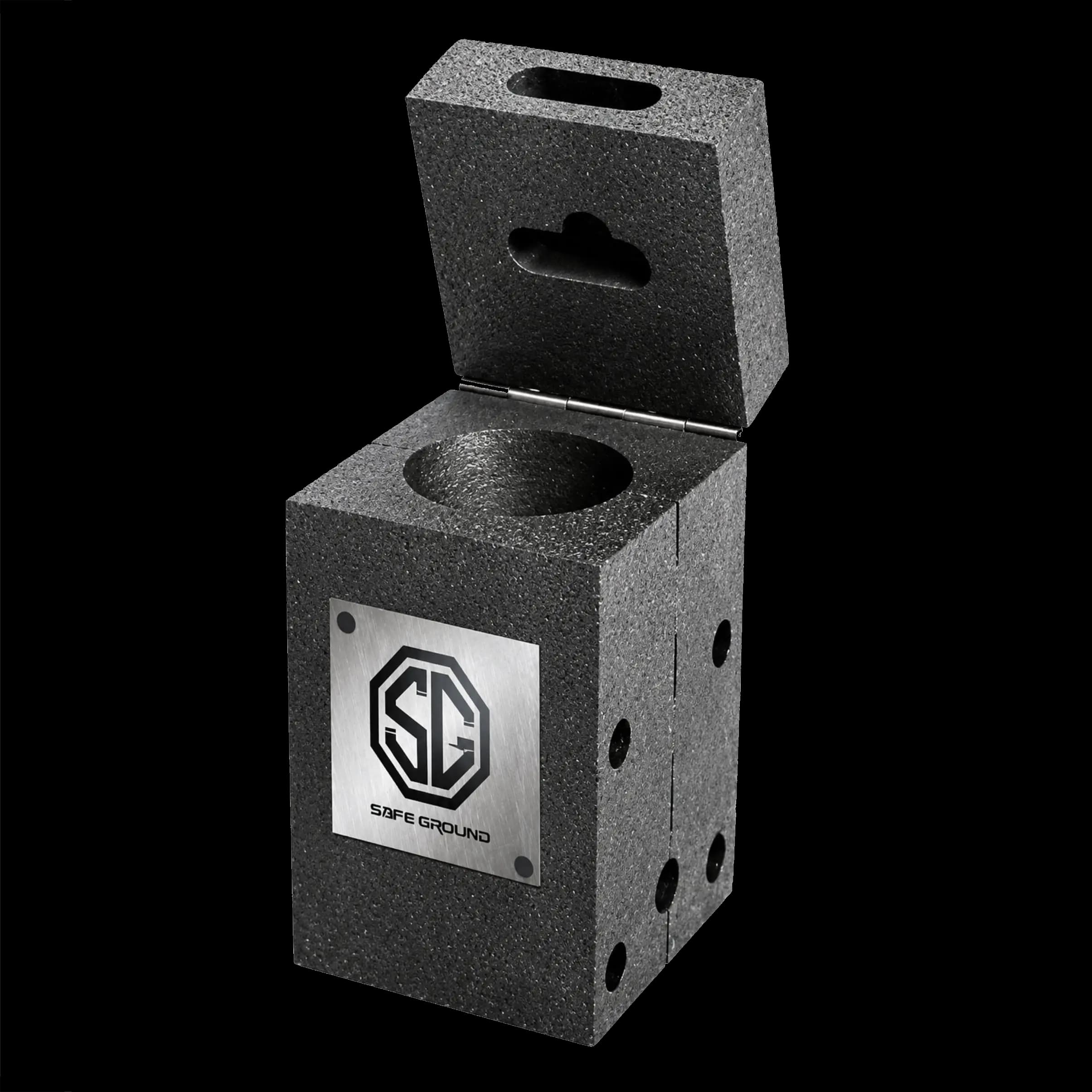
Buy an Exothermic Welding System Direct from the Manufacturer
| What you get | Details |
|---|---|
| Complete system | Graphite moulds, weld powder and tools and accessories from one manufacturer, so every part matches |
| Moulds matched to your job | Cable, strip, rod, steel, rebar and lug joints, sized to your conductors |
| Compliance | IEEE 80 and NBC 2016; ISO 9001:2015 certified manufacturer |
| Supply | Factory in Ghaziabad, office in Noida, delivery across India |
| Price | Price on request, based on your joint list |
Request a quote for your exothermic welding system: send your joint types, conductor sizes and number of joints, and we will recommend the right moulds and powder.
Key takeaways
Exothermic welding makes a permanent, molecular joint that cannot loosen or corrode at the contact.
Each joint needs a mould matched to the connection type and conductor size, and the powder size marked on that mould.
It needs no power supply, and each weld takes a few seconds.
It is the preferred method for buried and hidden earthing joints; bolted clamps suit joints that must be opened for testing.
Quick facts
What it joins: copper to copper, copper to copper bonded steel rods and copper to steel, plus brass, bronze and stainless steel
Reaction temperature: about 2,000–2,500°C; the finished weld is about 97% copper
Mould life: typically 50–75 welds per graphite mould
Compliance: IEEE 80 and NBC 2016
Price: Price on request, depending on connection type, conductor size and quantity
On this page
- What is exothermic welding?
- Exothermic welding system manufacturers in India
- Exothermic welding system suppliers across India
- Our range: moulds, powder and accessories
- Technical specifications
- What is in an exothermic welding kit?
- How the exothermic welding process works
- Connection types
- Graphite vs single-use moulds
- Exothermic welding vs clamps, brazing and compression
- Benefits
- Disadvantages
- Applications
- Standards and compliance
- Indian earthing practice
- Choosing the mould and weld powder
- How many moulds and how much powder
- Choosing a manufacturer or supplier
- Inspecting a weld
- Troubleshooting
- Safety tips
- Customer reviews and ratings
- Price
- Related products
- Sources and references
- FAQs
- Get a quote
What Is Exothermic Welding?
Exothermic welding is a permanent joining process in which a reaction between copper oxide and aluminium powder produces molten copper inside a graphite mould. The molten copper fuses earthing conductors, rods and steel into one solid, corrosion-resistant joint, with no electricity or gas needed.
It is also called exothermic bonding, thermit welding or, after a popular brand, “Cadweld” (often written as “CAD welding”). The weld powder is a mixture of copper oxide and aluminium. When a starting powder is lit with a flint igniter, the aluminium reacts with the copper oxide:
3Cu₂O + 2Al → 6Cu + Al₂O₃ + heat (or, with copper(II) oxide: 3CuO + 2Al → 3Cu + Al₂O₃ + heat)
The reaction reaches about 2,000–2,500°C, far above copper's melting point of about 1,085°C, and produces molten copper alloy that is about 97% copper. The molten copper runs down through a tap hole into the weld cavity, where it melts the ends of the conductors and fuses them together. The aluminium oxide is lighter, so it floats to the top as slag and is removed after the joint cools. The result is a true molecular bond, not a mechanical contact: an exothermically welded joint becomes part of the conductor itself.
A short history: thermite welding of railway rails was developed by Hans Goldschmidt in the 1890s. In 1938 the copper version for electrical connections was patented as Cadweld, which is why many engineers still call any exothermic weld a “Cadweld”. Today the process is made by many manufacturers worldwide. Cadweld is a trademark of nVent; SG Power makes its own exothermic welding system and is not associated with that brand.
The same chemistry with iron oxide in place of copper oxide is known as thermite welding. It is used to join railway rails and steel. For electrical earthing, copper-based weld powder is used. Read more about the exothermic welding process.
SG Power: Exothermic Welding System Manufacturers in India
Many sellers listed as exothermic welding manufacturers in India are traders who resell imported or third-party moulds and powder. SG Power is a manufacturer. We design and make our moulds and weld powder, and test them before they leave the factory.
Over 15 years of manufacturing earthing, lightning protection and power products
A 7,000 square metre factory with more than 250 employees
An exothermic weld system that complies with IEEE 80 and NBC 2016
ISO 9001:2015 certified and MSME registered, with products tested and approved by bodies such as CPRI, UL, NFC and NABL
100% of units tested with a three-level quality check
Branded graphite moulds carrying an SG Power identification plate, marked with the connection type, conductor sizes and the powder size to use
Weld powder in sealed foil pouches in several pack sizes, to keep moisture out until use
Complete earthing range from one manufacturer: exothermic welding, earthing rods, electrodes, backfill compound, pit covers and lightning protection
Because we make the system ourselves, we can match moulds to your exact conductor sizes and joint layouts, and supply the matching powder and accessories every time. Learn more about SG Power.
Exothermic Welding System Suppliers Across India
As exothermic welding system suppliers, we serve buyers from our head office in Noida (Delhi NCR) and support them through a service network in 127+ cities across India.
Who we supply: electrical and EPC contractors, power utilities, railway and metro projects, solar developers, telecom operators, industrial plants and builders
What we supply: complete kits for new teams, project quantities of moulds and powder, and refill powder and spares for ongoing work
Project support: we work from your joint list or earthing layout to recommend the right moulds and powder sizes
Documents: share your tender specification, and we will confirm the compliance documents we can supply with the order
Whether you need a single exothermic welding kit or a complete exothermic welding system for earthing a full substation grid, you buy direct from the manufacturer. We supply across India, including Delhi, Noida, Mumbai, Pune, Ahmedabad, Bengaluru, Chennai, Hyderabad, Lucknow and Jaipur.
Our Exothermic Welding System Range: Moulds, Powder and Accessories
Everything you need for an exothermic welding job comes from one supplier, so the mould, powder and accessories always match.
| Product | What it is | Choose it when |
|---|---|---|
| Exothermic weld mould | A semi-permanent graphite mould, made for one connection type and one set of conductor sizes | You need a specific joint, such as a cable to rod tee or a strip to strip cross |
| Exothermic weld powder | Copper oxide and aluminium weld metal with starting powder, packed by weight in sealed, moisture-proof foil pouches | You need the correct powder size for each mould |
| Tools and accessories | Handle clamps, flint igniters, steel discs, cleaning brushes, sealing compound and safety gear | You are setting up a new exothermic welding kit or replacing worn tools |
Each mould is marked with the connection type, conductor sizes and the powder size it needs. Send us your conductor sizes and joint layout, and we will match the mould and powder for you.
Exothermic Welding System Technical Specifications
The key technical data of the SG Power exothermic welding system at a glance:
| Parameter | Specification |
|---|---|
| Process | Aluminothermic reaction of copper oxide and aluminium, producing molten copper alloy |
| Reaction temperature | About 2,000–2,500°C |
| Weld metal | About 97% copper; aluminium oxide slag floats off and is removed |
| Joint type | Permanent molecular fusion, with current capacity equal to or greater than the conductor |
| Joint temperature withstand | Up to about 1,000°C, so the joint survives fault and lightning currents |
| Conductors joined | Copper cable, copper and GI strip, copper bonded steel rods, structural steel, rebar, brass, bronze and stainless steel |
| Mould | Semi-permanent graphite mould with crucible, tap hole and weld cavity; SG Power identification plate marked with connection type, conductor sizes and powder size |
| Mould life | Typically 50–75 welds with good care |
| Weld powder | Copper oxide and aluminium, with starting powder, in sealed moisture-proof foil pouches; sold by weight in grams |
| Ignition | Flint igniter lights the starting powder at about 450°C |
| Retaining disc | Steel disc, one per weld, holds the powder until the reaction melts through it |
| Weld time | A few seconds per reaction; a few minutes per joint including preparation |
| Power or gas needed | None for the weld; a gas torch is used only to dry and preheat |
| Compliance | IEEE 80 and NBC 2016; SG Power is ISO 9001:2015 certified |
| Price | Price on request |
What Is in an Exothermic Welding Kit?
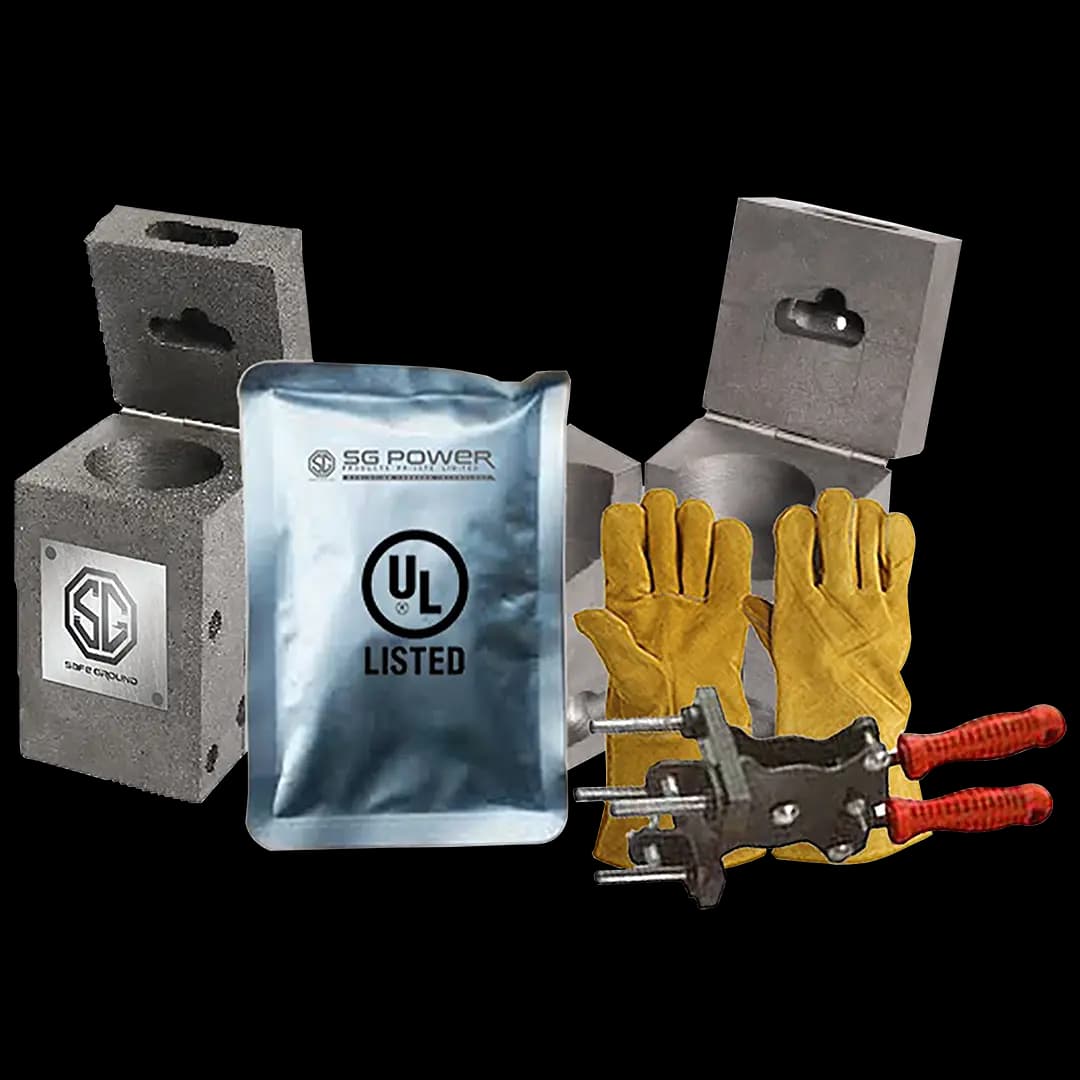
A complete exothermic welding kit contains everything needed to make joints on site:
Graphite mould (also called a mold): the heart of the system. It holds the conductors in position, contains the reaction and shapes the finished joint. Each mould is made for one connection type and conductor size, with a crucible, tap hole and weld cavity
Handle clamp: holds the mould halves tightly closed and lets you handle the hot mould safely
Weld powder and starting powder: packed by weight to suit each mould
Steel retaining discs: one per weld, to hold the powder in the crucible until it melts
Flint igniter (spark gun): lights the starting powder from a safe distance
Cleaning tools: a soft mould brush, a cable or wire brush and a file card brush
Mould sealing compound: seals gaps when welding to steel surfaces, pipes or uneven conductors
Sleeves, copper shims and packing: sleeves and shims fill the gap around small or undersized conductors, and packing seals the mould on rebar
Special clamps: a magnetic handle clamp for welding to flat steel such as tanks and structures, and a chain clamp for pipes
Gas torch: to dry and preheat the mould and heavy steel surfaces before welding
Safety gear: heat-resistant gloves and safety glasses
Buy refill weld powder and replacement tools and accessories separately as you use them up.
How the Exothermic Welding Process Works
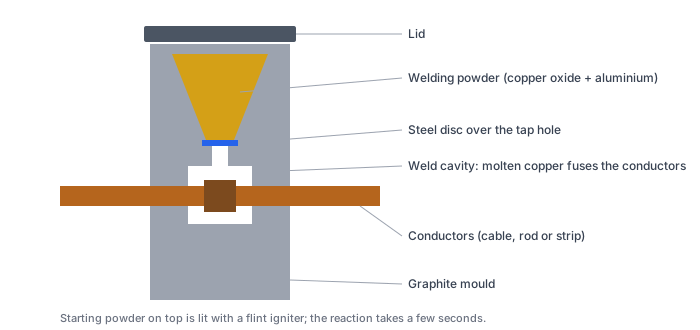
In short: in the exothermic welding procedure, the conductors are clamped inside a graphite mould, weld powder is poured into the crucible above them and lit. The reaction turns the powder into molten copper, which melts through a steel disc, flows into the weld cavity and fuses the conductors together. The steps are:
Clean the conductors. Brush copper conductors with a wire brush, and grind steel or galvanised surfaces back to clean bright metal.
Dry the mould and conductors. Warm the mould with a torch before the first weld. Any moisture can cause a porous joint and molten metal spatter.
Position the conductors. Place the conductors in the weld cavity of the open mould exactly as the mould is designed. For splices, leave a small gap of about 3 mm between the conductor ends.
Close and clamp the mould. Lock the two mould halves together with the handle clamp so that molten metal cannot leak.
Insert the steel disc. Seat the steel retaining disc over the tap hole at the bottom of the crucible.
Add the powders. Pour in the weld powder, then sprinkle the starting powder on top and on the lip of the mould, and close the lid.
Ignite. Stand to one side and fire the flint igniter at the starting powder, which lights at around 450°C. The reaction is over in about 3–4 seconds.
Wait, open and clean. Wait for the metal to solidify (usually less than a minute), open the mould, remove the slag and clean the mould with a soft brush for the next weld.
Common Exothermic Welding Connection Types
Every joint on an earthing or lightning protection system has a matching mould, from copper to copper exothermic welding of cables and strips to cable to rod exothermic welds on earthing rods. The most common types are:
| Connection type | Common industry code | Typical use |
|---|---|---|
| Cable to cable: straight splice, tee and cross (X) | CC | Joining copper cables in an earth grid or ring earth |
| Strip to strip: straight, tee and cross | BB | Copper or GI strip earth grids, down conductors and earth mats |
| Cable or strip to busbar / earth bar | – | Connecting earthing conductors to copper earth bars and busbars in substations and plant rooms |
| Rod to rod | – | Joining two earthing rods end to end to reach deeper, lower-resistance soil |
| Cable to rod and strip to rod | CR / BR | Joining the earthing conductor to a copper bonded earth rod |
| Cable or strip to steel surface | CS / BS | Bonding to structural steel, tanks, pipelines, fence posts and stainless steel surfaces |
| Cable to rebar | CRE | Bonding the earthing system to building reinforcement |
| Cable to lug or terminal | CL / lug | Making a termination for a bolted connection above ground |
| Rebar to rebar and strip to rebar | – | Electrical continuity of reinforcement in foundations and structural earthing |
| Cable to pipe | – | Bonding metallic pipelines, tanks and cathodic protection test leads |
The codes are common industry shorthand used in tenders and catalogues; tell us the joint type in plain words, and we will match the SG Power mould. Rail bonding (traction return and signalling bonds on the rail itself) and aluminium conductors need special moulds and weld metal, so check with us before you specify them.
Made to Match SG Power Earthing Rods
Cable to rod and strip to rod joints are the most common welds on an earthing system. Our moulds are made to fit our own UL listed copper bonded earthing rods, so the rod, the mould and the powder all come from one manufacturer.
The rods come in 14, 17, 20 and 25 mm diameters, with over 250 microns of 99.99% pure copper bonded to a low-carbon steel core, and are UL listed to UL 467. Tell us the rod diameter and the conductor size when you order cable to rod moulds.
Graphite Moulds vs Single-Use Moulds: Which Is Better?
| Mould type | Life | Best for |
|---|---|---|
| Full-size graphite mould | Typically 50–75 welds with good care | Projects with many joints of the same type, such as earth grids and substations |
| Mini graphite mould | Fewer welds; less robust | Small jobs with a limited number of joints |
| Single-use ceramic mould | One weld | A few one-off joints where buying a graphite mould is not worth it |
For most earthing projects, a graphite mould is the most economical choice, because the cost of the mould is spread over dozens of joints. SG Power supplies semi-permanent graphite moulds.
Exothermic Welding vs Bolted Clamps, Brazing and Compression
Short answer: for buried and permanent earthing joints, an exothermic weld is better than a bolted clamp, a brazed joint or a compression connector, because it is a molecular bond that cannot loosen or corrode. Bolted clamps are the better choice only where a joint must be opened for testing.
| Point | Exothermic weld | Bolted clamp | Brazing | Compression connector |
|---|---|---|---|---|
| Type of joint | Molecular fusion | Mechanical contact | Filler bonds the surfaces | Pressed mechanical joint |
| Loosening over time | Cannot loosen | Can loosen with vibration and heat cycles | Does not loosen | Low risk if correctly crimped |
| Corrosion at the joint | Very low; one solid mass of copper | Can corrode between contact surfaces | Low to moderate | Low |
| Fault current capacity (ampacity) | Equal to or greater than the conductor | Depends on tightening | Lower than the conductor | Depends on connector |
| External power or heat | None | None | Gas torch | Hydraulic tool |
| Maintenance | None after installation | Periodic retightening | Low | Low |
| Can be buried or encased | Yes | Not recommended | Yes | Yes, if rated for it |
A bolted or crimped joint carries current only through its contact points, so current density is uneven, and the joint usually needs an anti-oxidant compound to slow corrosion. An exothermic connection carries current through its whole cross-section.
Bolted earthing clamps still have a place where a joint must be opened for testing, such as at an inspection pit. For buried joints and joints you will never see again, exothermic welding is the safer choice. Not sure which joints on your layout to weld? Ask our earthing team.
What Are the Benefits of an Exothermic Welding System?
Permanent earthing connection: the joint does not loosen over time, even with vibration or repeated fault currents.
Higher mechanical strength: than bolted, brazed or crimped joints.
No corrosion at the joint: the conductors become one solid piece of copper, so there is no gap for moisture to enter. This gives the joint a long life.
High temperature capacity: the joint withstands temperatures of up to about 1,000°C, so it survives fault and lightning currents.
Low resistance: the current-carrying capacity is equal to or higher than the conductor.
Joins dissimilar metals: copper cable, copper bonded steel rods and structural steel fuse into one joint, with no contact surface between different metals for corrosion to start.
Portable: no power supply, generator or gas is needed on site.
Visual inspection: a good weld can be checked by eye, with no tools needed.
What Are the Disadvantages of Exothermic Welding?
Exothermic welding is the most reliable earthing joint, but it has a few disadvantages to plan for:
It is permanent: a welded joint cannot be opened for testing. Use a bolted test link or clamp at inspection pits.
A mould is needed for every joint type and size: large projects with many conductor sizes need several moulds.
Dry conditions are essential: moisture in the mould or on the conductors causes porous joints and spatter.
Each weld uses consumables: one powder cartridge and one steel disc per joint.
Basic training is needed: results depend on the installer, so installers should be shown the process and safety steps before working alone.
Where Is an Exothermic Welding System Used? Earthing, Grounding and Lightning Protection
An exothermic welding system for earthing and grounding is used wherever a joint must stay permanent, buried or out of sight:
Earthing systems: joining copper conductors to earthing rods, copper bonded earth electrodes and chemical earth electrodes
Lightning protection: each down conductor of a lightning protection system needs its own earth, and all lightning earths should be bonded together and to the facility earth. Exothermic welds make these bonds permanent.
Earth grids and mats: cable and copper or GI strip grids in substations, switchyards and industrial plants
Railways and metro: linking earth pits into a ring earth, and bonding stations, depots and structures
Solar power plants: module mounting structures and inverter earthing
Telecom towers and data centres: tower legs, equipment earth bars and earth rings
Oil, gas and pipelines: bonding of tanks, pipes and cathodic protection connections
Substation and plant perimeter fences: bonding fence posts and gates to the earth grid, which can mean hundreds of welds on a single site
Commercial and residential buildings: rebar bonding and foundation earthing
These joints connect our earthing rods, copper bonded earth electrodes, chemical earth electrodes and copper or GI strip into one continuous system.
Exothermic Welding System Standards and Compliance
SG Power's exothermic weld system complies with IEEE 80 (the guide for safety in AC substation grounding, which sets safe step and touch voltage limits for earth grids that depend on permanent, low-resistance joints) and NBC 2016 (the National Building Code of India). SG Power is an ISO 9001:2015 certified manufacturer.
Other standards often named in tenders and specifications are:
IEEE 837: the standard for qualifying permanent connections used in substation grounding, through mechanical, current-temperature cycling and fault current tests.
IEC 62561-1: requirements for connection components in lightning protection systems.
IEC 60364-5-54: names exothermic welding as an accepted method for connecting earth electrode parts and for joining the earthing conductor to the earth electrode.
UL 467: the UL standard for grounding and bonding equipment. SG Power's copper bonded earthing rods are UL listed to it.
If your project specification names a particular standard or test report, tell us when you ask for a quote, and we will confirm the documents we can supply.
Exothermic Welding in Indian Earthing Practice
Indian earthing systems are designed to IS 3043, the code of practice for earthing, and exothermic welding is now written into many Indian specifications and tenders:
Railway earthing: RDSO earthing and bonding practice links the earth pits around an equipment room into a loop with copper tape (such as 25 × 3 mm) or 8 mm round copper conductor, joined by exothermic welding.
Maintenance-free earthing: RDSO's earthing specification calls for strip joints to be made by exothermic welding (or at least two stainless steel bolts), and allows only one joint per copper strip where a single length is not enough.
Power plants and substations: PSU and EPC tenders, such as those for thermal power stations, specify exothermic welding materials together with copper clad steel earth rods.
Buildings: the National Building Code (NBC 2016) and the lightning protection standard IEC 62305 call for low-resistance, durable joints between down conductors and earth electrodes.
Always check the exact requirement in your tender, including any test reports or approvals it asks for, before you order.
How to Choose the Right Mould and Weld Powder
Connection type: splice, tee, cross, rod, steel surface, rebar or lug.
Conductor material: copper cable, copper strip, GI strip, copper bonded rod or steel.
Conductor sizes: the cable cross-section in mm², the strip width and thickness, or the rod diameter (for example, 14, 17, 20 or 25 mm).
Orientation: horizontal or vertical, and whether the conductor runs through or ends at the joint.
Site conditions: joints on steel surfaces or pipes may need mould sealing compound; wet sites need extra drying time.
The weld powder size is printed on each mould. Weld powder is sold by weight in grams; sizes across the industry range from about 15 g to 250 g, and in India packs such as 32 g, 45 g, 65 g, 90 g and 115 g are common. Large conductors may need two or more cartridges in one weld. Always use the size marked on the mould: too little powder gives a weak joint, and too much powder spills over.
How Many Moulds and How Much Powder Do You Need?
A simple way to plan an exothermic welding order is to count your joints by type and size from the earthing layout, then work out each item:
| Item | How to work it out |
|---|---|
| Graphite moulds | One mould for each joint type and conductor size combination. Add one more mould of the same type for about every 50 welds, plus a spare for the most common joint. |
| Weld powder | One cartridge of the size marked on the mould for each joint. Some large joints need two cartridges, as marked on the mould. |
| Steel discs and starting powder | One steel disc per weld. Starting powder is usually packed with each weld powder cartridge. |
| Handle clamps | One per mould size family; a crew working on two joint types at once needs two. |
| Tools | One flint igniter, set of brushes, sealing compound, gas torch and safety gear per welding crew. |
Worked example: a small substation earth grid has 40 cable to rod joints (70 mm² cable to 17 mm rod) and 100 cable to cable tee joints (70 mm² cable). You would need one cable to rod mould and two cable tee moulds (100 welds is more than one mould usually makes), 40 + 100 = 140 weld powder cartridges of the marked sizes plus about 10% extra for practice and remakes (about 155 in all), the same number of steel discs, two handle clamps and one tool kit. Send us the joint list, and we will check the quantities before you order.
How to Choose an Exothermic Welding System Manufacturer or Supplier
Not all exothermic welding system suppliers sell the same quality. Before you place an order, check these points:
Manufacturer or trader? Ask whether the supplier makes the moulds and powder or resells them. A manufacturer can match moulds to your sizes and stands behind the product.
Powder quality ask for the weld powder's test reports and batch details.
Standards check compliance with the standards in your specification, such as IEEE 80, IEEE 837 or IEC 62561-1, and ask for the reports.
Mould marking each mould should be marked with the connection type, conductor sizes and powder size.
Matched supply the moulds, powder and accessories should come from the same system, so sizes always match.
Range the supplier should cover all the joint types on your drawing, not just the common ones.
Support ask whether the supplier can guide your installers on the process and safety steps.
Availability check that refill powder and spare tools can be supplied quickly for ongoing projects.
How to Inspect a Good Exothermic Weld
The weld fully covers the conductors, with no exposed strands inside the joint.
The surface is smooth and even in colour, with no large holes or deep porosity.
There is no excessive slag on top of the joint.
The conductors are not burnt or thinned near the joint.
The joint cannot be moved by hand once it has cooled.
If a weld fails these checks, cut it out and remake it. Moisture and dirt cause most poor welds. To make a graphite mould last its full 50–75 welds, clean it with a soft brush after every weld, never force it open, and replace it once the halves no longer close tightly. On critical projects, some specifications also ask for sample welds to be cut open or X-rayed to confirm they are solid inside.
Troubleshooting Common Exothermic Welding Problems
Experienced installers agree on three rules: clean moulds, dry moulds and clean conductors. Most failed welds break one of them.
| Problem | Likely cause | Fix |
|---|---|---|
| Porous or bubbly weld | Moisture in the mould, powder or conductors | Preheat the mould and conductors with a torch; keep powder sealed until use |
| Molten metal leaks out | Mould not fully closed, worn mould, or gaps around the conductor | Check the handle clamp, use sealing compound or packing, and replace worn moulds |
| Weld does not bond to steel or rebar | Rust, paint, zinc coating or mill scale; heavy cold steel | Grind to bright metal and preheat heavy steel before welding |
| Starting powder will not ignite | Damp or old powder, or lighting it with a torch | Use fresh, dry powder and a flint igniter |
| Joint is not fully formed | Wrong powder size, or the steel disc not seated | Use the powder size marked on the mould and seat the disc over the tap hole |
| Mould cracks or chips | Forcing the mould open, or thermal shock | Open the mould gently and let it warm up before the first weld |
Safety Tips for Exothermic Welding
Wear safety glasses, leather gloves and full-sleeve cotton clothing.
Keep flammable materials away from the work area.
Never weld on wet conductors or in a wet mould; dry them first.
Stand to one side of the mould when igniting, never over it.
Store weld powder and moulds indoors in their sealed packing, away from heat and humidity. In the monsoon, cover and dewater the pit or trench before welding.
Let the mould and joint cool before handling; both stay hot for several minutes.
Customer Reviews and Ratings
SG Power is rated 4.1 out of 5 from 134 buyer ratings on IndiaMART (November 2026), where it has been a TrustSEAL verified manufacturer since 2012 with a 91% response rate.
Bought an exothermic welding system from SG Power? Tell us how it went; your feedback helps other buyers choose with confidence.
Exothermic Welding System Price: What Affects the Cost?
The price of an exothermic welding system depends on the connection type, conductor sizes, the number of joints, and whether you need a complete kit or only refill powder. All SG Power exothermic welding products are Price on request.
If you compare the exothermic welding system price in India or an exothermic welding kit price online, you will see very different figures. The difference usually comes from the number of moulds in the kit, the powder sizes and quantity, and whether you are buying from a manufacturer or a trader, so always compare quotes for the same joint list.
| Product | Price |
|---|---|
| Exothermic weld mould | Price on request |
| Exothermic weld powder | Price on request |
| Exothermic welding tools and accessories | Price on request |
| Complete exothermic welding kit | Price on request |
* Prices are indicative. For the latest price, contact SG Power.
Send us your connection list (joint type, conductor sizes and number of joints) for an accurate quote.
What to Send for an Exothermic Welding Quote
A joint list in this format gets you the fastest and most accurate quote:
| Joint type | Conductor 1 | Conductor 2 | Orientation | No. of joints |
|---|---|---|---|---|
| Cable to rod tee | 70 mm² copper cable | 17 mm copper bonded rod | Horizontal cable, vertical rod | 40 |
| Cable to cable tee | 70 mm² copper cable | 70 mm² copper cable | Horizontal | 60 |
| Strip to strip cross | 25 × 3 mm copper strip | 25 × 3 mm copper strip | Horizontal | 20 |
Also mention the delivery location, any standard or test report your tender asks for, and whether you need complete kits or refill powder only.
Sources and References
The technical information on this page is based on SG Power's product data and on these published standards and references:
IEEE 837: Standard for Qualifying Permanent Connections Used in Substation Grounding
IEC 62561-1: Lightning protection system components, Part 1: Requirements for connection components
IEC 60364-5-54: Earthing arrangements and protective conductors
IS 3043: Code of Practice for Earthing (Bureau of Indian Standards)
National Building Code of India (NBC) 2016
Frequently Asked Questions
Our Satisfied Clients

Project Location - Karnataka
Power infrastructure project with advanced electrical solutions.

Project Location - Kanheri Hills
Defence sector electrical and protection systems.

Project Location - Hyderabad
Airport infrastructure and electrical safety solutions.

Project Location - Pune
Metro rail electrical installations and grounding systems.

Project Location - Ajmer
State electricity distribution network solutions.

Project Location - Jodhpur
Power distribution and earthing solutions.

Project Location - Bangalore, Noida
Heavy electrical and industrial power systems.

Project Location - Odisha
Steel industry electrical infrastructure solutions.

Project Location - Nashik, Chhattisgarh
Defence-grade electrical protection systems.

Project Location - Lucknow, Jabalpur
Telecom infrastructure and grounding systems.

Project Location - Ghaziabad
Government electronics and power systems.

Project Location - Sambalpur
Aluminium industry electrical safety solutions.

Project Location - Srinagar
Military-grade electrical infrastructure.

Project Location - Kerala
Railway electrification and protection systems.

Project Location - Rajasthan
Cement industry electrical solutions.

Project Location - Haryana
State power distribution infrastructure.

Project Location - Noida
Industrial electrical and safety systems.

Project Location - Khavda, Bikaner
Large-scale construction and power projects.

Project Location - Noida
Private electricity distribution systems.

Project Location - Chhattisgarh
Thermal power plant electrical solutions.

Project Location - Shahjahanpur
Power generation and infrastructure systems.

Project Location - Gurugram
Aviation electrical infrastructure solutions.

Project Location - Noida
Smart city electrical and infrastructure systems.
Get a Quote from Exothermic Welding System Manufacturers
Buy your exothermic welding system direct from the manufacturer. Tell us your joint types, conductor sizes and number of joints, and our team will recommend the right moulds, powder and accessories.
- Email: enquiry@sgpower.co.in
- Office: 17th Floor, L-17 – 1714B, The Iconic Corenthum, Plot No. A-41, Sector 62, Noida, Uttar Pradesh 201309
- Hours: Monday to Saturday, 9:30 AM to 6:30 PM