
By SG Power Products Pvt. Ltd. | Last updated: 16 October 2026
Once a project has decided on chemical earthing, the next question on almost every enquiry is which chemical earthing electrode material to use: GI, copper bonded or pure copper. Once installed, all three chemical earthing electrodes look alike, and all three can meet the design resistance on the day of commissioning.
The difference shows up later. The material of the outer pipe decides how long the electrode keeps a sound, conductive surface, how it copes with your soil, and what you pay over the life of the installation.
Most comparisons online set copper against GI and skip pure copper altogether, or treat copper bonded and pure copper as the same thing. They are not. This guide compares all three materials for chemical earthing electrodes used on Indian projects, with tables for soil and application, a price guide, a lifecycle cost method and sample specification lines. For a deeper look at GI against copper bonded alone, read our guide, Copper Bonded vs GI Earth Electrode.
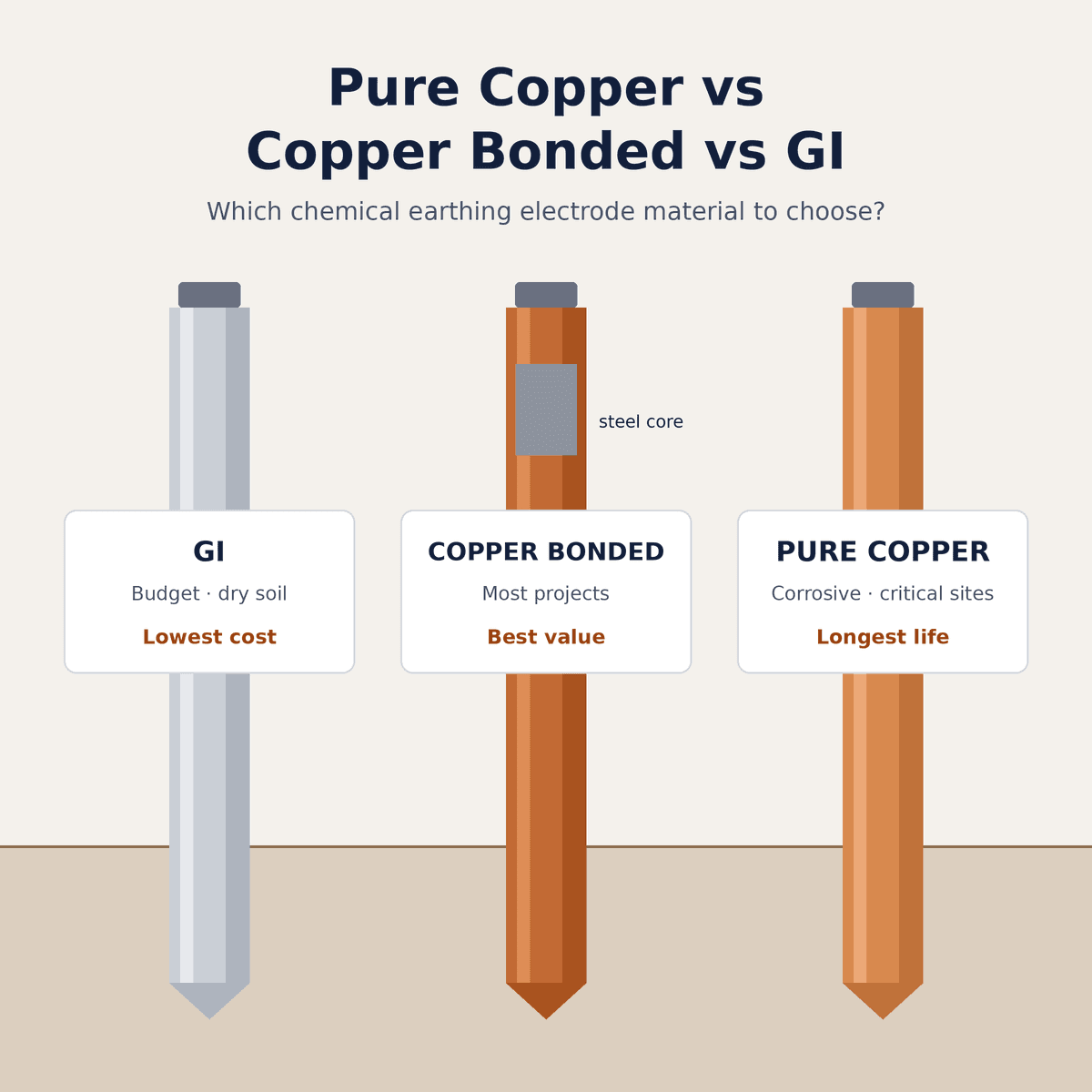
Quick answer: Copper bonded is the right chemical earthing electrode material for most projects, because it resists corrosion well at a moderate cost. Choose GI for dry, non-corrosive soil, tight budgets or short-life sites, and pure copper for highly corrosive, coastal or chemically contaminated soil and critical installations.
Copper bonded chemical earthing electrodes suit most industrial, utility and solar projects: strong corrosion resistance at a moderate cost.
GI chemical earthing electrodes are the budget choice for dry, non-corrosive soil and short-life or temporary sites.
Pure copper chemical earthing electrodes are for highly corrosive or contaminated soil, coastal sites and critical installations.
Material has little effect on the first resistance reading. Depth, soil, earth enhancing compound and the number of electrodes decide that. Material decides how well the reading holds over the years.
Do not mix bare copper and GI in the same earthing system without dealing with galvanic corrosion.
A chemical earthing electrode is a sealed metal pipe, filled with a conductive mix, that is installed in a bore and surrounded by earth enhancing compound to give fault and lightning current a low, stable path into the ground. Because it needs no watering or salt refills, it is also sold as a maintenance-free earthing electrode. International specifications sometimes call it a chemical grounding electrode.
Buyers, contractors and tenders often call the same product a "chemical earthing rod". Everything in this guide applies whichever name your bill of quantities uses. (A solid rod driven into the ground with no filling or compound is a different product, a driven earth rod.)
A chemical earthing electrode has the same parts whatever the material: an outer pipe, a conductive filling sealed inside it, and a terminal for the earthing conductor. Each material is made in three constructions: standard, pipe in pipe and strip in pipe (also called flat in pipe). Only the outer pipe changes, and that pipe is what sits in contact with the compound and soil for the life of the earth pit.
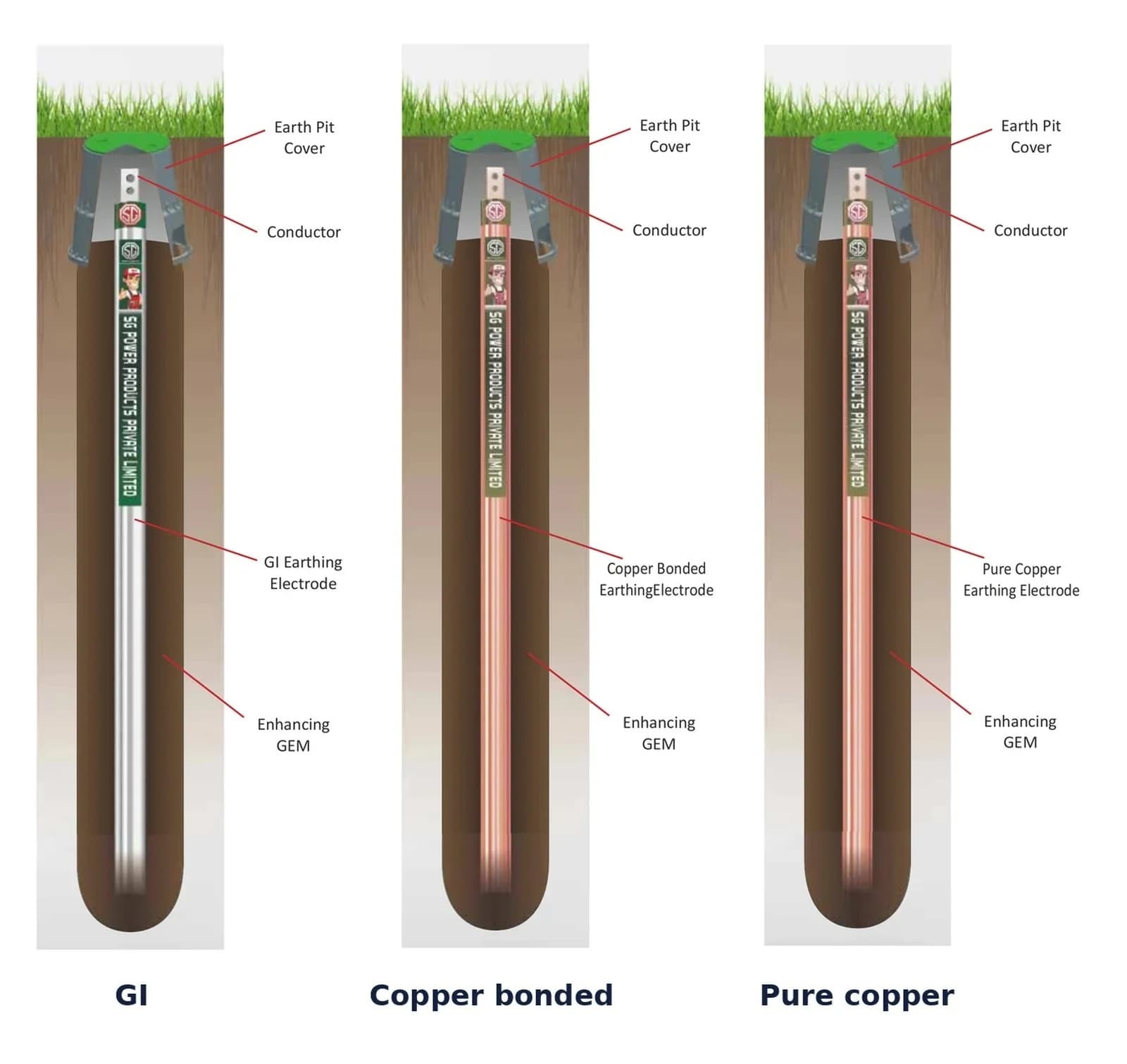
GI stands for galvanised iron ("galvanized" in US spelling). A GI electrode is a steel pipe with a hot-dip galvanised zinc coating. Zinc protects the steel sacrificially: it corrodes first, so the steel underneath stays intact. Once the zinc is used up, the steel starts to corrode, and the electrode's surface and cross-section begin to shrink.
A copper bonded electrode is a steel pipe with copper molecularly bonded to its surface by electrolytic deposition. Copper resists soil corrosion far better than zinc, so it protects the steel for much longer, provided the copper layer is thick enough and stays bonded. The steel gives strength; the copper gives conductivity and corrosion resistance. For datasheet terms and constructions, see our guide to copper bonded earth electrode types, specifications and uses.
A pure copper electrode is a copper pipe with no steel to expose. It has the highest conductivity and the best resistance to aggressive soil, but it costs the most, is softer than steel, and its scrap value makes it a theft target on unguarded sites.
| Factor | GI | Copper bonded | Pure copper |
|---|---|---|---|
| Outer pipe | Steel with zinc coating | Steel with bonded copper layer | Solid copper |
| How it resists corrosion | Zinc corrodes first to protect the steel | Copper layer shields the steel | Copper throughout |
| Surface conductivity | Moderate | High | Highest |
| Corrosive or saline soil | Poor | Good | Best |
| Mechanical strength | High | High (steel core) | Lower |
| Relative service life | Shortest | Long | Longest |
| Initial cost | Lowest | Moderate | Highest |
| Lifecycle cost | Higher where replacement is needed | Low | Low, but high upfront |
| Theft risk | Low | Low | High |
You will see fixed figures quoted for chemical earthing electrode life, sometimes decades apart for the same material. Treat them with care. The same copper bonded electrode can last far longer in neutral, well-drained soil than in saline, waterlogged ground, and a thin copper layer can fail early anywhere. A credible manufacturer ties any life estimate to the coating thickness and your soil conditions, rather than quoting one number for every site.
Once the electrode is installed, periodic earth resistance testing by the fall-of-potential method described in IS 3043, ideally every year in the dry, pre-monsoon season when resistance is highest, is the only reliable way to see how an electrode is ageing.
Soil is usually the deciding factor. Before choosing, measure soil resistivity with a four-pin (Wenner) test, as described in IEEE 81, and, where corrosion is a concern, check soil pH and chloride content as well.
| Soil condition | Suggested chemical earthing electrode |
|---|---|
| Dry, sandy or rocky, neutral pH, low chloride | GI is acceptable; copper bonded for longer life |
| Normal moist or clay soil | Copper bonded |
| Saline, coastal (for example, coastal Gujarat, Tamil Nadu or Odisha), high chloride or waterlogged | Copper bonded with a generous copper thickness, or pure copper |
| Acidic or chemically contaminated (effluent, fertiliser, chemical plants) | Pure copper |
Not sure which material suits your soil? Share your soil resistivity and target earth resistance, and our engineers will recommend the right chemical earthing electrode. Ask an engineer
| Application | Typical choice |
|---|---|
| Substations and transformer neutral earthing | Copper bonded, pipe in pipe or strip in pipe |
| Solar power plants | Copper bonded; GI strip in pipe where soil is dry and non-corrosive |
| Data centres and hospitals | Copper bonded or pure copper |
| Telecom towers | Copper bonded (low theft value, long life) |
| Commercial and residential buildings | GI or copper bonded |
| Coastal sites and chemical plants | Pure copper |
| Temporary or construction power | GI |
Two of the most common enquiries are about choosing a chemical earthing electrode for solar plants and for transformer earthing. For solar, copper bonded suits most sites, with GI strip in pipe an option only on dry, non-corrosive ground; for transformers, copper bonded pipe in pipe or strip in pipe handles the higher fault current.
See each range for sizes and constructions: GI earthing electrode, copper bonded earthing electrode and pure copper earthing electrode.
The price of a chemical earthing electrode follows its material. GI costs the least, copper bonded sits in the middle, and pure copper costs the most, because the whole pipe is copper. Copper bonded and pure copper prices also move with the international copper rate set on the London Metal Exchange (LME), so their quotations usually carry a shorter validity than GI quotations.
Within each material, the price rises with length, diameter, construction (pipe in pipe and strip in pipe cost more than standard) and coating thickness. Public B2B listings in 2026 show common sizes from roughly ₹1,085 to ₹11,999 per electrode, but listings rarely state the coating thickness or whether the pipe is fully filled and sealed. Compare specifications, not headline prices.
Two chemical earthing electrodes of the same material can perform very differently if their size and wall thickness differ. Standard chemical earthing electrode sizes are nominal bores of 40, 48, 58, 76, 88 and 115 mm and lengths of 1, 1.5, 2, 3 and 6 m. Each size is usually offered in three pipe wall classes: standard, Class B and Class C, from lighter to heavier.
| Parameter | What it changes | What to specify |
|---|---|---|
| Length | Has the biggest effect on earth resistance, because a longer electrode reaches deeper, moister soil | 2 m or 3 m for most pits; 6 m where the design needs deeper earthing |
| Diameter (nominal bore) | Increases the contact area with the compound and the fault current capacity, but has a smaller effect on resistance than length | Larger bores for substations, transformers and high fault levels |
| Pipe wall class | More metal to lose before the electrode is weakened, so a heavier wall extends life, most of all for GI | Class B or Class C for GI in corrosive soil or long-life projects |
This is why a heavy-wall GI electrode can outlast a thin-wall one by a wide margin in the same soil, and why comparing quotations on material alone can mislead. Always state the wall class alongside the material.
A GI chemical earthing electrode almost always wins on the price per piece. The comparison changes once you count what a replacement really costs: digging out the pit, a new electrode, fresh earth enhancing compound, labour, any shutdown needed to work safely, and re-testing.
Lifecycle cost per earth pit = (electrode + compound + installation + testing) × number of installations needed over the project life
Ask for quotations on all three materials in the same size and construction, estimate how many times each would need replacing in your soil over the design life, and compare the totals. On long-life projects in normal or corrosive soil, copper bonded usually comes out lowest. On a short-life site in dry soil, GI often does.
The electrode is only one part of a chemical earth pit. The other parts should suit it:
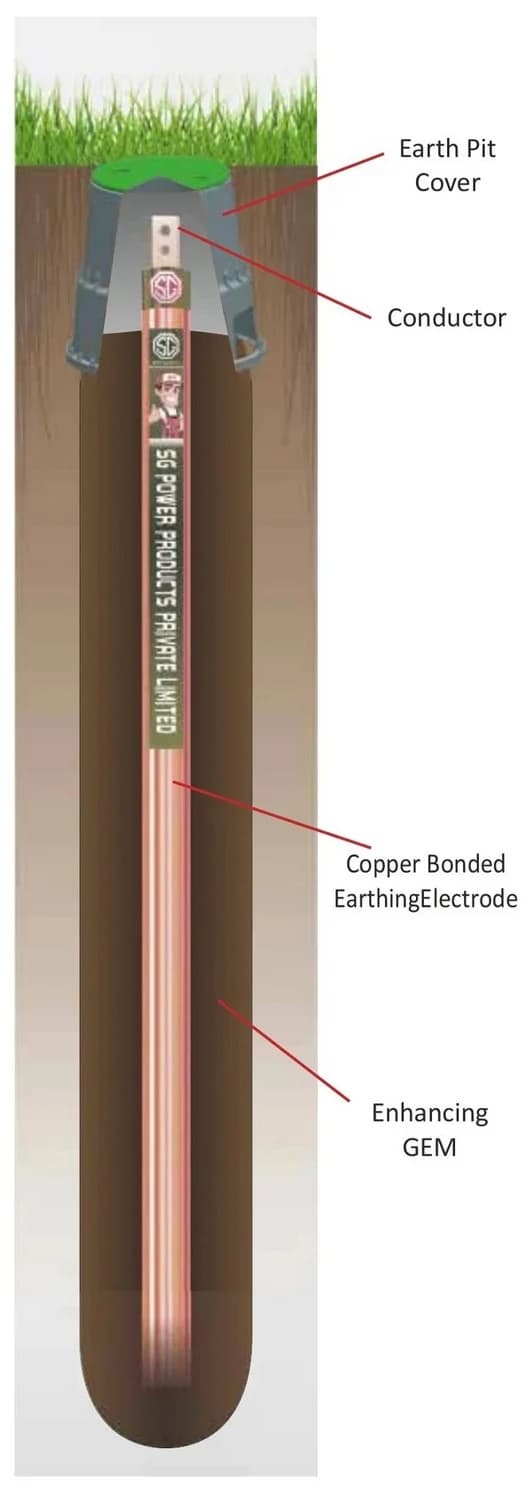
Earth enhancing compound: (also called backfill compound or ground enhancing material, GEM): use a non-corrosive, carbon- or graphite-based earth enhancing compound, not salt and charcoal, which corrode the electrode whatever its material.
Earthing strip or conductor: GI strip with a GI electrode; copper strip, tape or cable with a copper bonded or pure copper electrode. Size it from the fault current in your IS 3043 design.
Connections: use rated earthing clamps or an exothermic weld. Where copper must meet GI, use a proper bimetallic joint and keep it out of standing water, or the GI side corrodes first.
Pit cover: an earth pit cover keeps the terminal accessible for testing.
Choosing on unit price alone. The cheapest chemical earthing rod can make the most expensive earth pit over ten years.
Mixing GI and copper in one system. Bare copper connected to GI in moist soil sets up galvanic corrosion, and the GI corrodes faster.
Writing “copper bonded” without a copper thickness. A thin coating gives a short life. Always state the minimum thickness in microns.
Using pure copper on unguarded remote sites. At remote solar or telecom sites, theft can cost more than corrosion. Copper bonded is often the safer choice.
Expecting the material to fix high-resistivity soil. In rocky or sandy ground, depth, the number of electrodes and the compound do far more than the material.
Clear specification lines make quotations comparable. Fill in the values your design needs:
GI: Chemical earthing electrode, hot-dip galvanised steel pipe, zinc coating 80 to 100 microns minimum, 50 mm nominal bore × 3 m, pipe wall class Standard / B / C, construction standard / pipe in pipe / strip in pipe, conductive filling sealed at both ends, designed to IS 3043, with test report.
Copper bonded: Chemical earthing electrode, copper bonded steel pipe, copper thickness 250 microns minimum, 50 mm nominal bore × 3 m, pipe wall class Standard / B / C, construction as above, designed to IS 3043, with coating thickness record.
Pure copper: Chemical earthing electrode, copper pipe of 99.9 % purity, wall thickness 2 mm to 3 mm (or wall class Standard / B / C), 50 mm nominal bore × 3 m, construction as above, designed to IS 3043, with material test certificate.
The earthing design itself should follow IS 3043:2018, Code of Practice for Earthing. For electrode materials and coatings, international specifications often refer to IEC 62561-2 (conductors and earth electrodes), and for backfill to IEC 62561-7 (earthing enhancing compounds).
Once you have chosen the material, this is how it maps to SG Power's range. Every electrode is made at our own factory in Ghaziabad (Delhi NCR), designed to IS 3043 and dispatched across India.
| Material | Part number series | Construction | Nominal bore | Lengths | Wall class |
|---|---|---|---|---|---|
| GI | GIE | Standard, pipe in pipe, flat in pipe | 40–115 mm | 1, 1.5, 2, 3, 6 m | Standard, B, C |
| Copper bonded | CBE | Standard, pipe in pipe, flat in pipe | 40–115 mm | 1, 1.5, 2, 3, 6 m | Standard, B, C |
| Pure copper | PCE | Standard, pipe in pipe, flat in pipe | 40–115 mm | 1, 1.5, 2, 3, 6 m | Standard, B, C |
Datasheet and drawings for consultant approval before you order
Test report and inspection record with every dispatch, with batch marking for traceability
Factory inspection by you or a third-party agency, on request
The rest of the earth pit from one source: earth enhancing compound, pit covers, clamps, strips and exothermic welding
Pan-India dispatch, including remote project sites, and phased deliveries to match your schedule
Custom lengths, diameters and terminals are made to order for bulk projects. Send your BOQ for a techno-commercial offer
There is no single best chemical earthing electrode material, only the best match for your soil, application and design life. Copper bonded is the right answer for most projects, GI where budget and dry soil allow, and pure copper where the ground or the site's importance demands it.
As a chemical earthing electrode manufacturer, SG Power makes GI, copper bonded and pure copper electrodes in standard, pipe in pipe and flat in pipe construction, in nominal bores from 40 mm to 115 mm, lengths from 1 m to 6 m and three pipe wall classes (standard, Class B and Class C), all designed to IS 3043.
Share your soil resistivity, target earth resistance and quantity, and our engineers will recommend the material and size that fit your project.
SG Power Products Pvt. Ltd. manufactures earthing and lightning protection products at its own factory in Ghaziabad (Delhi NCR), supplying utilities, EPC contractors, railways, defence and heavy industry across India. This guide was prepared by the company's earthing applications team.
How it works, types and installation
Soil, service life and lifecycle cost in more depth
For substations and transformers
The backfill every chemical earth pit needs