
Table of Contents
- What Is a Conventional Lightning Arrester?
- How Does a Conventional Lightning Arrester Work?
- SG Power Conventional Lightning Arrester Range
- Conventional Lightning Arrester Specifications
- Copper Bonded vs GI vs Pure Copper: Which One to Choose?
- Standards for Conventional Lightning Arresters
- Applications of Conventional Lightning Arresters
- Installation Best Practices
- Why Choose SG Power as Your Conventional Lightning Arrester Manufacturer?
- Conventional Lightning Arrester Price
- Frequently Asked Questions
- Request a Quote
What Is a Conventional Lightning Arrester?
A conventional lightning arrester is a pointed metal rod, usually with multiple spikes, fixed at the top of a building. It intercepts a lightning strike and carries the current through a down conductor into the earth, protecting the structure and the people inside. It is also called a Franklin rod or an air terminal, and is often written as a conventional lighting arrester.
The arrester is one part of a complete lightning protection system. A working installation needs three things:
Air terminal: the conventional lightning arrester with its spikes, mounted on a base plate.
Down conductor: a copper or GI strip or cable that carries the current from the arrester to the ground.
Earthing system: earth electrodes, backfill compound and an earth pit that spread the current safely into the soil.
An arrester on its own does nothing. Without a low-resistance earthing system and a properly routed down conductor, the strike current has nowhere safe to go.
How Does a Conventional Lightning Arrester Work?
1. Interception
The arrester stands at the highest point of the structure. Its spikes present the sharpest, highest point in the area, so a descending lightning strike attaches to them rather than to the roof, the wall or a person.
2. Conduction
The strike current passes from the spike head, down the main rod, through the base plate and into the down conductor, which runs along the outside of the building on the shortest route available.
3. Dissipation
The down conductor ends at an earth electrode in an earth pit. The current spreads into the soil, where it is harmless. Backfill compound around the electrode keeps the earth resistance low in dry weather.
A conventional arrester is passive. It has no electronics and nothing to reset after a strike. Note that it protects the structure, not the equipment inside it. For that you also need a surge protection device on the incoming supply.
SG Power Conventional Lightning Arrester Range
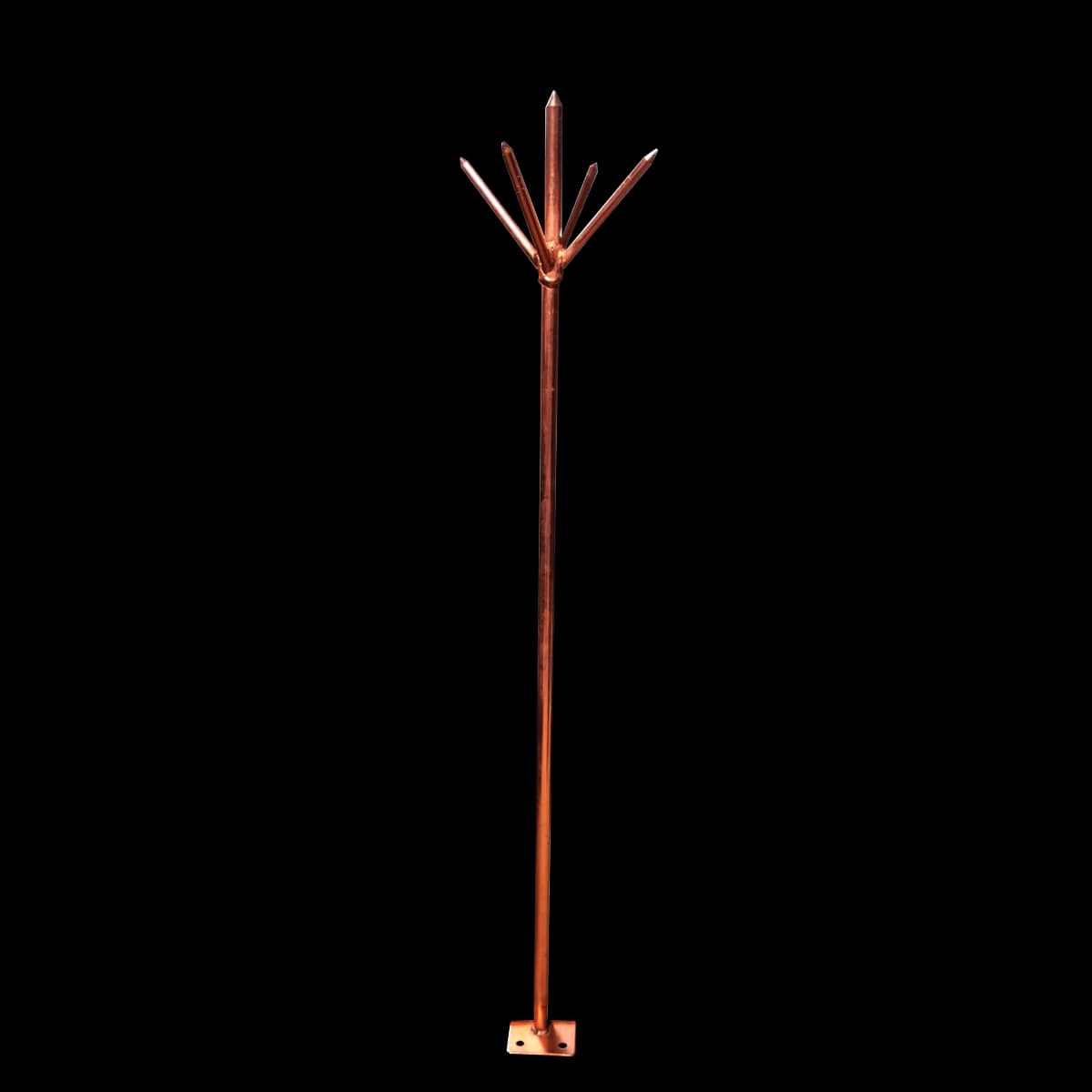
Copper Bonded Lightning Arrester
Model CBLA14SG050M
The copper bonded lightning arrester uses a high tensile low carbon steel core with a copper bonded surface. The steel core gives high mechanical strength, so the rod stays straight under wind load. The copper layer gives good conductivity and corrosion resistance. It comes with the largest base plate in the range, 100 × 100 mm, for a firm mount on roofs and parapets. This model offers the best balance of strength, conductivity and price for most commercial and industrial projects.
View the copper bonded lightning arrester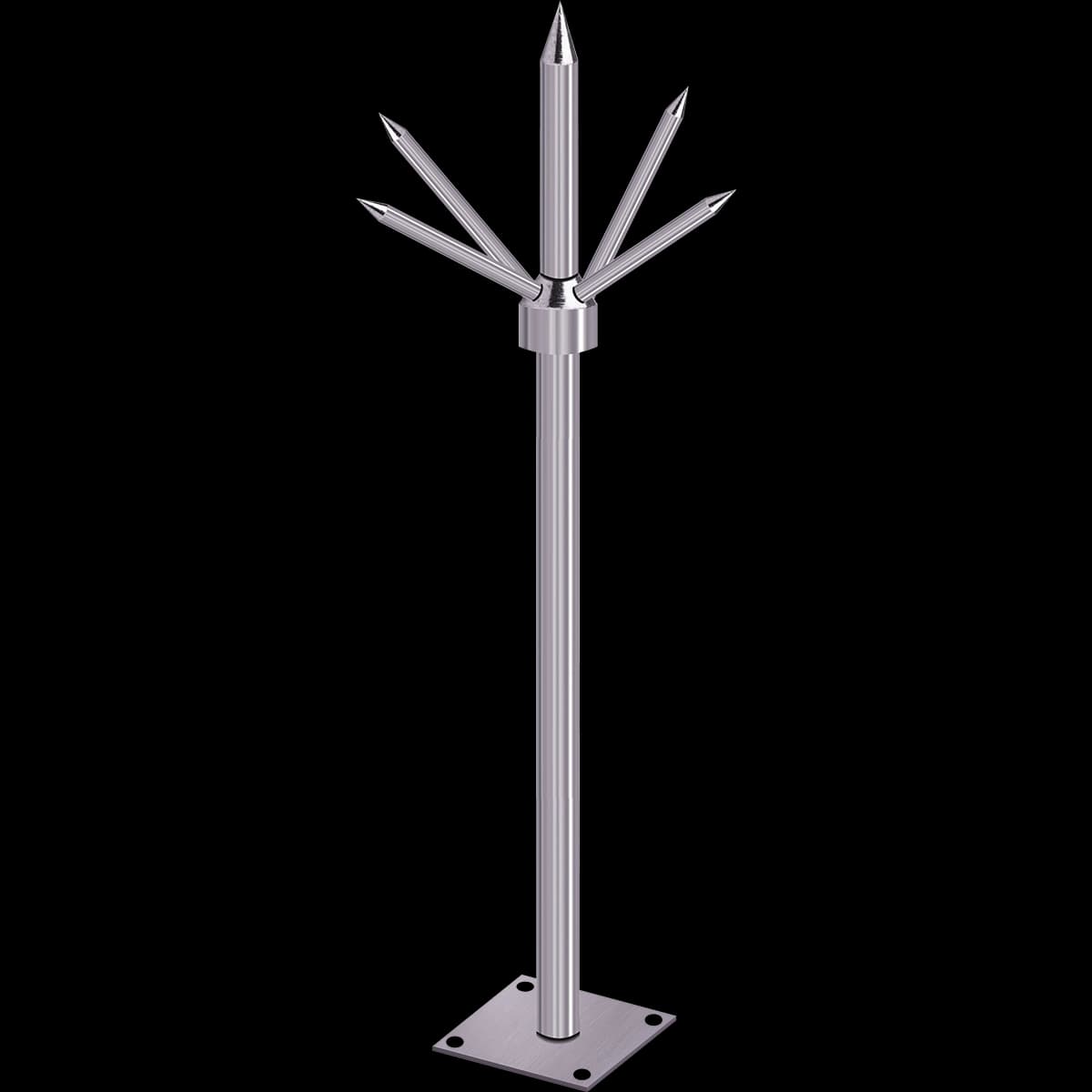
GI Lightning Arrester
Model GILA14SG050M
The GI lightning arrester also uses a high tensile low carbon steel core, finished with galvanised iron (GI) protection and an 80 × 80 mm GI base plate. It is the most economical option. It suits low-risk buildings, temporary structures and projects where the rest of the protection system is already in GI strip, because matching metals avoids galvanic corrosion at the joints.
View the gi lightning arrester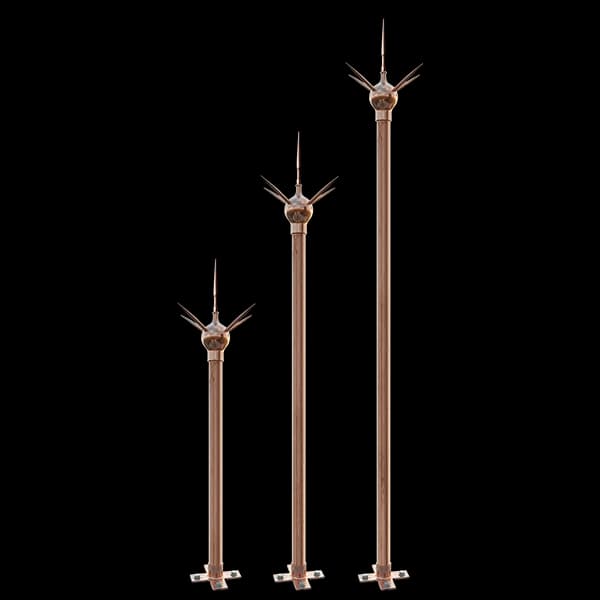
Pure Copper Lightning Arrester
Model CuLA14SG050M
The pure copper lightning arrester is made from 99.9% pure copper, with an 80 × 80 mm pure copper base plate. Copper has the highest conductivity of the three and resists corrosion well in coastal, humid and industrial air. It is the preferred choice for critical sites such as data centres, hospitals, control rooms and telecom towers, and for systems already built with copper down conductors.
View the pure copper lightning arresterConventional Lightning Arrester Specifications
All three models share the same rod diameter, length and spike count. The differences are the material and the base plate size.
| Specification | Copper Bonded | GI | Pure Copper |
|---|---|---|---|
| Model number | CBLA14SG050M | GILA14SG050M | CuLA14SG050M |
| Make | SGPL | SGPL | SGPL |
| Core material | High tensile low carbon steel | High tensile low carbon steel | 99.9% pure copper |
| Main rod diameter | 14 mm | 14 mm | 14 mm |
| Total length | 500 mm | 500 mm | 500 mm |
| Spike configuration | 5 spike | 5 spike | 5 spike |
| Base plate material | Copper bonded | GI | 99.9% pure copper |
| Base plate size | 100 × 100 mm | 80 × 80 mm | 80 × 80 mm |
| Standard | IEC 62305 | IEC 62305 | IEC 62305 |
Other diameters, lengths and base plate options are made to order. Each model page carries a configurator for the available variants, with a downloadable datasheet and drawing.
Copper Bonded vs GI vs Pure Copper: Which One to Choose?
| Factor | Copper Bonded | GI | Pure Copper |
|---|---|---|---|
| Conductivity | High | Moderate | Highest |
| Mechanical strength | Highest (steel core) | High (steel core) | Moderate |
| Corrosion resistance | High | Moderate | High |
| Relative cost | Medium | Lowest | Highest |
| Best for | Industrial, commercial, solar plants | Budget and low-risk buildings | Critical, coastal and copper-based systems |
In short: pick copper bonded for most commercial and industrial jobs, GI when the budget is tight or the rest of the system is in GI strip, and pure copper for critical or coastal sites. Match the arrester to the down conductor metal where you can: mixing copper and GI at a joint invites galvanic corrosion, so use a bimetallic clamp or an exothermic welded joint if you cannot.
If one terminal has to cover a wide roof, compare these with an ESE lightning arrester.
Standards for Conventional Lightning Arresters
IEC 62305: the international standard for protection against lightning. All three SG Power conventional arresters are made to it.
IEC 62305-2: risk management. It sets out how to assess a structure's lightning risk and arrive at a protection level.
IEC 62305-3: physical damage to structures and life hazard. It covers air terminal placement by the protection angle, mesh and rolling sphere methods.
IS 2309: the Indian code of practice for the protection of buildings and allied structures against lightning.
IEC 62561-2: requirements for conductors and earth electrodes, including the materials and minimum dimensions used in a protection system.
The number of arresters a roof needs, and where they go, comes from an IEC 62305 risk assessment rather than from a fixed coverage figure. Send us the building dimensions and we will work it out.
Applications of Conventional Lightning Arresters
Residential houses, apartments and villas
Schools, colleges and hospitals
Factories, warehouses and industrial sheds
Commercial buildings, malls and offices
Telecom towers and shelters
Rooftop and ground-mounted solar power plants
Railway, metro and power distribution (discom) installations
Water tanks, chimneys and tall masts
Installation Best Practices
1. Mount at the highest point. Fix the arrester on the roof, parapet or a mast so the spikes stand clear of every nearby object.
2. Fix the base plate firmly. Bolt the base plate to the structure so the rod stays vertical in strong wind.
3. Use a direct down conductor. Run the down conductor along the shortest, straightest route to earth and avoid sharp bends.
4. Provide a dedicated earth pit. Connect to a low-resistance earth electrode with backfill compound, and bond it to the main earthing system.
5. Test after installation. Measure earth resistance and check all joints. Repeat the check before every monsoon.
An earth resistance of 10 ohms or less is the general recommendation. A copper bonded earthing rod or a chemical earthing electrode with backfill compound helps reach and hold that value, and an earth pit cover keeps the test joint accessible. Clamps, strips and fasteners are on the lightning protection accessories page.
Why Choose SG Power as Your Conventional Lightning Arrester Manufacturer?
Clear specifications: every model has a published model number, core material, rod diameter, length, spike count and base plate size.
Three material options: copper bonded, GI and 99.9% pure copper, to match any budget and site.
Built to IEC 62305: designed for reliable performance in different environmental conditions.
Project experience: supplies railway, metro, discom, renewable energy and engineering projects.
Complete system supply: arrester, down conductor accessories, earthing and pit covers from one supplier.
SG Power Products Pvt. Ltd. manufactures in Noida, Uttar Pradesh and supplies projects across India. Learn more about SG Power.
Conventional Lightning Arrester Price
Price depends on the material, rod length, diameter and order quantity, so we quote per project rather than publish a fixed rate. GI is the lowest-cost option, copper bonded sits in the middle and pure copper costs the most.
| Model | Relative Cost | Price |
|---|---|---|
| GILA14SG050M (GI) | Lowest | Price on request |
| CBLA14SG050M (copper bonded) | Medium | Price on request |
| CuLA14SG050M (pure copper) | Highest | Price on request |
| Bulk and project quantities | Set by quantity and delivery location | Price on request |
* Prices are indicative. For the latest price, contact SG Power.
Frequently Asked Questions
Our Satisfied Clients

Project Location - Karnataka
Power infrastructure project with advanced electrical solutions.

Project Location - Kanheri Hills
Defence sector electrical and protection systems.

Project Location - Hyderabad
Airport infrastructure and electrical safety solutions.

Project Location - Pune
Metro rail electrical installations and grounding systems.

Project Location - Ajmer
State electricity distribution network solutions.

Project Location - Jodhpur
Power distribution and earthing solutions.

Project Location - Bangalore, Noida
Heavy electrical and industrial power systems.

Project Location - Odisha
Steel industry electrical infrastructure solutions.

Project Location - Nashik, Chhattisgarh
Defence-grade electrical protection systems.

Project Location - Lucknow, Jabalpur
Telecom infrastructure and grounding systems.

Project Location - Ghaziabad
Government electronics and power systems.

Project Location - Sambalpur
Aluminium industry electrical safety solutions.

Project Location - Srinagar
Military-grade electrical infrastructure.

Project Location - Kerala
Railway electrification and protection systems.

Project Location - Rajasthan
Cement industry electrical solutions.

Project Location - Haryana
State power distribution infrastructure.

Project Location - Noida
Industrial electrical and safety systems.

Project Location - Khavda, Bikaner
Large-scale construction and power projects.

Project Location - Noida
Private electricity distribution systems.

Project Location - Chhattisgarh
Thermal power plant electrical solutions.

Project Location - Shahjahanpur
Power generation and infrastructure systems.

Project Location - Gurugram
Aviation electrical infrastructure solutions.

Project Location - Noida
Smart city electrical and infrastructure systems.
Request a Conventional Lightning Arrester Quote
Call +91 8929722150 or email enquiry@sgpower.co.in with the material, model number, quantity and delivery location. If you are not sure which model fits, send the building height and roof area and we will advise.