
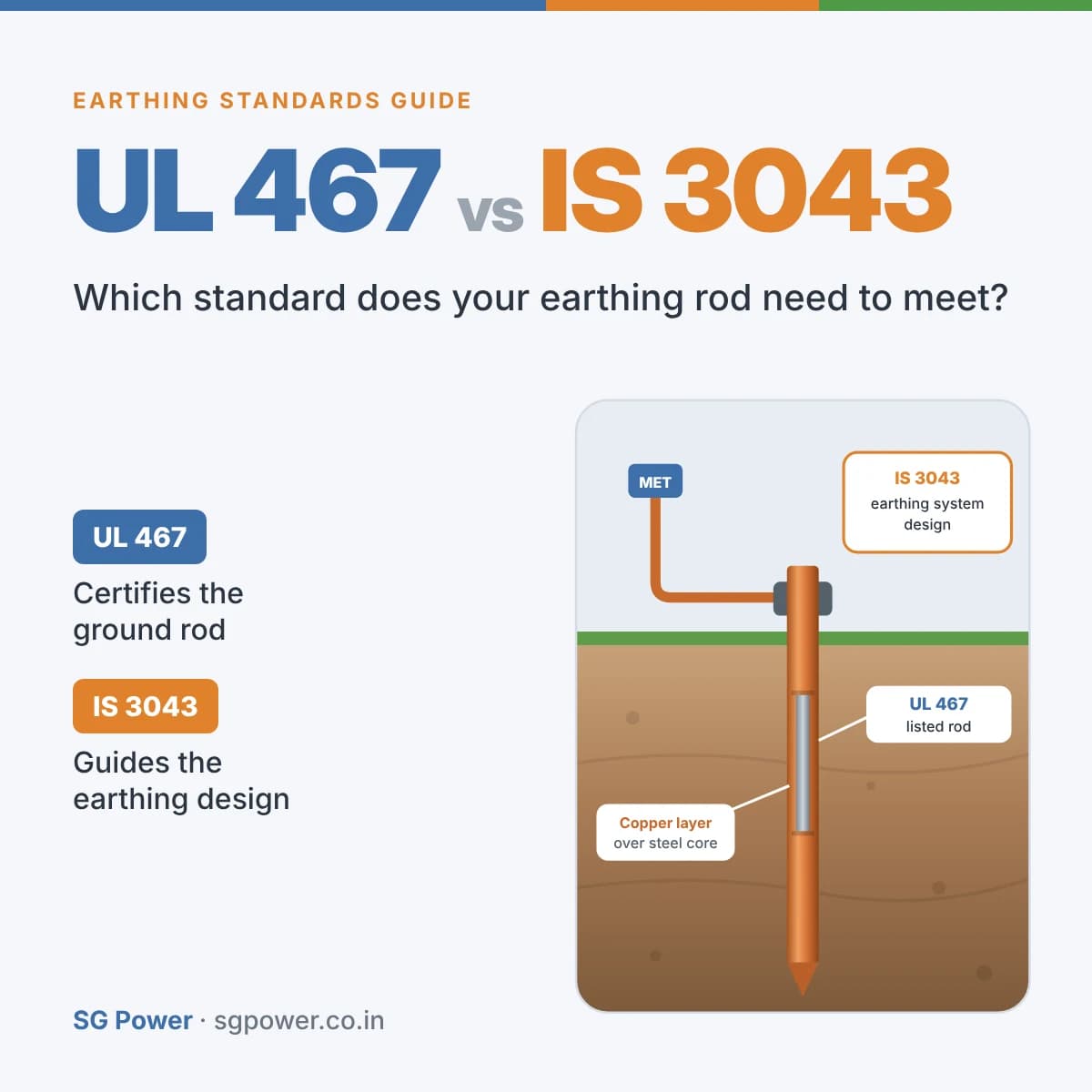
Confusing the two causes real problems. One project buys costly UL listed copper bonded rods it never needed. Another installs IS 3043 copper bonded rods and has its submittal rejected because the owner's spec asked for UL listing.
Already know what your spec needs?
UL 467 / UL listed: SG Power's UL listed copper bonded rods in 14, 17, 20 and 25 mm, UL File No. E511876, with submittal documents.
IS 3043 only: our copper bonded earth rods cost less where UL listing is not required.
Contents
- UL 467, IS 3043 and the other standards in an earthing spec
- UL 467 vs IS 3043 vs IEC 62561-2: side by side
- UL 467 and the other UL standards in a grounding spec
- IS 3043 vs IS 732
- UL 467 or IS 3043? How to read your project specification
- Can one rod meet UL 467 and IS 3043?
- What a real UL 467 certificate shows
- UL 467 vs IS 3043 on copper thickness
- How Indian tenders cite UL 467 and IS 3043 together
- Five UL 467 and IS 3043 specification mistakes
- 7 questions to ask your earthing rod supplier
- Key takeaways and glossary
- FAQs
- Related reading and products
- References
UL 467, IS 3043 and the Other Standards in an Earthing Spec
Indian earthing specifications usually cite one or more of four documents. Two are product standards, which set what the rod is. Two are design and installation codes, which set how it is used.
A note on words: US documents such as UL 467 and the NEC say grounding, ground rod and grounding electrode. Indian documents such as IS 3043 say earthing, earth rod, earthing rod or earth electrode. They mean the same thing, and this guide uses both.
What is UL 467? The product standard for UL listed rods
UL 467, Grounding and Bonding Equipment, sets the requirements a ground rod must meet to be UL listed. For copper bonded rods it covers copper thickness (10 mils, or 0.254 mm, minimum), adhesion of the copper, dimensions and marking. A rod is UL listed only when UL has tested it and recorded it under a UL file number, and UL then audits the factory periodically.
UL 467 at a glance
| Item | Detail |
|---|---|
| Full title | UL 467, Standard for Safety: Grounding and Bonding Equipment |
| Current edition | Edition 11, published 29 April 2022 (replaced Edition 10, 2013) |
| Published by | UL Standards & Engagement, as a tri-national standard |
| Codes it serves | NFPA 70 (US NEC), CSA C22.1 (Canadian Electrical Code), NOM-001-SEDE (Mexico); its Canadian product counterpart is CSA C22.2 No. 41 |
| Where to buy | ANSI Webstore or the UL Standards shop; it is a paid document |
UL 467 covers far more than ground rods. Its scope includes:
- Grounding electrodes, including copper bonded, stainless and galvanised ground rods
- Ground clamps and connectors that join grounding conductors to electrodes
- Bonding devices and grounding bushings for metal raceways
- Water-meter shunts and bonding devices for metal piping
- Intersystem bonding terminations for telecom, CATV and broadband
- Hospital grounding jacks and mating cord assemblies
For a copper bonded ground rod, UL 467 checks the copper thickness, how well the copper adheres when the rod is bent, the dimensions and the marking. Each listed rod must carry the UL mark within the top 12 inches (305 mm).
New to UL marks? Our guide what does UL listed mean explains UL listing, how it compares with BIS certification, and how to check a listing yourself.
NEC (NFPA 70): the US installation code
The National Electrical Code sets how ground rods are installed on US-standard projects. Article 250 covers rod length (at least 8 ft), soil contact, the 25-ohm single-rod rule and rod spacing. The NEC expects the rods to be listed, which is where UL 467 comes in.
NEC ground rod rules at a glance (NEC 250.52 and 250.53)
| Requirement | NEC rule |
|---|---|
| Minimum rod length | 8 ft (2.44 m) |
| Minimum diameter, steel rod | 5/8 inch (15.9 mm); 1/2 inch (12.7 mm) if listed |
| Soil contact | At least 8 ft of the rod in contact with soil |
| Rock at shallow depth | Drive at up to 45° from vertical, or lay in a trench at least 30 in (750 mm) deep |
| Single rod resistance | 25 ohms or less, or add a second electrode |
| Spacing of a second rod | At least 6 ft (1.8 m) apart |
| Electrodes not permitted | Metal underground gas piping; aluminium |
What is IS 3043? The Indian code of practice for earthing
IS 3043, the Code of Practice for Earthing published by BIS, is the main design reference for earthing in India. The current edition is IS 3043:2018, the second revision. It covers soil resistivity, earth electrode types, earth resistance calculations and installation. It is a design code: it does not certify a rod or give it a mark.
A draft third revision, Doc. ETD 20 (26877), was circulated for comment, with comments closing on 5 January 2025. Until BIS publishes it, specify IS 3043:2018. Its normative references do not list UL 467 or IEC 62561-2, so tenders that want those must name them separately.
IS 3043 at a glance
| Item | Detail |
|---|---|
| Full title | IS 3043:2018, Code of Practice for Earthing (Second Revision) |
| Published | 14 December 2018, by the Bureau of Indian Standards |
| Committee | Electrical Installations Sectional Committee, ETD 20 |
| Replaces | IS 3043:1987 (First Revision), still widely quoted in older tenders |
| Next edition | Third revision in draft, Doc. ETD 20 (26877) |
| Type | Code of practice (design guidance), not a product standard |
| Where to read it | BIS standards portal |
What IS 3043 covers
- Why and how systems and equipment are earthed
- Soil resistivity and how to measure it
- Earth electrode types, such as rods, pipe electrodes, plates and strips, and how to install them in earth pits
- Calculating and measuring earth resistance, and keeping touch and step voltages safe
- Earthing for substations, power stations, industrial plants, buildings and generators
- Inspection, testing and maintenance of earthing systems
What IS 3043 does not do
- It does not certify, test or mark any product
- It does not set one earth resistance value for every installation
- It does not replace UL 467, IEC 62561-2 or a test report as proof of rod quality
IEC 62561-2: the international component standard
IEC 62561-2 sets requirements for conductors and earth electrodes used in lightning protection systems. For copper bonded steel rods it calls for at least 250 microns of copper, close to UL's 254 microns. Many Indian and European rod datasheets cite it alongside IS 3043, often as BS EN 62561-2.
IEC standards you may see beside IS 3043
| Standard | What it covers |
|---|---|
| IEC 62561-2 | Conductors and earth electrodes for lightning protection, including copper bonded rods |
| IEC 62305-3 | Lightning protection design, including the earth-termination system |
| IEC 60364-5-54 | Earthing arrangements and protective conductors in low-voltage installations |
| BS EN 62561-2 | The British adoption of IEC 62561-2, common on UK- and Gulf-designed projects |
UL 467 vs IS 3043 vs IEC 62561-2: Side by Side
| Point | UL 467 | NEC (NFPA 70) | IS 3043 | IEC 62561-2 |
|---|---|---|---|---|
| Type of document | Product standard | Installation code | Design code of practice | Component standard |
| Published by | UL Standards & Engagement (US) | NFPA (US) | BIS (India) | IEC (international) |
| What it covers | What the rod is: materials, copper, marking | How rods are installed: length, depth, resistance | How the earthing system is designed and installed | What lightning protection earth electrodes must be |
| Copper bonded rod copper minimum | 10 mils (254 µm) | Rods must be listed | Refers to electrode materials; confirm clause | 250 µm |
| Certification or mark | Yes: UL listing, file number, UL mark | No; relies on listed products | No product mark | No mark; test reports from the maker or a lab |
| How a buyer verifies | UL file number in Product iQ | Inspector checks listed products | Design review by the consultant | Type test report |
| Typical projects in India | Data centres, oil and gas, multinational owners, overseas EPC | US-standard and owner-standard projects | Utilities, government, most commercial buildings | Lightning protection packages, European-led projects |
The short version: IS 3043 and the NEC tell you how to build the earthing system. UL 467 and IEC 62561-2 tell you what rod to build it with.
UL 467 and the Other UL Standards in a Grounding Spec
UL 467 is the standard for the ground rod and its clamp. A US-based earthing or lightning protection spec often cites other UL standards next to it, each for a different part of the system.
| Standard | What it covers | Where you meet it |
|---|---|---|
| UL 467 | Grounding and bonding equipment: ground rods, clamps, bonding devices | Earthing electrodes and their connections |
| UL 96 | Lightning protection components: air terminals, conductors, fittings | Lightning protection packages |
| UL 96A | Installation requirements for lightning protection systems | LPS design and inspection on US-standard projects |
| UL 486A-486B | Wire connectors for copper and aluminium conductors | Lugs and connectors on grounding conductors |
| UL 514B | Conduit, tubing and cable fittings | Raceway fittings, including grounding fittings |
| UL 2703 | Mounting systems and bonding devices for solar PV modules | Solar PV module frame bonding and racking |
Two points that often confuse buyers:
UL 467 vs UL 96. A ground rod in a lightning protection system is still a grounding electrode, so it is listed to UL 467. UL 96 covers the air terminals and conductors above ground.
UL 467 vs UL 2703 on solar projects. Bonding devices that connect PV module frames and racking are evaluated to UL 2703, not UL 467. The array earth rods remain UL 467 products.
IS 3043 vs IS 732: The Two Indian Codes Used Together
Indian electrical specifications often cite IS 3043 next to IS 732. They cover different parts of the same installation, and electrical inspectors check both.
| Point | IS 3043:2018 | IS 732:2019 |
|---|---|---|
| Title | Code of Practice for Earthing | Code of Practice for Electrical Wiring Installations |
| Covers | Earthing system design, electrodes, earth resistance, testing | Wiring, protection, cables, switchgear and safety in installations |
| Earthing content | Full detail on electrodes and earth resistance | Protective conductors and bonding inside the installation; points to IS 3043 for earthing |
| Rod or electrode choice | Electrode types and installation | Not covered in detail |
As a rule of thumb: IS 732 governs the wiring and protective conductors inside the installation, and IS 3043 governs the earthing system from the main earthing terminal to the electrode. UL 467 or IEC 62561-2 then covers the electrode itself, if your spec asks for them.
UL 467 or IS 3043? How to Read Your Project Specification
The earthing clauseof your specification, not habit or the supplier's default, decides which rod to buy. If the spec, the owner's engineering standard or the NEC asks for UL listing, buy UL listed rods. If not, an IS 3043 rod with the right test reports is usually enough.
Words that mean you need UL listed rods
- “UL listed”, “listed to UL 467” or “UL 467 listed ground rods”
- “Listed grounding electrodes” or “listed and labelled”
- “Installed per NEC Article 250” or “per NFPA 70”
- A reference to the owner’s global standard that calls for UL listed parts
Words that usually mean you do not
- “As per IS 3043” with no mention of UL
- “Copper bonded steel rod, 250 microns minimum” with an IEC or BS EN reference
- “Equivalent to UL 467” (raise a technical query: this usually means a test report is enough, but get it in writing)
If the wording is unclear, raise a technical query before you order. It costs a day; a rejected submittal costs weeks.
Which standard do different projects usually follow?
| Project type | Design basis | Rod usually specified |
|---|---|---|
| Data centres for global operators | IS 3043 or NEC, plus owner standard | UL listed to UL 467 |
| Oil, gas and petrochemical | Owner or international EPC spec | UL listed to UL 467 |
| Indian Railways signalling | IS 3043 and RDSO/SPN/197 | UL listed, 250 µm, 17 mm x 3 m minimum |
| Multinational factories and campuses | IS 3043 plus corporate standard | UL listed to UL 467 |
| Solar parks | IS 3043, lender or owner spec | Varies; UL 467 or IEC 62561-2 rods |
| Lightning protection packages | IS/IEC 62305 | IEC 62561-2 rods, sometimes UL listed |
| Government and PSU buildings | IS 3043 and IS 732 | Copper bonded rods to IS 3043, with test reports |
| Commercial and residential buildings | IS 3043 and IS 732 | Copper bonded or GI earth rods to IS 3043 |
This is a guide to what is common, not a rule. Your project specification always decides.
Can One Rod Meet UL 467 and IS 3043?
Yes. This is the most common case on multinational projects in India. The earthing system is designed to IS 3043, and the electrodes are UL listed rods. The two do not conflict: IS 3043 sets the design, UL 467 certifies the rod.
A UL listed copper bonded rod with at least 254 microns of copper also clears the 250-micron minimum in IEC 62561-2. So one well-made rod can be submitted against all three, as long as the maker holds the paperwork for each:
| To satisfy | Document to ask for |
|---|---|
| UL 467 | UL file number that covers the exact size, plus the UL mark on each rod |
| IEC / BS EN 62561-2 | Type test report from the maker or an accredited lab |
| IS 3043 design | Datasheet showing rod material, size and copper thickness for the design review |
One caution: the UL listing covers only the sizes in the listing. A custom length made to fit an IS 3043 design is not UL listed, even if it uses the same steel and copper. Check the size against the file number before you order.
What a Real UL 467 Certificate Shows: SG Power's Example
A genuine UL 467 certificate names the standard and edition, the maker, the UL file number and the exact models covered. This is what SG Power's UL Certificate of Compliance for copper bonded ground rods, dated 2 July 2024, states:
| Item | United States | Canada |
|---|---|---|
| Certificate number | UL-US-L511876-11-41210202-2 | UL-CA-L511876-31-41210202-2 |
| UL file / report reference | E511876 (report E511876-20201214) | E511876 (report E511876-20201214) |
| UL category code | KDER: Grounding and Bonding Equipment | KDER7: Grounding and Bonding Equipment Certified for Canada |
| Standard | UL 467, Edition 11, issued 29 April 2022 | CSA C22.2 No. 41:22, 7th Edition, issued 29 April 2022 |
| Issued to | SG Power Products Pvt. Ltd., Duhai Industrial Area, Ghaziabad, Uttar Pradesh | Same |
| Models covered | Copper bonded grounding rods SGPCBR-1403, SGPCBR-1703, SGPCBR-2003, SGPCBR-2503 (14, 17, 20 and 25 mm) | Same four models |
How to read any UL 467 certificate
Use SG Power's certificate as a template when you check any supplier's paperwork:
File number: the UL file number (here E511876) is what you search in UL Product iQ. It must show the same company.
Category code: KDER means Grounding and Bonding Equipment. A certificate under a different category does not cover ground rods.
Standard and edition: it should name UL 467 and its edition, here Edition 11 (2022).
Models: your rod’s model and size must appear on the addendum page. A size that is not listed is not covered.
Certificate vs UL mark: UL states that a Certificate of Compliance “does not provide authorization to apply the UL Mark”. Only products bearing the UL Mark are covered by UL’s follow-up services, so check the mark on every rod too.
US and Canada: a “UL-CA” certificate to CSA C22.2 No. 41 means the same rods are also certified for Canada, which helps on projects for North American owners.
Our guide on UL listed vs UL recognized vs UL classified covers which marks to accept on a submittal, and which to send back.
UL 467 vs IS 3043 on Copper Thickness: 100, 250 or 254 Microns
Copper thicknessis where most “UL 467 vs IS 3043” confusion turns into a buying mistake. Indian suppliers sell copper bonded rods from about 100 microns up to 250 microns or more. Only the upper end meets the product standards.
| Copper thickness on the quote | Meets UL 467 (10 mil = 254 µm)? | Meets IEC 62561-2 (250 µm)? | Typical use |
|---|---|---|---|
| 100 to 200 µm | No | No | Budget earthing where no product standard is specified |
| 250 µm | Only if the rod is UL listed, so the listing confirms it | Yes | IEC-based and many Indian tender specs, including RDSO |
| 254 µm (10 mil) or more, UL listed | Yes | Yes | UL-specified, NEC and multinational projects |
Three points to take from this table:
- A thickness figure alone never proves UL 467. Only a UL listing does, checked by file number.
- “250 micron” and “10 mil” are often used as if they were the same. On a UL project, ask for the listed thickness, not a rounded figure.
- A 100-micron rod sold “as per IS 3043” meets neither product standard. Thinner copper also wears through sooner in corrosive soil.
Working in highly corrosive or saline soil? Compare solid copper earth rods, and use earth enhancing compound where the soil resistivity is high.
How Indian Tenders Cite UL 467 and IS 3043 Together
Many Indian government and PSU specifications cite IS 3043 for the design and UL 467 for the electrode in the same clause. The clearest example is Indian Railways signalling.
Example: RDSO/SPN/197 (Indian Railways signalling earthing)
RDSO/SPN/197, the Code of Practice for Earthing & Bonding System for Signalling Equipments (Version 1.0, July 2016), lists IS 3043, ANSI/UL 467 and IEC 62561-2 as its reference standards. For the earth electrode it asks for:
| Requirement | RDSO/SPN/197 |
|---|---|
| Electrode | High-tensile low-carbon steel, copper bonded |
| Standards | UL 467 (2007 or later) and IEC 62561, UL listed |
| Diameter | 17.0 mm minimum |
| Length | 3 m minimum (a grid of three 1 m rods in rocky ground) |
| Copper | 250 microns minimum, 99.9% electrolytic grade |
| Marking | UL mark, maker, length, diameter and catalogue number on every electrode |
| Earth resistance | 1 ohm or less at the main equipotential earth busbar |
Government e-Marketplace (GeM) BoQ documents for chemical earthing often cite “IS 3043 Code of practice for earthing” and “ANSI/UL 467” side by side in the same way. For background on chemical earthing, see our chemical earthing electrode guide.
Sample specification clause
Consultants who want a UL listed rod in an IS 3043 design can adapt this wording. Replace the bracketed values with your own:
Earth electrodes shall be copper bonded steel rods, UL listed to UL 467, with a minimum copper thickness of 0.254 mm (10 mils), and of [diameter] x [length]. The supplier shall submit the UL file number covering the offered size. The earthing system shall be designed and installed to IS 3043:2018.
Supplying to an RDSO or UL-specified tender? SG Power's UL listed copper bonded rods come in 14, 17, 20 and 25 mm diameters under UL File No. E511876. See sizes and specifications.
Five UL 467 and IS 3043 Specification Mistakes to Avoid
Treating “UL 467 compliant” as UL listed. Only a UL file number in UL Product iQ proves a listing. A maker's own claim of compliance does not.
Asking for UL listing on a purely IS 3043 project. It raises cost with no benefit if neither the owner nor the consultant needs it.
Copying NEC values into an IS 3043 design. NEC’s 8 ft rod and 25-ohm rule are US installation rules. An IS 3043 design sets its own target resistance from soil data and fault current.
Ordering custom lengths for a UL project. Sizes outside the listing are not UL listed, and the rods may be rejected at inspection.
Forgetting the accessories. If the spec asks for a fully listed system, couplers and earthing clamps must be UL listed too, not only the rods.
Your spec calls for UL listed rods? SG Power makes UL listed copper bonded rods to UL 467 under UL File No. E511876, in 14, 17, 20 and 25 mm diameters, with documents for your submittal.
Designing to IS 3043 only? See our standard copper bonded earth rods.
7 Questions to Ask Your Earthing Rod Supplier About UL 467 and IS 3043
Whichever standard your spec names, these seven questions sort genuine suppliers from the rest.
What is your UL file number, and does it cover this exact size? Search it in UL Product iQ before you place the order.
What is the minimum copper thickness, in microns or mils? Ask for 254 microns (10 mils) for UL 467, or 250 microns for IEC 62561-2.
Can you share a type test report to IEC 62561-2? You need it if your spec cites IEC or BS EN 62561-2.
Is the copper molecularly bonded or a clad sleeve? Bonded copper will not slip or tear when the rod is driven.
Are the threads rolled or cut? Rolled threads keep the copper layer intact; cut threads expose steel.
Are couplers and clamps listed too? A fully listed system needs listed accessories, not only listed rods.
Which documents come with the offer? Expect the UL listing, datasheet, test reports, MTC and a QAP if your project needs one.
Ask SG Power these seven questions. Our offers answer each one in writing, with UL File No. E511876 and the documents for your submittal.
Key Takeaways: UL 467 vs IS 3043
The UL 467 vs IS 3043 question comes down to one idea: IS 3043 tells you how to design the earthing system, and UL 467 proves the ground rod you build it with. Six points to remember:
UL 467 certifies the rod; IS 3043 guides the design. They are not alternatives, and many Indian projects need both.
Only a UL file number proves UL 467. “UL 467 compliant” or “as per UL” without a file number in Product iQ is not a listing.
IS 3043:2018 is the current edition. The 1987 edition is superseded, and a third revision is in draft.
Copper thickness: UL 467 needs 254 microns (10 mils), IEC 62561-2 needs 250 microns, and a 100-micron rod meets neither.
Read the spec first. Buy UL listed rods only when the spec, the owner’s standard or the NEC asks for them.
Check the size against the listing. A custom length outside the UL listing is not UL listed.
Glossary
| Term | Meaning |
|---|---|
| Code of practice | A document that guides how to design and install a system, such as IS 3043. It does not certify products. |
| Product standard | A document that sets what a product must be, such as UL 467 or IEC 62561-2. |
| UL listed | Tested by UL to a standard, recorded under a UL file number, with periodic factory follow-up. |
| UL file number | UL’s reference for a maker’s listing, searchable in UL Product iQ. |
| Mil | One thousandth of an inch, or 25.4 microns. 10 mils = 0.254 mm. |
| Copper bonded rod | A steel rod with copper molecularly bonded to its surface. |
| Main earthing terminal (MET) | The terminal or busbar where protective conductors, bonding conductors and the earthing conductor meet. |
| Earth resistance | The resistance between the earth electrode and the general mass of earth, measured in ohms. |
| Soil resistivity | How strongly the soil resists current, measured in ohm-metres. It decides how many rods, and how deep, a design needs. |
| NEC | National Electrical Code (NFPA 70), the US installation code. |
| RDSO | Research Designs and Standards Organisation, the Indian Railways technical body. |
FAQs: UL 467 vs IS 3043
References
- UL Standards & Engagement, UL 467: Grounding and Bonding Equipment
- NFPA, NFPA 70: National Electrical Code, Article 250
- Bureau of Indian Standards, IS 3043:2018: Code of Practice for Earthing (Second Revision)
- Bureau of Indian Standards, Draft IS 3043 Third Revision, Doc. ETD 20 (26877)
- IEC, IEC 62561-2: Lightning protection system components, requirements for conductors and earth electrodes
- RDSO, RDSO/SPN/197: Code of Practice for Earthing & Bonding System for Signalling Equipments, Version 1.0
- UL Solutions, Product iQ certification database