
By SG Power Products Pvt. Ltd. | Last updated: 24 October 2026
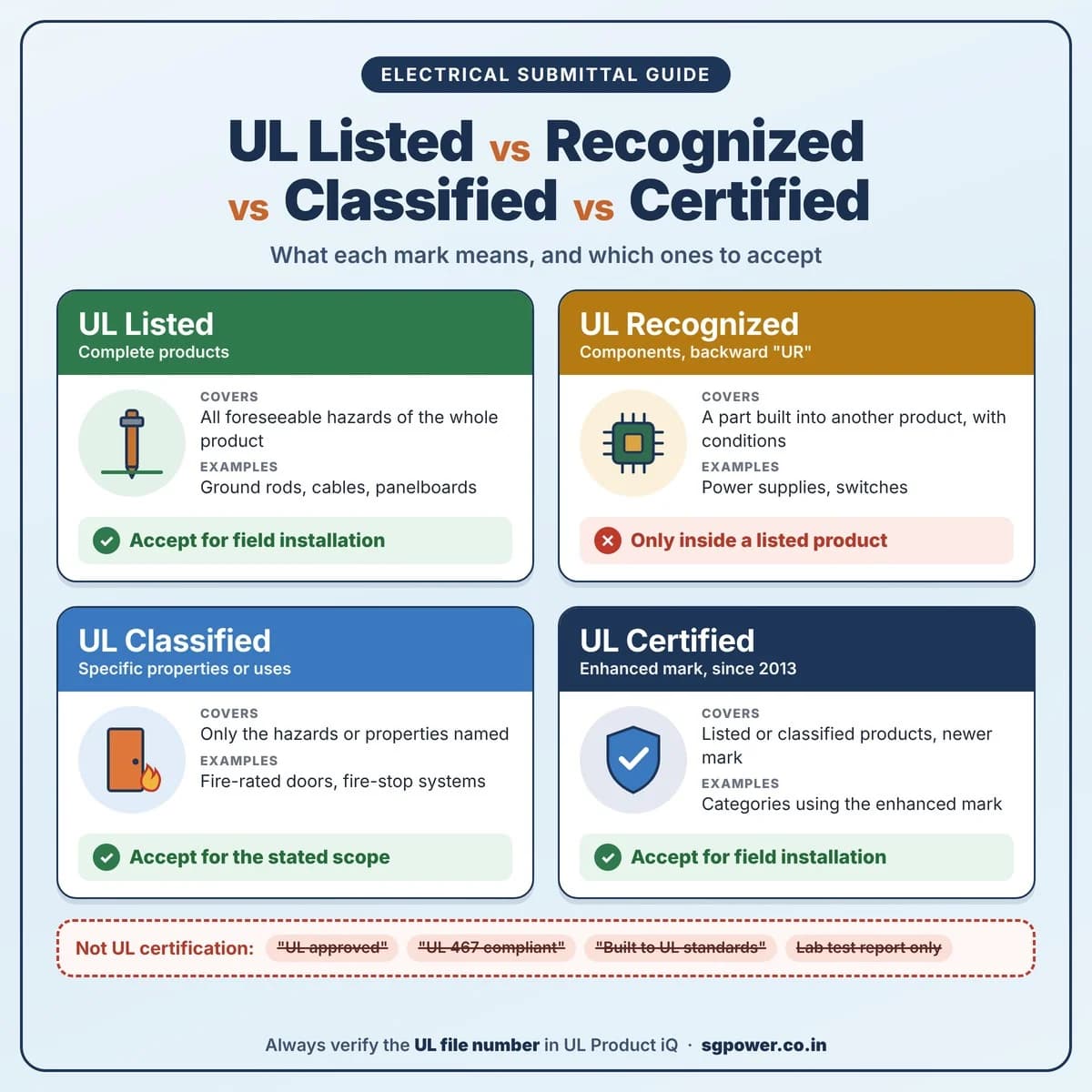
What is the difference between UL listed and UL recognized? UL listed means a complete product is certified for installation in the field; UL recognized means a component is certified only for use inside another product. UL classified products are certified for specific properties, such as fire resistance, while a product described as “UL 467 compliant” or “UL approved” has no UL certification at all. On any submittal, the deciding test is a valid UL file number that covers the exact product you are buying.
This guide is for consultants, EPC engineers and procurement teams who review datasheets and submittals. It sets out what each mark means, which ones meet the NEC, the red flags to watch for, and a checklist you can use on your next approval. If you are new to the topic, start with What Does UL Listed Mean?. If you are sourcing earthing materials, see our page as a UL listed copper bonded rod supplier.
Accept for field-installed products: UL Listed, UL Classified (for the property or use it is classified for), and the enhanced UL Certified mark.
Accept only inside a listed product: UL Recognized Component (backward “UR” mark).
Do not accept as certification: “UL approved”, “UL 467 compliant”, “built to UL standards”, “UL grade”, a lab test report, or a UL Verified marketing claim.
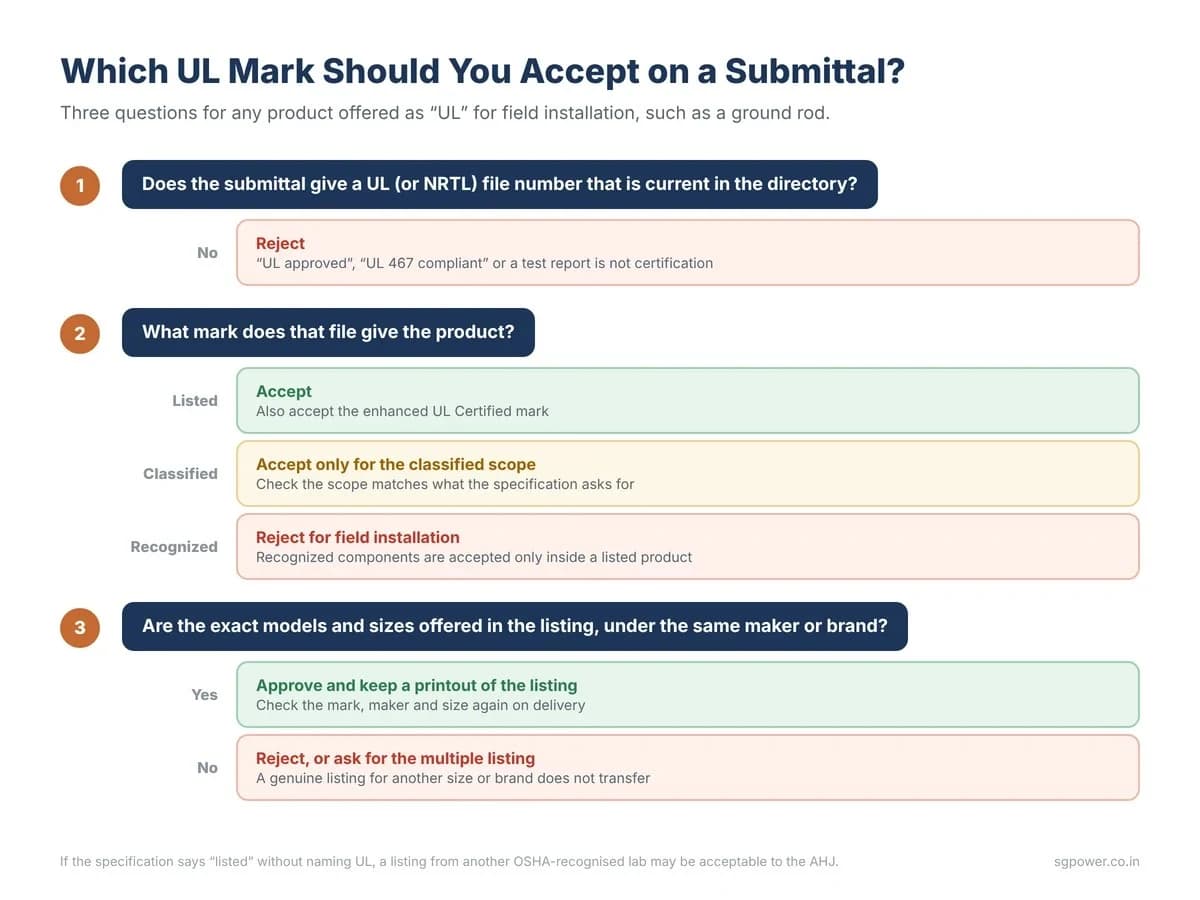
Always check: the file number in UL Product iQ covers the company, the product category and the exact model and size.
If the specification says “listed” without naming UL: a listing from another OSHA-recognised laboratory may be acceptable to the authority having jurisdiction.
| Item | SG Power UL listed copper bonded rods |
|---|---|
| Standard | UL 467, Grounding and Bonding Equipment |
| UL File No. | E511876 |
| UL category | KDER (US) and KDER7 (Canada), Grounding and Bonding Equipment |
| Sizes | 14, 17, 20 and 25 mm diameters |
| Submittal documents | UL listing, Product iQ printout, datasheet and test certificates |
| Supply | Project orders across India |
| UL Listed | UL Recognized Component | UL Classified | UL Certified (enhanced mark) | |
|---|---|---|---|---|
| What is evaluated | The complete product for its foreseeable hazards | A part, for use inside a specific type of end product | Specific hazards, properties or uses only | Listed or classified certifications shown in a newer mark design |
| Intended use | Field installation as a stand-alone product | Factory installation inside other equipment | Field use within the classified scope | As for the listing or classification it carries |
| Mark | UL symbol with “Listed”, product name and control number | Backward “UR” symbol | UL symbol with “Classified” and a scope statement | UL symbol, “Certified”, attributes, country codes and unique ID; optional QR code |
| Factory follow-up | Yes | Yes | Yes | Yes |
| Meets NEC “listed” | Yes | No, not on its own | Yes | Yes |
| Examples | Ground rods, cables, panelboards, luminaires | Internal power supplies, switches, insulating materials | Fire-stop systems, fire-rated doors | Any product category that has adopted the enhanced mark |
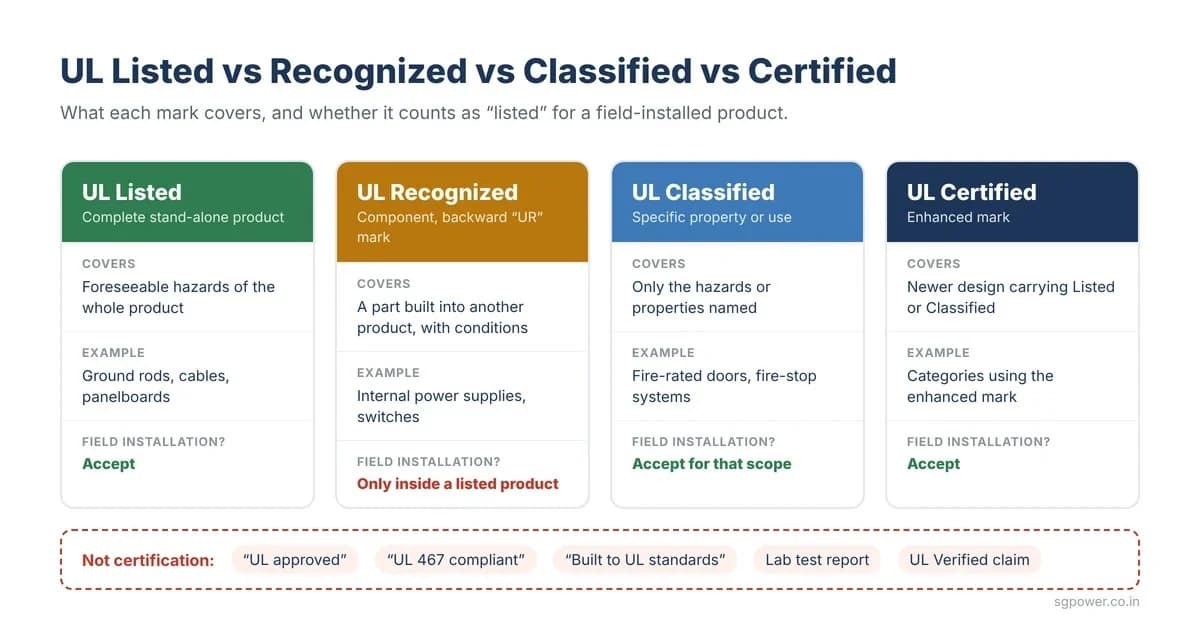
Each mark also comes in country versions: for the US only, for Canada only (with a small “C”), or for both (“C-UL-US”). Check that the version on the product matches the market your specification follows.
UL is short for Underwriters Laboratories, so the full form of “UL listed” is “listed by Underwriters Laboratories”. For a plain introduction to the marks, read What Does UL Listed Mean?.
The NEC (NFPA 70) defines “listed” in Article 100 as equipment included in a list published by an organisation that evaluates products and periodically inspects their production. That organisation must also be acceptable to the authority having jurisdiction (AHJ), meaning the inspector, consultant or owner's engineer who approves the installation. UL's guidance to code officials states that:
UL Listed meets the definition.
UL Classified also meets the definition, within the scope of the classification.
UL Certified (the enhanced mark) carries the same meaning as Listed or Classified.
A UL Recognized Component mark alone is not evidence of listing or labeling. Recognized components have not been evaluated as stand-alone products for field installation.
Two other NEC terms matter on a submittal:
| NEC term | Meaning | Who decides |
|---|---|---|
| Listed | In a published list from a certifying organisation with factory follow-up | The certifier (UL or another NRTL) |
| Labeled | Carries the certifier’s label or mark | The certifier |
| Identified (for the use) | Recognisable as suitable for a specific purpose, environment or application | Shown by the listing, marking or instructions |
| Approved | Acceptable to the authority having jurisdiction | The AHJ (inspector, consultant or owner’s engineer) |
A listing is evidence for approval, not approval itself. Under NEC 110.3(B), listed equipment must be installed and used according to the instructions in its listing.
A UL listed product has been evaluated as a complete product for the hazards reasonably expected in its intended use, such as fire, electric shock and mechanical failure. It can be installed in the field according to its instructions and the applicable code.
What to check on a listed product:
Scope: only the models and sizes in the file are listed, not the maker’s whole range.
Conditions of use: some listings are limited to dry, damp or wet locations, or to certain conductor sizes or materials.
Combinations: a listed rod does not make a non-listed clamp listed. If the specification asks for a fully listed system, each part needs its own listing.
A UL Recognized Component is a part that UL has evaluated for use inside another product, often with conditions of acceptability that the end-product maker must meet. Typical examples are internal power supplies, switches, terminal blocks and insulating materials. The mark is a reversed “UR” symbol, a backwards R followed by a U, so some guides call it the “RU” mark.
Recognition makes it easier for the end product to be listed, because UL has already examined the part. However, it does not tell an inspector that the part is safe on its own in the field.
Listed is not a sign of higher quality than recognized. The two marks cover different uses: one for a complete product installed on site, the other for a part built into equipment at the factory.
On a submittal:
Accept a recognized component when it is built into a listed assembly by the assembly's maker.
Do not accept it as a substitute where the specification asks for a listed product installed on site.
If the same part is offered as both, check which mark covers the version being supplied. Some products, such as external power adapters, are listed while similar internal versions are only recognized.
The same kind of product can be listed in one form and only recognized in another. Check the mark on the exact version offered.
| Product | Usually UL listed when… | Usually only UL recognized when… |
|---|---|---|
| Power supply | It is an external adapter or DIN-rail unit installed on its own | It is an open-frame unit built inside equipment |
| Wire and cable | It is building wire or cable for field installation | It is appliance wiring material used inside equipment |
| Switches and terminal blocks | They are sold as complete field devices in their own enclosures | They are parts built into a panel or machine |
| Grounding and bonding equipment | Ground rods, clamps and connectors installed on site | Rarely; field earthing parts are normally listed to UL 467 |
Industrial control panels show how the two marks work together. A panel built to UL 508A by a UL-authorised panel shop can be listed as a complete panel even though many parts inside it are only UL recognized, as long as each part is used within its conditions of acceptability. The listing covers the finished panel, not each part on its own.
A UL Classified product has been evaluated only for specific hazards, properties or conditions of use, such as fire resistance, rather than for every foreseeable hazard. The mark carries a statement of the scope it was classified for. That scope is the key point in any UL listed vs UL classified comparison: a listing covers the whole product, while a classification covers only what it names.
On a submittal: accept a classified product for the property it is classified for, and check that this matches the requirement. A fire-stop system classified for a fire rating says nothing about its electrical safety, and vice versa.
Since 2013, UL has offered an enhanced mark that reads “UL Certified” and shows the certified attributes (such as safety), country codes (such as US and CA) and a unique identifier, usually the file number. A smart version adds a QR code that links to a certification page.
UL treats “Certified” as covering both Listed and Classified, so the enhanced mark carries the same meaning. The older Listing and Classification marks remain valid, so you may see both on similar products from different makers.
These phrases often appear on Indian datasheets and quotations. None of them is a UL certification.
| Claim | Why it is not UL certification | What to ask for |
|---|---|---|
| “UL approved” | UL lists, classifies or certifies; it does not approve | The UL file number |
| “UL 467 compliant”, “conforms to UL 467”, “UL grade”, “built to UL standards” | The maker’s own claim that it follows the standard; no UL testing or follow-up | The UL file number, or a listing from another NRTL if the specification allows it |
| “Tested to UL 467” with a lab report | A one-time test of samples, possibly by a lab that is not UL | The listing, not the report |
| “Made with UL recognized components” | The parts are recognized; the finished product is not listed | A listing for the finished product |
| “UL Verified” | A verified marketing or performance claim, not a safety certification | A listing or classification for the safety requirement |
| A UL logo on a website or brochure only | Marks must be on the product itself | The mark on the product and the file in Product iQ |
A CE mark is often offered in place of a UL listing on imported products. They are not interchangeable.
| UL listed | CE marked | |
|---|---|---|
| Who checks the product | UL, an independent laboratory, with factory follow-up | Usually the maker’s own declaration; a notified body only for some product types |
| Market it is for | North America (NEC and US or Canadian codes) | European Union |
| Meets a “UL listed” specification | Yes | No |
| Checkable online | Yes, in UL Product iQ | Only the maker’s declaration of conformity, on request |
| What the supplier provides | Specification says “UL listed” | Specification says “listed” (no lab named) | Specification names IS 3043 only |
|---|---|---|---|
| UL Listed or UL Certified, file covers the product and size | Accept | Accept | Accept (more than required) |
| UL Classified, scope matches the requirement | Accept for that scope | Accept for that scope | Accept |
| Listing by another NRTL (such as CSA or Intertek ETL) | Reject unless the specification allows “or equivalent” | Accept if the AHJ accepts that lab | Accept |
| UL Recognized Component only, field-installed | Reject | Reject | Check against IS requirements |
| “UL 467 compliant” or a test report only | Reject | Reject | Check against IS requirements |
| File number missing, under another company, or not covering the size | Reject until clarified in writing | Reject until clarified | Not relevant |
If your specification names IS 3043 only, standard copper bonded earth rods built to IS 3043 may be more economical than UL listed rods.
UL is one of several laboratories recognised by OSHA in the US as a Nationally Recognized Testing Laboratory (NRTL); others include CSA Group and Intertek. OSHA considers NRTLs recognised for the same test standard to be equivalent in their capability to certify to it. Whether you name UL or allow any NRTL is a specification choice.
To check a listing from another laboratory, search Intertek's online directory of listed products or CSA Group's certified product listings, just as you would search UL Product iQ.
Looking for UL listed companies? Search UL Product iQ by product category rather than by brand. For ground rods, open the grounding and bonding equipment category: the results list every company that holds a current listing, with its file number.
| Wording | Effect |
|---|---|
| “UL listed to UL 467” | Only a UL listing meets it. Narrowest choice of vendors |
| “Listed to UL 467 by a Nationally Recognized Testing Laboratory acceptable to the Engineer” | Any NRTL listing to UL 467 meets it. Wider choice; reviewer checks the lab |
| “Conforming to UL 467” | Weak: a maker’s own claim may be argued to meet it. Avoid if you need certification |
Sample clause for grounding electrodes (have your consultant adapt it):
“Ground rods shall be copper bonded steel, listed to UL 467 by a Nationally Recognized Testing Laboratory, and marked with the certification mark, the manufacturer's name or trademark and the rod size. The submittal shall include the certification file number and the directory listing showing the sizes offered. Earthing design shall follow IS 3043.”
Some products are made by one company and sold under another brand. UL can cover this through a multiple listing, where the product appears under the selling company's name but is linked to the original maker's file. UL notes that its enhanced marks no longer use four-character control numbers, except for products under multiple listing.
On a submittal: if the brand on the product is not the company named in the main file, ask the supplier to show the multiple listing or the brand's own entry in Product iQ. A listing in someone else's name, with no visible link to the brand supplied, is a red flag.
If a product arrives on site without a valid mark, or has been modified after manufacture, the authority having jurisdiction may ask for a UL field evaluation. UL evaluates the installed product against the same requirements used for listing and, if it complies, applies a Field Evaluated Product mark at the site. Only products that can be fully evaluated on site are eligible.
A field evaluation costs time and money and is no substitute for buying listed products. It is a fallback for one-off equipment, not a routine route for bulk items such as ground rods.
A data centre specification asks for “copper bonded ground rods, UL listed to UL 467, 3/4 inch x 10 ft”. Three vendors submit:
| Vendor A | Vendor B | Vendor C | |
|---|---|---|---|
| Datasheet claim | UL listed, with a UL file number | “Conforms to UL 467”, copper 254 microns | UL listed, with a UL file number |
| Product iQ check | File found, company matches, 3/4 in x 10 ft listed | No file | File found, but only 5/8 in sizes listed |
| Mark on sample rod | UL mark, maker, size near top end | Maker’s name and size only | UL mark, maker, size |
| Decision | Accept | Reject: no listing, however good the coating | Reject for 3/4 in, or ask whether 5/8 in is acceptable to the consultant |
Vendor B may make a good rod, but the specification asked for proof, not a promise. Vendor C shows why the size check matters: a valid file is not enough if it does not cover what you are buying.
For UL listed copper bonded rods with the listing documents ready for submittal, see our UL listed copper bonded rods page.
Sourcing UL listed ground rods for a submittal? SG Power supplies UL 467 listed copper bonded rods in 14, 17, 20 and 25 mm diameters (UL File No. E511876), with the UL listing, Product iQ printout, datasheet and test certificates ready for your consultant.
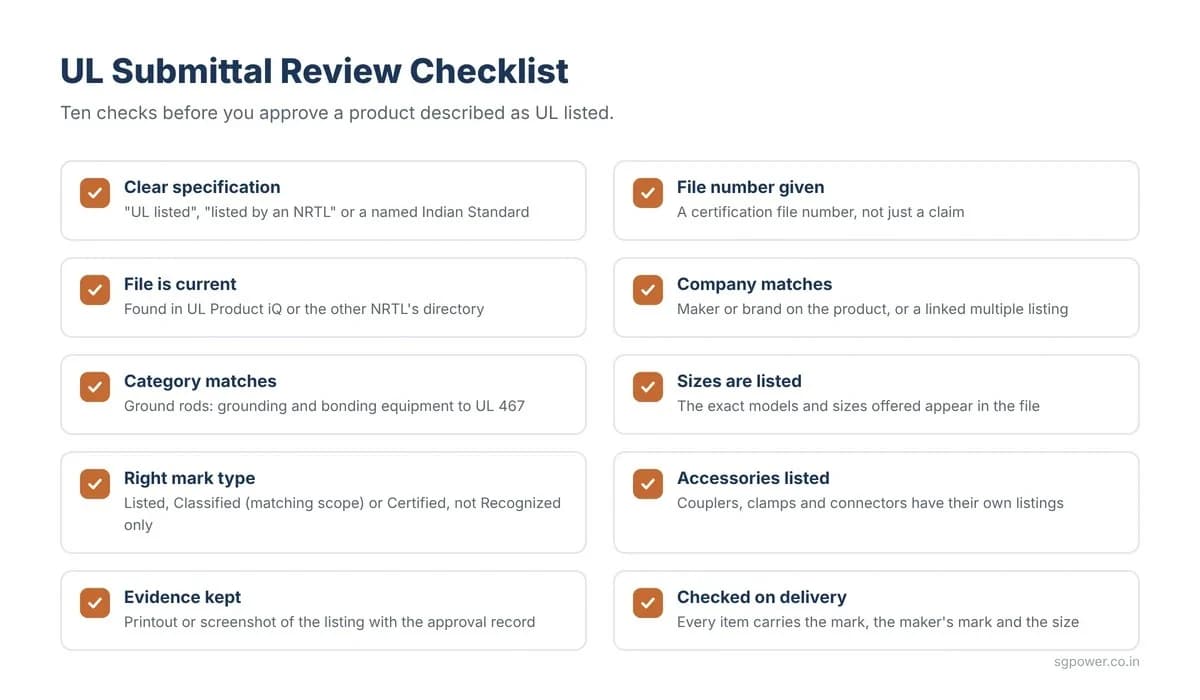
View UL Listed Copper Bonded RodsThe specification clause is clear: “UL listed”, “listed by an NRTL”, or a named Indian Standard.
The submittal gives a certification file number, not just a claim.
The file is found in UL Product iQ (or the other NRTL’s directory) and is current.
The company name matches the maker or brand on the product, or a multiple listing links them.
The product category matches the item (for ground rods, grounding and bonding equipment to UL 467).
The exact models and sizes offered are in the listing.
The mark type is Listed, Classified (with matching scope) or Certified, not Recognized only.
Accessories required to be listed (couplers, clamps, connectors) have their own listings.
A printout or screenshot of the listing is kept with the approval record.
On delivery, every item carries the certification mark, maker’s mark and size.
SG Power Products Pvt. Ltd., based in Noida, Uttar Pradesh, makes earthing and lightning protection materials under the SGP brand. Its range includes copper bonded earth rods in 14 to 32 mm diameters, chemical earthing electrodes, earth enhancing compound and earth pit covers.
Quality system: ISO 9001:2015 certified for chemical earthing electrodes, copper bonded rods, earth pit covers, earthing compound and lightning arresters.
Clients: Siemens, Aditya Birla Group, JSW Steel, Hindalco Industries, JK Cement and Ratnamani Metals & Tubes, among others.
Exports: Saudi Arabia and Kenya, where projects often follow US or international specifications.
Buyer rating: 4.2 from 131 buyer ratings on IndiaMART.
For projects that call for UL certified earthing, see our page as a UL listed copper bonded rod supplier.
What Does UL Listed Mean? — the basics, and UL compared with BIS.
UL listed copper bonded rods — listed sizes, listing details and submittal documents.
Copper bonded earth rods — for projects that specify IS 3043 only.
Earthing clamps — for rod-to-conductor connections.
Exothermic welding system — for permanent joints.
Send your specification clause and bill of quantities. Our engineers will reply with a compliance statement against each line, the UL listing details for every item offered, and a quotation.
This guide is based on the following published sources, together with SG Power's experience supplying earthing materials for projects with UL requirements.