
By SG Power Products Pvt. Ltd. | Last updated: 24 October 2026
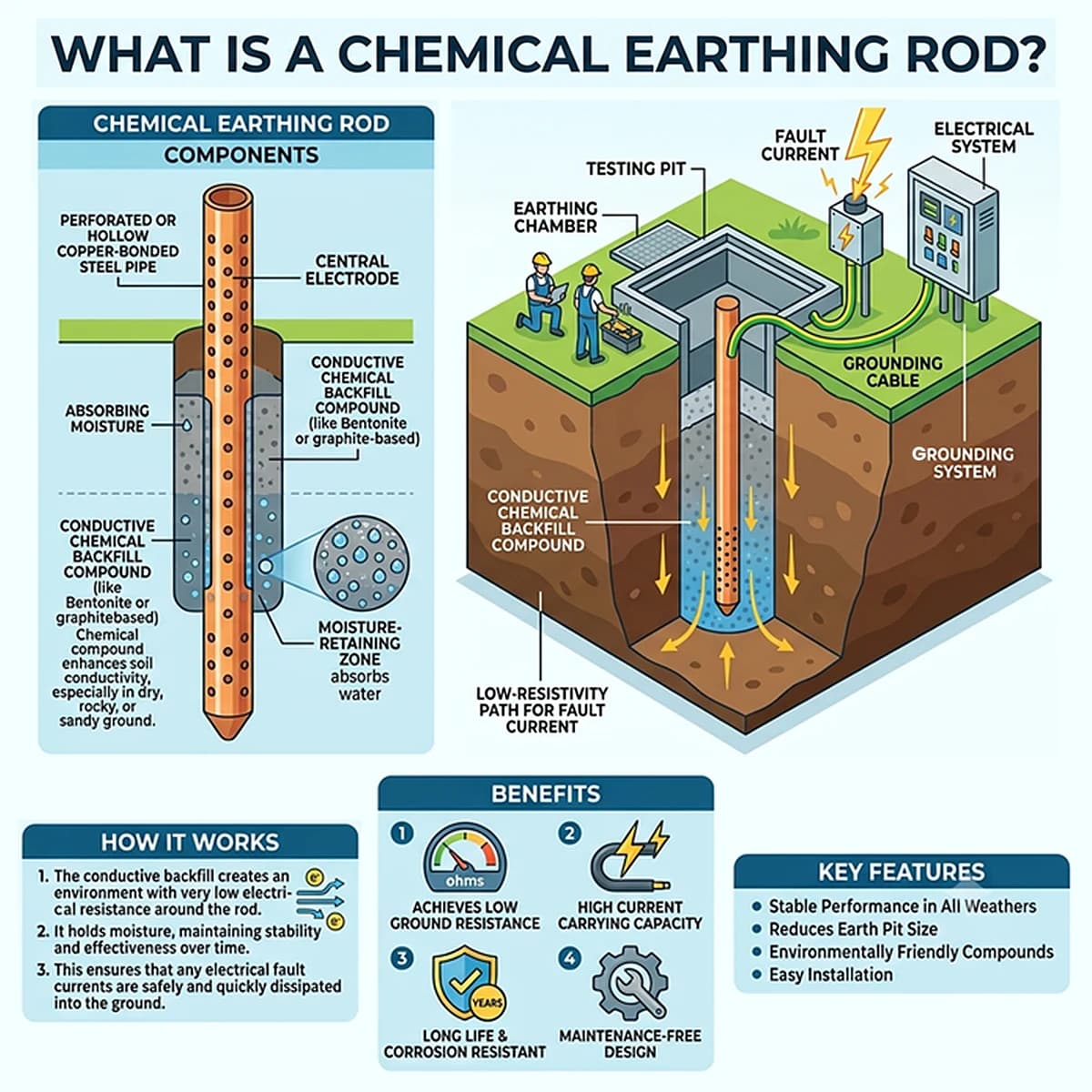
A chemical earthing rod is a sealed metal pipe, usually GI, copper bonded or pure copper, filled with a crystalline conductive compound and installed vertically in a bore packed with earth enhancing compound. It carries fault and lightning current into the soil and keeps earth resistance low and stable through the year, without the salt, charcoal and regular watering that old pipe earthing needs. It is also called a chemical earth electrode or maintenance-free earthing electrode.
This guide explains what is inside a chemical earthing rod, the main types and sizes, how it is made and tested, why prices vary so much, and how to check quality before you buy. If you already know what you need, see our range as one of India's chemical earthing rod manufacturers.
What it is: a sealed pipe electrode with a conductive compound inside, set in earth enhancing compound in the ground.
Materials: GI (lowest cost), copper bonded steel (most common for industry) and pure copper (critical and corrosive sites).
Constructions: standard (single pipe), pipe in pipe and strip in pipe.
Common sizes: 1 m, 2 m and 3 m long; about 50 mm, 76 to 80 mm and 100 mm in diameter.
Coating: at least 250 microns of copper on copper bonded rods (IEC 62561-2); a hot-dip zinc coating on GI rods.
What decides quality: pipe wall thickness, coating thickness, the compound inside, the terminal and the end seals.
| Item | SG Power TRUESAFE chemical earthing rods |
|---|---|
| Materials | GI, copper bonded and pure copper |
| Constructions | Standard, pipe in pipe and strip in pipe |
| Core | Sealed pipe filled with a crystalline conductive compound |
| Quality | Made in-house, with a 3-level quality check before dispatch |
| Supply | Project and bulk orders across India |
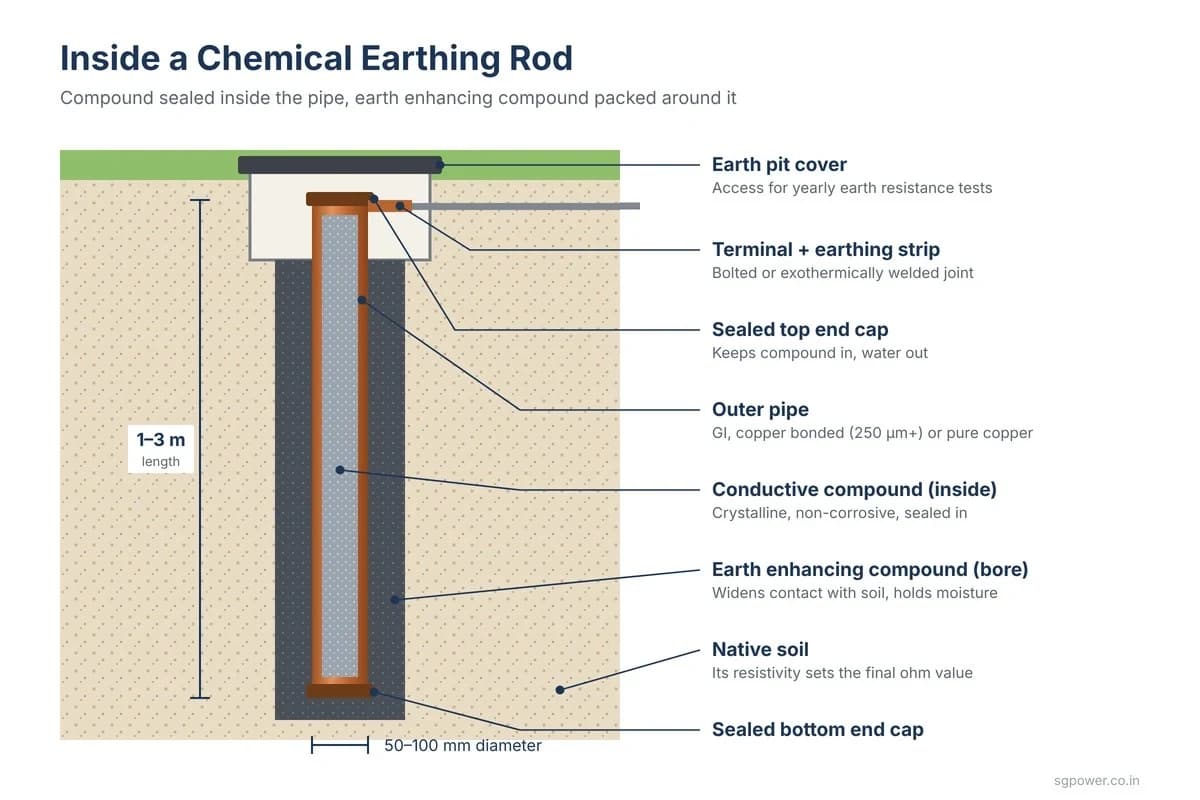
Every chemical earthing rod has six parts, and the quality of each one decides how long the rod lasts and how well it carries fault current.
| Part | What it is | What to look for |
|---|---|---|
| Outer pipe | GI, copper bonded steel or pure copper pipe, usually 1 to 3 m long | Wall thickness and coating thickness, not just the diameter |
| Conductive core | A crystalline conductive compound packed inside the pipe | Non-corrosive, does not dissolve in water, fills the pipe fully |
| Inner pipe or strip (pipe in pipe and strip in pipe types) | A second pipe or a flat strip inside the outer pipe | Same material as the outer pipe, firmly joined at the top |
| Terminal | A flat plate or lug welded or brazed to the top for the earthing conductor | Solid joint, with bolt holes sized for the strip or cable |
| End caps | Seals at both ends that keep the compound in and water out | Welded or crimped shut, with no gaps |
| Earth enhancing compound (supplied separately) | Backfill poured around the rod in the bore | Low resistivity, tested to IEC 62561-7 |
A chemical earth electrode gives fault current a low-resistance path into the ground in four steps:
The earthing conductor carries current from the panel or equipment to the rod's terminal.
The pipe and its conductive core carry it down the full length of the rod.
The earth enhancing compound around the rod spreads it into the soil over a much larger area than the bare pipe could reach.
The compound holds moisture so the contact between rod and soil, and the earth resistance, stays steady in dry months.
The rod itself does not lower soil resistivity; it improves the contact with the soil. That is why the soil, the rod length and the number of rods still decide the final earth resistance. Our guide to what chemical earthing is explains the full earth pit, installation and testing.
These rods are grouped two ways: by the material of the pipe and by its construction.
| Material | How it is made | Strengths | Typical use |
|---|---|---|---|
| GI chemical earthing rod | Steel pipe, hot-dip galvanised with zinc | Lowest cost; fine in normal, non-corrosive soil | Homes, small commercial buildings, panels, street lights |
| Copper bonded chemical earthing rod | Steel pipe with a layer of copper bonded to it | Steel's strength with copper's corrosion resistance; long life | Factories, solar plants, telecom towers, substations |
| Pure copper chemical earthing rod | Solid copper pipe | Highest conductivity and corrosion resistance | Data centres, hospitals, coastal and chemical sites |
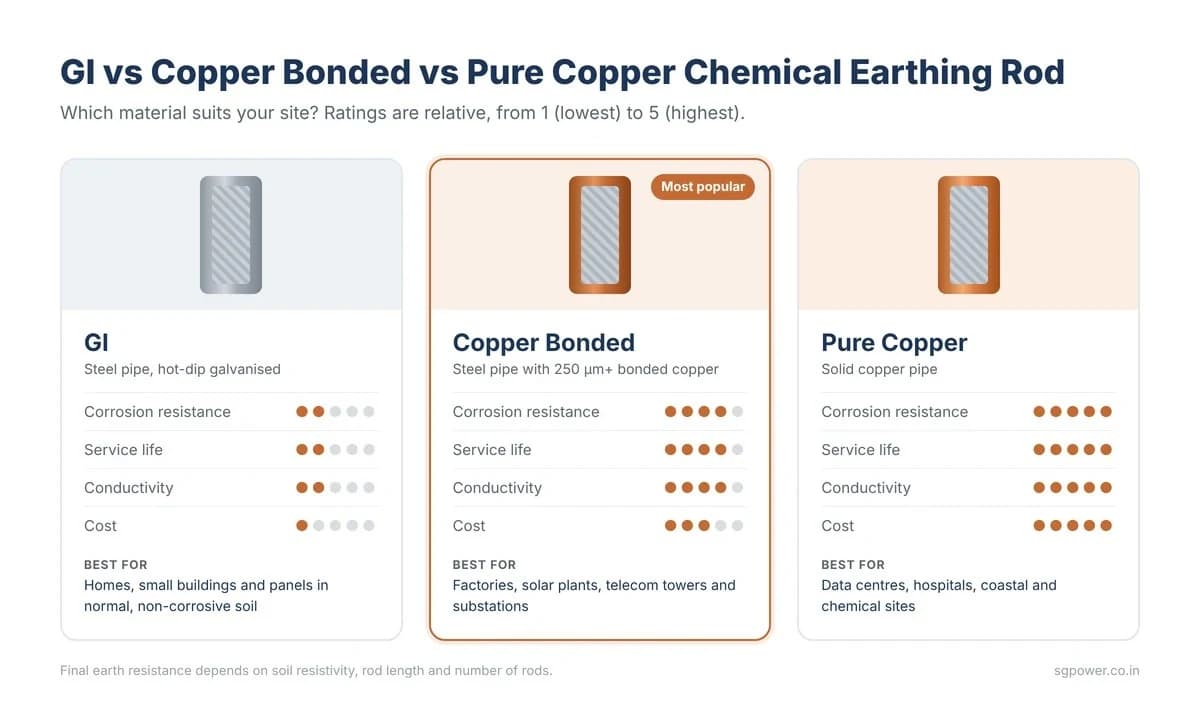
For a closer comparison of the two most common materials, read Copper Bonded vs GI Earth Electrode: Which Is Better?
| Construction | Design | When to use it |
|---|---|---|
| Standard | One pipe filled with conductive compound | General earthing in normal soil and low fault current |
| Pipe in pipe | A smaller pipe inside a larger one, with compound between them | Higher fault current and a larger contact area |
| Strip in pipe | A metal strip running through the pipe, surrounded by compound | Higher current capacity and a strong internal connection to the terminal |
The chemical earthing rod size is given as length × outer diameter, for example 3 m × 50 mm. The most common lengths are 2 m and 3 m, and diameters run from about 50 mm to 100 mm. Longer rods reach moister soil and give lower resistance; larger diameters carry more fault current.
| Parameter | Common options | Why it matters |
|---|---|---|
| Length | 1 m, 2 m, 3 m | Longer rods reach moister soil and lower the earth resistance |
| Outer diameter | 50 mm, 76 to 80 mm, 100 mm | Larger diameter means more contact area and more current capacity |
| Pipe wall thickness | 2 to 3 mm | Thin walls corrode through sooner, whatever the coating |
| Copper bonding (copper bonded rods) | At least 250 microns (IEC 62561-2) | Thicker copper lasts longer in corrosive soil |
| Zinc coating (GI rods) | Hot-dip galvanised, 80-100 microns | Protects the steel from rusting |
| Terminal | Flat plate with 1 or 2 bolt holes, or a lug | Must match the earthing strip or cable size |
| Inner compound | Crystalline conductive compound, sealed in | Must be non-corrosive and must not leach out |
| Weight | Approx. 6 kg | A quick check that the pipe wall is not thinner than stated |
Which size do you need? It depends on the soil resistivity at your site, the earth resistance you need and the fault current. A 3 m rod is the usual choice for industrial and commercial sites; 2 m rods suit homes and small buildings with good soil. Our chemical earthing guide shows how to work out the number of rods from a soil test.
Coating is measured in microns (µm); 1 mm is 1,000 microns. A copper bonded rod with 250 microns of copper has a layer a quarter of a millimetre thick. Thicker copper takes longer to corrode through, which is why IEC 62561-2 sets 250 microns as the minimum for copper bonded earth electrodes, and UL 467 asks for at least 0.254 mm (254 microns) on listed copper bonded ground rods. Ask for the coating thickness in writing and check it with a coating gauge on delivery.
A chemical earthing rod is a filled pipe set in a drilled bore with compound around it; a copper bonded driven rod is a solid steel rod with a copper layer, hammered straight into the ground. Both are used for earthing, and many sites use both.
| Feature | Chemical earthing rod (pipe electrode) | Copper bonded driven rod |
|---|---|---|
| Form | Hollow pipe filled with conductive compound | Solid steel rod with copper bonded to it |
| Typical diameter | 50 to 100 mm | 14 to 25 mm |
| Installation | Drilled bore, rod placed, earth enhancing compound around it | Driven in with a hammer; can be coupled for depth |
| Best soil | Dry, sandy or rocky soil where contact is poor | Soil that can be driven into; deep moist layers |
| Extending depth | Fixed length per rod | Several rods coupled end to end |
| Standards | IS 3043 for design; IEC 62561-7 for the backfill compound | IEC 62561-2 and UL 467 for the rod |
If you need driven rods, see our copper bonded earth rods, including UL listed sizes. Our guide to what UL listed means explains what that mark proves.
A chemical earthing rod is made in eight stages, from cutting the pipe to the final check before dispatch. Knowing them helps you ask the right questions when you compare products.
Pipe selection and cutting. Steel or copper pipe of the right diameter and wall thickness is checked and cut to length (for example, 3 m).
Surface preparation. The pipe is cleaned of rust, oil and scale so the coating bonds fully.
Coating. GI rods are hot-dip galvanised in molten zinc; copper bonded rods get a copper layer bonded to the steel; pure copper rods need no coating.
Inner pipe or strip fitting. For pipe in pipe and strip in pipe types, the inner pipe or strip is fitted and joined to the top.
Terminal fitting. A terminal plate or lug is welded or brazed to the top for the earthing conductor.
Compound filling. The pipe is packed with crystalline conductive compound so no air gaps are left.
Sealing. Both ends are capped and sealed so the compound stays in and water stays out.
Inspection and marking. Each rod is checked for size, coating thickness, weld quality and seals, then marked with size, material and batch number.
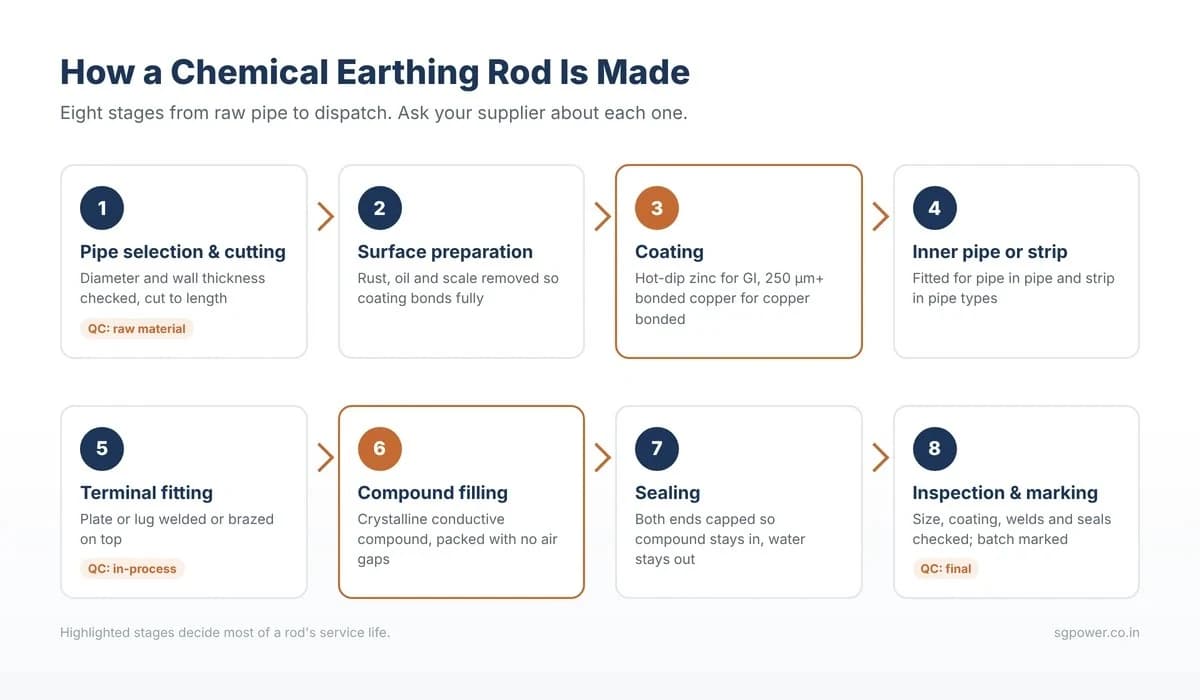
At SG Power, every TRUESAFE rod is made in-house and passes a 3-level quality check before dispatch: raw material, in-process and final inspection.
There is no single Indian product standard for chemical earth electrodes, so quality is shown through tests on the materials and the finished rod, and by designing to the earthing codes below.
| Test | What it checks | Typical method or reference |
|---|---|---|
| Dimension check | Length, outer diameter, wall thickness | Measuring tape, vernier, micrometer |
| Coating thickness | Copper or zinc layer in microns | Coating thickness gauge; IEC 62561-2 for copper bonded |
| Coating adhesion | Copper or zinc does not peel or crack | Bend or scratch test |
| Weld and terminal check | Terminal joint is solid and conductive | Visual check and continuity test |
| Seal check | End caps keep compound in and water out | Visual check |
| Compound resistivity | Conductivity of the backfill compound | IEC 62561-7 |
| Raw material test | Copper purity, steel grade | Mill test certificate or lab report |
| Standard | What it covers |
|---|---|
| IS 3043 | Indian code of practice for earthing: electrodes, sizes, resistance and testing |
| IEC 62561-2 | Earth electrodes and conductors for lightning protection, including copper bonding thickness |
| IEC 62561-7 | Earth enhancing compounds used around the rod |
| UL 467 | Grounding and bonding equipment in North America, including ground rods |
| IEEE 80 | Grounding design for AC substations |
Chemical earthing rods are used wherever earth resistance must stay low all year or the soil is dry, sandy or rocky:
Homes and housing projects: lifts, pumps, inverters and surge protection.
Commercial buildings and hospitals: HVAC, DG sets, lifts and medical equipment.
Factories: motors, panels, transformers and machines.
Solar plants: module structures, inverters and transformers on dry land.
Telecom towers and data centres: stable, low resistance for sensitive electronics.
Substations: high fault currents, alongside an earth mat.
Lightning protection: the earth termination for down conductors.
For how many rods a site needs and how to install and test them, see our chemical earthing guide.
A well-made rod typically lasts 10 to 15 years or more, and copper bonded and pure copper rods last longest. Life depends on four things: the coating thickness, the pipe wall thickness, how corrosive the soil is, and whether the compound around the rod is non-corrosive. Salt and charcoal around any rod shorten its life sharply.
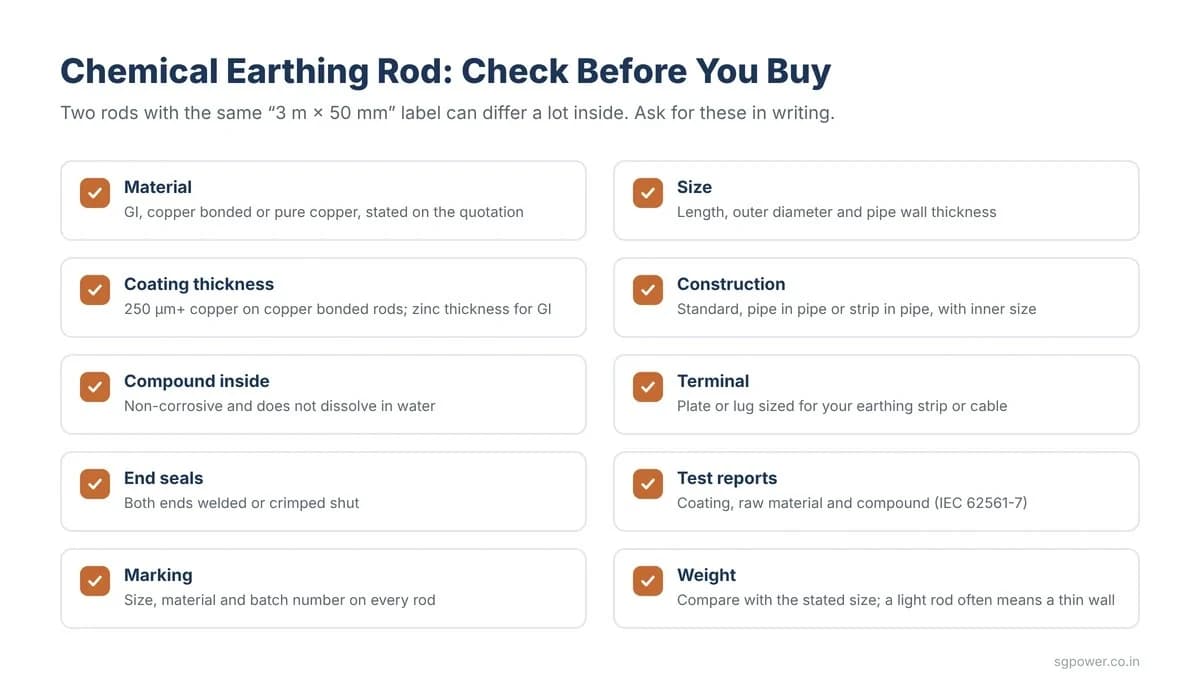
Two rods with the same "3 m × 50 mm" label can differ a lot inside. Before you order from any chemical earthing rod supplier, ask for these details in writing and check them on delivery.
Material: GI, copper bonded or pure copper, stated clearly on the quotation.
Size: length, outer diameter and pipe wall thickness.
Coating thickness: at least 250 microns of copper for copper bonded rods; the zinc thickness for GI rods.
Construction: standard, pipe in pipe or strip in pipe, and the inner pipe or strip size.
Compound inside: its type, and confirmation that it is non-corrosive and does not dissolve in water.
Terminal: plate or lug size, matched to your earthing strip or cable.
End seals: both ends welded or crimped shut.
Test reports: coating thickness, raw material certificate and compound test to IEC 62561-7.
Marking: size, material and batch number on each rod.
Accessories: earth enhancing compound, pit cover and clamp, so the whole earth pit matches.
Weight: compare it with the stated size; a light rod often means a thin pipe wall.
Not sure which rod suits your site? Share your soil type or soil resistivity, the earth resistance you need and the application, and our engineers will suggest the material, size and number of rods, free of charge.
Get a Free Rod Size RecommendationOn Indian B2B marketplaces, a 2 m or 3 m chemical earthing rod is listed at anything from about Rs. 300 to over Rs. 11,000 per piece (October 2026). The gap comes from what is inside the pipe, not the label on it.
| Price driver | Lower price | Higher price |
|---|---|---|
| Material | GI | Copper bonded, then pure copper |
| Length and diameter | 1 m or 2 m, 50 mm | 3 m, 76 to 100 mm |
| Pipe wall thickness | Thin wall | Thick wall |
| Coating | Thin or unstated coating | 250 microns or more of copper, stated and tested |
| Construction | Standard | Pipe in pipe or strip in pipe |
| Compound inside | Salt-based or unstated | Non-corrosive crystalline conductive compound |
| Testing and paperwork | None | Test reports and batch marking |
| Quantity | Single pieces | Project and bulk orders |
A very low price usually means a thin pipe, a thin or unstated coating, or a salt-based fill that corrodes the rod from inside. Compare the full specification, not the price per piece. For current prices by type and size, see the earth electrode page or request a quotation.
“A chemical earthing rod is maintenance-free.”
It is low-maintenance. It needs no watering or salt, but the earth resistance should still be tested at least once a year.
“The compound inside the pipe lowers the earth resistance.”
The compound inside mainly protects and connects the rod; the earth enhancing compound around it is what improves contact with the soil.
“Any chemical earth electrode gives less than 1 ohm.”
Earth resistance depends mainly on the soil. A low value comes from a soil test, the right rod size and enough rods in parallel.
“All 3 m × 50 mm rods are the same.”
Wall thickness, coating, construction and the compound inside can differ widely between products of the same size.
“Copper bonded and pure copper are the same.”
Copper bonded is steel with a copper layer; pure copper is solid copper. Pure copper costs more and suits the most corrosive sites.
“A chemical earthing rod works without backfill compound.”
Without the right earth enhancing compound around it, the rod loses most of its advantage over a plain pipe.
Earth enhancing compound for the bore around each rod
Earth pit covers to finish each earth pit
Material weight calculator to check a rod's weight against its size
GI, copper bonded and pure copper earth electrodes
Earthing clamps to finish each earth pit
Tell us your application, site location, soil type and the earth resistance you need, and our team will recommend the rod type, size and quantity and send a quotation.
This guide is based on the following standards, together with SG Power's own manufacturing experience.