SG Power Product Pvt. Ltd.
SGP/Blog/How to Calculate Servo Stabilizer kVA

How to Calculate Servo Stabilizer kVA: Formula, Worked Examples and Size Chart

Written and reviewed by the SG Power technical team at SG Power Products Pvt. Ltd.  |  Last updated: 6 November 2026

To calculate servo stabilizer kVA, add the kW of every load that runs at the same time and divide by a 0.8 power factor. Then multiply by 1.25 for motor starting current and growth, and choose the next standard rating. This guide explains each step, with worked examples for homes and factories and a size chart.

It is written for plant heads, maintenance engineers, electrical contractors, purchase teams and homeowners. Each needs a servo voltage stabilizer and wants the right size before asking for quotes. The same stabilizer kVA calculation works for single-phase and three-phase units, air cooled or oil cooled. Some guides call it a servo stabilizer capacity calculation or a stabilizer load calculation, but the method is the same. A servo stabilizer, also called an automatic voltage regulator (AVR) or servo stabiliser, protects equipment from voltage fluctuation only when it is sized correctly.

Servo stabilizer kVA calculation: SG Power artwork showing a three phase servo stabilizer with voltage regulation curves
Sizing a servo stabilizer starts with the load it has to carry

Servo Stabilizer kVA Calculation in Brief

In short, the servo stabilizer kVA calculation needs only your running load and two fixed numbers. Divide the running load in kW by 0.8 to get kVA, multiply by 1.25 for a safety margin, then round up to the next standard size. The table shows the four steps with one worked example.

Formula: Required kVA = running load (kW) ÷ 0.8 × 1.25

StepWhat to DoExample (90 kW factory)
1. Running loadAdd the kW of all loads that run together90 kW
2. Convert to kVADivide by the 0.8 power factor90 ÷ 0.8 = 112.5 kVA
3. Add the marginMultiply by 1.25 for starting current and growth112.5 × 1.25 = 140.6 kVA
4. Choose the sizePick the next standard rating150 kVA

Method used by Indian stabilizer makers, including SG Power. Reviewed November 2026.

Want Your kVA Calculation Checked?

If you would rather not size the stabilizer alone, SG Power's engineers can check your stabilizer sizing for free. SG Power makes servo stabilizers from 10 kVA to 500 kVA at its Ghaziabad factory and sizes them from its Noida office, so its team does this every day. Share your figures, and you get a recommended size with the reasons behind it.

What You ShareWhat the Team Checks
Load list or machine nameplatesRunning load and the kVA it needs
Clamp meter readings or electricity billMeasured load and peak demand
Phase-wise voltage readingsPhase balance and the input range you need
Plans for new machinesRoom for growth

What Is kVA, and Why Are Stabilizers Rated in kVA?

kVA (kilovolt-ampere) is the apparent power a stabilizer must carry, while kW is the real power your loads use. A servo stabilizer is rated in kVA because its transformers and variac heat up with current, whatever the load's power factor. That is why the kW to kVA step comes first in every calculation.

kW (real power): the power that does useful work, shown on most nameplates

kVA (apparent power): volts × amps ÷ 1,000, which sets the current through the stabilizer

kVAR (reactive power): the part of kVA that magnetises motors and transformers; it does no useful work but still loads the stabilizer

Power factor: kW ÷ kVA; motors, compressors and pumps usually run at about 0.8

1 kVA ≈ 0.8 kW at a 0.8 power factor, so a 10 kVA stabilizer carries about 8 kW at full rating

When your loads' real power factor is known and is lower than 0.8, use the real figure. For example, a 40 kW load at 0.7 power factor is about 57 kVA, not 50 kVA.

Load TypeTypical Power Factor
Induction motors, pumps and compressors0.70–0.85 (lower on light load)
Refrigeration and AC compressorsabout 0.8
CNC machines and drives0.8–0.95, depending on the drive
Computers, LED lighting and electronics0.85–0.95
Heaters, geysers and ovens1.0
Mixed home or factory loadabout 0.8 (the standard sizing value)

Typical values; a power analyser or your electricity bill gives the real figure for your site.

How to Calculate Servo Stabilizer kVA in Four Steps

You can calculate servo stabilizer kVA in four steps, using a load list or nameplate readings. Each step removes a common error: counting standby machines, forgetting the power factor, leaving no starting margin, or buying a non-standard size. Work through them in order, and keep your figures for the quote.

1

List the running load: add the rated kW of every machine, AC, light and appliance that runs at the same time. When calculating, leave out standby machines and loads you will keep off the stabilizer.

2

Convert kW to kVA: divide the total by 0.8, or by your measured power factor.

3

Add a 25% margin: multiply by 1.25 to cover motor starting current and modest growth.

4

Choose the next standard size: for example 10, 15, 20, 25, 30, 40, 50, 60, 75, 100, 125, 150, 200, 250, 400 or 500 kVA.

What Is the Servo Stabilizer kVA Formula?

The servo stabilizer kVA formula is simple: required kVA = running kW ÷ 0.8 × 1.25. This works out to about 1.56 times the running load in kW. Turned around, a stabilizer's safe running load is about 0.64 times its kVA rating. Use these related formulas when your figures are in amps or horsepower.

To FindFormulaExample
Required stabilizer kVAkW ÷ 0.8 × 1.2540 kW ÷ 0.8 × 1.25 = 62.5 kVA
kW from HPHP × 0.74610 HP × 0.746 = 7.46 kW
Single-phase kVA from ampsvolts × amps ÷ 1,000230 V × 40 A = 9.2 kVA
Three-phase kVA from amps1.732 × 415 V × amps ÷ 1,0001.732 × 415 × 100 A = 71.9 kVA
kVA on one phasephase voltage × phase amps ÷ 1,000240 V × 100 A = 24 kVA
Safe running load of a stabilizerkVA × 0.64100 kVA × 0.64 = 64 kW

Horsepower on a motor nameplate is output power. The motor draws more from the supply, because its efficiency is usually 85–95%; efficiency classes IE1 to IE3 are set out in IS 12615, published by the Bureau of Indian Standards. The nameplate full-load current already includes efficiency and power factor, so use it whenever it is shown.

The 1.732 in the three-phase formula is the square root of 3. At 415 V, three-phase kVA is about 0.72 times the current per phase. Each phase of a 415 V supply is about 240 V (415 ÷ 1.732), while a single-phase home supply is nominally 230 V.

Some sizing guides use a 15–20% margin instead of 25%. A 25% margin is safer for motor-heavy loads, and it is the margin used throughout this guide and on SG Power's product pages.

How Do You Find the Running Load for Stabilizer Sizing?

For stabilizer sizing, the running load is the total kW of loads that actually run together, not everything connected. Many sites connect far more than they use at once. Take the figures from nameplates or the typical values below, then remove standby machines and loads that never run at the same time.

Connected load: every machine and appliance wired to the supply, used or not

Running load: what runs together at your busiest time; this is what you size for

Demand or diversity factor: running load ÷ connected load; measure it with a clamp meter if you can

Standby loads: spare pumps and backup machines do not add to the running load

Typical Running Watts for a Stabilizer Load List

These typical running watts help you build a stabilizer load list when nameplates are hard to read. They are approximate values for Indian homes, offices and workshops. Always use the rating label when you can, because models differ, and remember that motor loads draw several times their running current at start.

LoadTypical Running Power
LED bulb or tube light10–20 W each
Ceiling fan50–75 W each
LED TV with set-top box120–200 W
Refrigerator (single or double door)150–350 W
Washing machine400–700 W (up to about 2,000 W on a hot wash with its heater)
Microwave oven1,000–1,400 W
1 ton split AC1,000–1,200 W
1.5 ton split AC1,500–1,800 W
2 ton split AC2,000–2,400 W
Water pump, 1 HPabout 750 W
Desktop computer with monitor150–300 W
Geyser or water heater2,000–3,000 W (keep off the stabilizer)

How to Calculate Stabilizer kVA for a Home

To calculate stabilizer kVA for a home, list the ACs, refrigerator, pump, TV, lights and fans that can run together on a hot evening. Leave out geysers, irons and induction cooktops, which work on almost any voltage. Then apply the same formula and pick the next size.

Worked example: a 3BHK home with three 1.5 ton ACs

LoadRunning Power
Three 1.5 ton split ACs (about 1.6 kW each)4.8 kW
Refrigerator0.3 kW
LED TV with set-top box0.2 kW
Washing machine0.5 kW
Lights, fans and router0.7 kW
Water pump, 1 HP0.75 kW
Total running load7.25 kW

Required kVA = 7.25 ÷ 0.8 × 1.25 = 11.3 kVA, so a 15 kVA servo stabilizer fits. Adding a 2 kW geyser would push the need to about 14.5 kVA, leaving almost no margin. That is why heaters belong on a separate, unstabilized circuit.

Single-phase homes: for a mainline stabilizer for home use, SG Power's 10 kVA and 15 kVA air cooled units suit most flats and villas.

Three-phase homes: size on the most heavily loaded phase, as explained below.

Check your supply first: a 15 kVA single-phase unit draws about 65 A. Many homes with three or more ACs have a three-phase connection, so check your connection type and sanctioned load before choosing a single-phase or three-phase stabilizer.

One appliance only: a single 1.5 ton air conditioner (AC) needs about 2.8 kVA by the formula, so a 3–4 kVA appliance stabilizer is enough; a servo stabilizer is for the whole home.

How to Calculate Stabilizer kVA for a Factory

To calculate stabilizer kVA for a factory or other industrial site, add the kW of machines that run together on your busiest shift. Include CNC machines, compressors, pumps, chillers and lighting. Leave out standby machines and furnaces that do not need stabilized voltage. These worked examples show the formula on typical Indian sites.

SiteRunning LoadCalculationRequired kVAChoose
Small workshop15 kW15 ÷ 0.8 × 1.2523.4 kVA25 kVA
Machine shop40 kW40 ÷ 0.8 × 1.2562.5 kVA75 kVA
Plastics unit75 kW75 ÷ 0.8 × 1.25117.2 kVA125 kVA
CNC shop, 12–15 machines90 kW90 ÷ 0.8 × 1.25140.6 kVA150 kVA
Cold storage plant37 kW37 ÷ 0.8 × 1.2557.8 kVA75 kVA
Larger plant or mall110 kW110 ÷ 0.8 × 1.25171.9 kVA200 kVA
Textile mill260 kW260 ÷ 0.8 × 1.25406.3 kVA500 kVA

A stabilizer for a 100 kW load works out to 156.3 kVA, just above 150 kVA. Choose 200 kVA, or bring the stabilized load down to about 96 kW by moving heaters and ovens to a separate feeder.

Not sure which machines run together? Send the machine list, and SG Power's team will work out the running load with you.

How to Calculate kVA From Amps or Your Electricity Bill

When you do not have a full load list, calculate stabilizer kVA from amps or from your electricity bill. A clamp meter reading at your busiest time is the most reliable. A bill gives a quick estimate. Add the same 25% margin to either figure, and confirm it before ordering.

MethodHow to CalculateExample
Clamp meter, single phase230 V × peak amps ÷ 1,000, then × 1.2540 A → 9.2 kVA → 11.5 kVA → 15 kVA
Clamp meter, three phase0.72 × highest phase amps, then × 1.25160 A → 115 kVA → 144 kVA → 150 kVA
Maximum demand (MD) on the billRecorded MD in kVA × 1.2590 kVA MD → 112.5 kVA → 125 kVA
Sanctioned load or contract demandA ceiling, not a sizing figureCheck it against the running load

Measure at peak: take readings when ACs, compressors and the largest machines are all running.

Use the highest phase: in three-phase supplies, size on the most heavily loaded phase.

Remove unstabilized loads: subtract heaters, furnaces and other loads that will not go through the stabilizer.

Check the MD period: use the highest MD from the last 12 months, as summer loads are often higher.

Know what MD means: the Electricity (Rights of Consumers) Rules, 2020 define maximum demand as the highest average load in kVA or kW over any 30-minute period in the billing cycle, unless your state commission sets another period.

How Do Motor Starting and Phase Imbalance Affect Stabilizer kVA?

Motor starting current and phase imbalance are the two things that most often trip a correctly calculated servo stabilizer. The 25% margin covers normal starting of small and medium motors. Large direct-on-line motors and heavily unbalanced phases need a closer check before you choose the size.

Starting MethodTypical Starting CurrentEffect on Stabilizer Size
Direct-on-line (DOL)About 5–7 times running current (inrush or locked-rotor current)Check large DOL motors before ordering
Star-delta starterAbout one-third of DOL currentUsually covered by the 25% margin
Soft starterSet on the starter, often 2–4 timesUsually covered by the 25% margin
Variable frequency drive (VFD)Close to running currentNo extra allowance needed

When one DOL motor makes up a large share of the load, share its kW and starter type. The size can then be checked against its starting current.

A stabilizer has two ratings: a continuous kVA rating and a short-time overload rating. A DOL start usually lasts only a few seconds, so ask the maker how much overload the unit carries, and for how long, before choosing a larger kVA.

How Do You Size a Stabilizer for Unbalanced Phases?

For unbalanced phases, size the three-phase stabilizer on the most heavily loaded phase, not on the total. Each phase of a three-phase unit carries one-third of its rating. If one phase carries far more than the others, a unit sized on the total can overload that phase while the others run light.

Example: after converting to kVA, phase R carries 30 kVA, Y carries 22 kVA and B carries 18 kVA, a total of 70 kVA.

Sized on the total: 70 × 1.25 = 87.5 kVA, so 100 kVA, but phase R needs 37.5 kVA against a capacity of 33.3 kVA per phase.

Sized on the highest phase: 3 × 30 × 1.25 = 112.5 kVA, so 125 kVA, which covers phase R safely.

For any 3 phase servo stabilizer kVA calculation with mixed loads, work out the kVA requirement of each phase first.

Rebalance first: move single-phase loads so each phase carries about 23.3 kVA. The same 70 kVA load then needs only 70 × 1.25 = 87.5 kVA, so a 100 kVA unit fits instead of 125 kVA. Ask your electrician whether loads can be shifted between phases before you buy.

Homes, hospitals and hotels with ACs and lights on different phases often suit an unbalanced servo stabilizer, which corrects each phase on its own.

Servo Stabilizer Size Chart: 10 kVA to 500 kVA

This servo stabilizer size chart lists each standard rating with its safe running load and its full-load current. Find the first row whose safe running load is above your running load. That row is your size. The safe running load already includes the 0.8 power factor and the 25% margin.

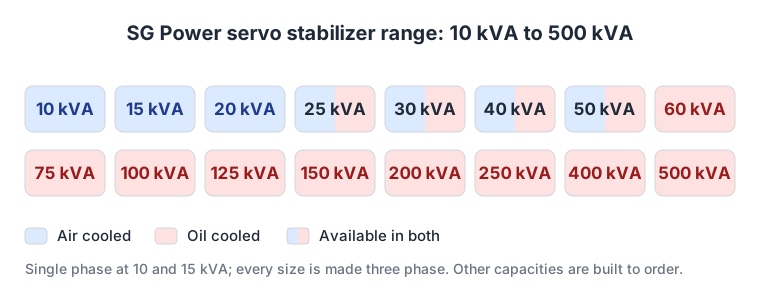
Servo stabilizer kVA sizes from 10 kVA to 500 kVA, air cooled and oil cooled
SG Power servo stabilizer range from 10 kVA to 500 kVA
RatingSafe Running LoadFull-Load CurrentCooling in SG Power's Range
10 kVA single phaseabout 6.4 kWabout 43 A at 230 VAir
15 kVA single phaseabout 9.6 kWabout 65 A at 230 VAir
10 kVA three phaseabout 6.4 kWabout 14 A per phaseAir
15 kVA three phaseabout 9.6 kWabout 21 A per phaseAir
20 kVAabout 12.8 kWabout 27.8 A per phaseAir
25 kVAabout 16 kWabout 35 A per phaseAir or oil
30 kVAabout 19.2 kWabout 41.7 A per phaseAir or oil
40 kVAabout 25.6 kWabout 55.6 A per phaseAir or oil
50 kVAabout 32 kWabout 70 A per phaseAir or oil
60 kVAabout 38.4 kWabout 83.5 A per phaseOil
75 kVAabout 48 kWabout 104 A per phaseOil
100 kVAabout 64 kWabout 139 A per phaseOil
125 kVAabout 80 kWabout 174 A per phaseOil
150 kVAabout 96 kWabout 209 A per phaseOil
200 kVAabout 128 kWabout 278 A per phaseOil
250 kVAabout 160 kWabout 348 A per phaseOil
400 kVAabout 256 kWabout 556 A per phaseOil
500 kVAabout 320 kWabout 696 A per phaseOil

Safe running load = kVA × 0.8 × 0.8 (power factor, then the 25% margin). Three-phase current = kVA × 1,000 ÷ (1.732 × 415). Other capacities are built to order.

For example, 150 kVA to kW is about 120 kW at full rating, while its safe running load is about 96 kW.

The full-load current in the chart is also the figure your electrician uses to choose the input and output cables and the breaker. Cable size then depends on the cable run and voltage drop, as covered in the installation guide. The stabilizer body also needs a sound connection to the site's earth electrode.

Which kVA Range Suits Which Site?

Most sites fall into one of four stabilizer kVA bands, from single-phase homes to large process plants. Use this table as a starting point, then confirm the size with your own load list. Your exact machine list, phase loading, voltage swing and duty cycle decide the final rating.

kVA RangeSupplyTypical Sites
10–15 kVASingle or three phaseFlats, villas, clinics, shops and small offices
25–50 kVAThree phaseWorkshops, showrooms, schools, small offices and small factories
75–150 kVAThree phaseEngineering units, CNC shops, cold storage, hospitals, hotels and commercial buildings
200–500 kVAThree phaseTextile mills, plastic moulding, food processing and large plants

Above about 500 kVA, large plants with their own HT supply often correct the voltage on the high-tension side instead, with an HT AVR transformer.

What Load Can a 10 kVA or 15 kVA Stabilizer Run?

A 10 kVA stabilizer runs about 8 kW at full rating, or about 6.4 kW with a 25% margin. A 15 kVA stabilizer runs about 12 kW at full rating, or about 9.6 kW with the margin. These two sizes cover most single-phase homes, clinics, shops and small offices.

10 kVA: two or three 1.5 ton ACs with a fridge, TV, lights and fans

15 kVA: three or four ACs with a pump, fridge, washing machine, lights and fans

One Mainline Stabilizer or One Per Machine?

You can size one mainline stabilizer for the whole site, or smaller dedicated units for critical machines. A single unit at the main incomer is simplest and protects everything downstream. Dedicated units cost more but give tighter protection where a fault would be expensive. Many plants use both.

ApproachHow to Size ItBest For
One mainline stabilizerTotal running load of the site ÷ 0.8 × 1.25Most homes, offices and factories
Dedicated stabilizer per machineThat machine’s kW or full-load current, plus 25%CNC lines, medical imaging, lifts and other critical machines
Mainline plus dedicated unitsSize each on the loads it feeds, without counting any load twicePlants with one or two very sensitive or very large machines

Size a mainline stabilizer on the load it protects, not on the rating of your distribution transformer. Most transformers are rated well above the running load, and heaters or furnaces fed from them may stay off the stabilizer.

Does the Input Voltage Range Change the Stabilizer kVA?

A servo stabilizer's input voltage range does not change your running load, but it affects how hard the unit works. At the lowest input voltage, the stabilizer draws more current from the mains to hold the output steady. Choose an input range that covers the lowest and highest voltages you actually record on site.

Record your voltage: note the lowest and highest readings on each phase over a few days, including summer evenings.

Match the range: SG Power’s standard ranges are 295–465 V or 340–460 V for three phase, and 170–270 V or 190–270 V for single phase.

Wider is bigger: a wider input range needs a larger variac and transformer for the same kVA.

Ask about derating: check whether the kVA rating holds at the lowest input voltage, or is derated there.

Output and regulation: across its input range, a servo stabilizer holds the output at about 230 V single phase or 415 V three phase; SG Power’s units regulate within ±1%.

Low voltage areas: where dips below the standard range are common, ask for a custom range rather than simply a bigger kVA.

Which Loads Should Not Go on the Stabilizer?

Resistive loads rarely need a servo stabilizer, because geysers, heaters, ovens and furnaces work on almost any voltage. Keeping them on a separate feeder can cut the required kVA sharply. Some electronic loads also need a different device, so check these before you add them to your load list.

Leave off: geysers, room heaters, irons, induction cooktops, electric ovens and heating furnaces

Use a UPS instead: computers and servers that must not lose power during a cut; a stabilizer does not store energy

Add surge protection: lightning and switching spikes need a surge protection device, not a bigger stabilizer

Check inverters: place the stabilizer before a home inverter or UPS, never on its output, and include the battery charging load

What Are the Common Servo Stabilizer Sizing Mistakes?

The most common servo stabilizer sizing mistakes are sizing on connected load, forgetting motor starting current and ignoring one overloaded phase. Mixing up kW and kVA and leaving no room for growth are also common. Each mistake gives a unit that trips under load, or one far larger than the site needs.

1

Using connected load: machines that never run together inflate the size.

2

No starting margin: compressors and large DOL motors trip an exactly sized unit.

3

Ignoring phase imbalance: one heavily loaded phase can overload a unit sized on the total.

4

Mixing up kW and kVA: buying a 10 kVA unit for a 10 kW load leaves it overloaded.

5

Oversizing far beyond the margin: a much larger unit costs more, takes more space and can hunt on very light loads.

6

Forgetting growth: if you will add machines within two years, include them now.

7

Using kWh from the bill: kWh is energy used over the billing period, not load. Size from kW or kVA, and divide kW by the power factor, never multiply.

What Do Indian Forum Users Ask About Stabilizer Sizing?

Indian forum users most often ask what kVA they need for a whole house, how many ACs a stabilizer can carry, and where it should go. Threads on Quora, Reddit, TechEnclave, HiFiVision, NoBroker and Physics Forums repeat the same questions, and the same lessons.

Forum QuestionWhat It Teaches
Is a 30 kVA three-phase stabilizer right for a house after an 11 kV line fault? (TechEnclave)Size to the real running load per phase; a stabilizer cannot stop high-voltage faults, so fit surge protection
What kVA does a home with a 3 HP treadmill need? (Physics Forums, Indian user)Count motor peaks, and choose an input range that covers the lowest voltage seen, here 180–190 V in summer
Which mainline stabilizer for two 2 ton ACs, PCs, TVs and three water heaters? (TechEnclave)Without the 3 kW of water heaters, the running load is about 7.25 kW and needs about 11.3 kVA; with them, about 16 kVA
What size servo for a home with five ACs? (TechEnclave)Count only the ACs that run together; one home runs five ACs, usually three at once, on a 15 kVA servo
Can a stabilizer go on the inverter’s output? (TechEnclave)Place the stabilizer before the inverter, ask for rated amps as well as kVA, and use wiring rated for the stabilizer’s current
Single-phase or three-phase servo for a whole house? (HiFiVision)Ask how a three-phase unit behaves if one phase fails, and confirm local service before buying

Across these threads, Indian homeowners give the same practical advice:

Measure first: record your site voltage for a few days, and read the real wattage of the largest loads from their labels.

Watch the pump: a 1–2 HP submersible pump causes a visible voltage dip when it starts, so include it in the margin.

Check the wiring: if appliances restart even in bypass mode, the fault is in the house wiring, not the stabilizer.

Forum threads checked November 2026. Prices and brand names from the threads are not used here.

After Calculating kVA: Air or Oil Cooled, Balanced or Unbalanced Stabilizer?

Once you have calculated the servo stabilizer kVA, choose the cooling and the design. In SG Power's range, air cooled units cover 10 to 50 kVA and suit clean indoor rooms. Oil cooled units cover 25 to 500 kVA for continuous duty and hot or dusty sites. Phase loading decides between balanced and unbalanced.

ChoiceChoose This When
Air cooledLoad up to 50 kVA in a clean, ventilated indoor room
Oil cooledAbove 50 kVA, 24×7 duty, or hot and dusty sites
BalancedThree-phase motors and production lines that load each phase equally
UnbalancedHomes, hospitals, hotels and offices with single-phase loads on different phases

To see how the variac and buck-boost transformer correct the voltage, read how a servo stabilizer works. For cable, breaker and earthing after sizing, see the servo stabilizer installation guide. At 50 kVA the choice is open, so compare the 50 kVA air and oil cooled models before you order.

Want a second opinion on your size? SG Power's team can check your calculation against your load list and voltage readings.

Servo Stabilizer kVA Calculation Checklist

Use this servo stabilizer kVA calculation checklist before you ask for quotes. It makes sure every supplier sizes the same load, so the offers can be compared fairly. Keep a copy with your load list and voltage readings, and share both when you request a quotation.

  • Running load listed, with standby machines removed
  • Heaters, geysers and furnaces moved off the stabilized load
  • kW converted to kVA at 0.8 or the measured power factor
  • 25% margin added
  • Load per phase checked, and the highest phase used for three-phase supplies
  • Large DOL motors and their starters noted
  • Lowest and highest site voltages recorded on each phase
  • Machines planned for the next two years included
  • Next standard kVA size chosen
  • Cooling type and balanced or unbalanced design chosen

Servo Stabilizer kVA Calculation: Key Facts

These are the main facts about servo stabilizer kVA calculation, written as short statements for quick reference:

Formula: servo voltage stabilizer kVA = running kW ÷ 0.8 × 1.25.

Safe running load: about 0.64 times the stabilizer’s kVA rating.

From current: three-phase kVA at 415 V is about 0.72 times the amps per phase.

Unbalanced loads: size on the most heavily loaded phase, times three.

Examples: 15 kW needs 25 kVA; 60 kW needs 100 kVA; 90 kW needs 150 kVA.

Never use kWh: bill units show energy, not load.

Frequently Asked Questions About Servo Stabilizer kVA Calculation

Still unsure about your size? Send your load list and voltage readings, and SG Power's engineers will recommend a size, input range and design for free.

Sources and References

This guide uses the standard kW, kVA and power factor relationships and SG Power's sizing method and capacity range. Appliance wattages are typical values, and forum findings were checked in November 2026. Always confirm the final size with your load list, site voltage readings and the stabilizer maker.

Learn More

To go further, these pages cover the stabilizer types, sizes and steps that follow a kVA calculation. They help when you are choosing between air and oil cooling, comparing balanced and unbalanced designs, planning the installation or protecting the site from surges.

Ready to size your stabilizer? Send your load list, and SG Power will confirm the kVA, input range and design.