
By SG Power Products Pvt. Ltd. | Last updated: 29 October 2026
A servo stabilizer works by sensing its output voltage, comparing it with a set value, and using a small servo motor to turn a variac when the two differ. The variac feeds a buck-boost transformer, which adds voltage when the mains is low and subtracts it when the mains is high. The output stays within about ±1%.
Senses: a control card measures the output voltage many times a second
Corrects: a servo motor turns a variac, which drives a buck-boost transformer to add or subtract voltage
Holds: the output stays at about ±1% of the set value, smoothly and without steps
Limits: it does not stop lightning spikes or give backup in a power cut

This servo stabilizer diagram shows the power path from the mains, through the variac and buck-boost transformer, to the load, with one set of parts on each of the three phases. The servo controller on each phase is the feedback loop that makes it a servo system.
Looking for a servo stabilizer? SG Power manufactures KNEUTRON servo voltage stabilizers from 10 to 500 kVA, single and three phase, air and oil cooled, at its own factory in Ghaziabad. Every unit is tested before dispatch.
A servo stabilizer keeps the voltage reaching your equipment steady when the mains supply rises or falls. It sits between the mains and the load, and corrects slow voltage changes smoothly, without steps. Homes use single-phase units, while factories, hospitals and buildings use three-phase units on the main supply.
Indian supply often runs low at peak hours and high late at night, with short sags (dips) and swells in between. A servo voltage stabilizer removes most of that swing before it reaches the equipment. Buyers also call it a voltage servo stabilizer, a servo controlled voltage stabilizer, a servo stabiliser or an automatic voltage regulator (AVR).
Motors and compressors: low voltage raises current and heat; high voltage stresses insulation
Electronics, LED lights and drives: fail more often at high voltage and reset at low voltage
Lighting and heating: give less light and heat at low voltage
Production: in a factory, steady voltage regulation means fewer trips, fewer rejects and more uniform quality
The main parts, or components of a servo stabilizer, are a variac, a servo motor, a buck-boost transformer, a microcontroller control card and its protection and display circuits. Large units also have an oil tank for cooling. Each part has one clear job in holding the output steady.
| Part | What It Does |
|---|---|
| Variac (variable autotransformer, or dimmer) | Gives an adjustable voltage as a carbon brush moves around its winding |
| Servo motor | Turns the variac’s brush in the right direction, by the right amount |
| Buck-boost transformer | Adds voltage to the mains (boost) or takes it away (buck) |
| Microcontroller control card | Measures the output, compares it with the set value and drives the motor |
| Protection and time delay circuits | Cut the output on very high or low voltage, overload or phase faults |
| Display | Shows input and output voltage, current and frequency |
| Cooling (air or oil) | Removes heat from the transformers; oil for larger, continuous loads |
Some designs use a roller instead of a carbon brush, or an AC synchronous motor instead of a stepper motor. The job is the same.
In a servo stabilizer, the buck-boost transformer is connected in series between the mains and the load. Its primary winding is fed from the variac, and its secondary winding sits in the supply line. When the variac changes the primary voltage, the secondary adds to or subtracts from the mains, so only the correction passes through the transformer.
This is why a servo stabilizer is efficient: the buck-boost transformer handles only the correction voltage, not the full supply voltage. SG Power units are tested at 97% efficiency as per IS 2026 (Part 1):1977.
“Servo” means a motor controlled by feedback. The control card keeps checking the result, the output voltage, and moves the motor until the result matches the target. It is the same idea used in robot arms and hobby servo motors, applied here to a variable transformer instead of a joint.
The servo stabilizer working principle is a closed feedback loop. The control card measures the output many times a second, finds the error signal, and moves the servo motor until the error disappears. Because the variac moves smoothly, the correction is stepless, unlike relay-type stabilizers that switch between fixed taps.
Measure: the control card reads the output voltage, ideally with true RMS sensing.
Compare: a comparator in the control card compares the reading with the set output, such as 230V single phase or 410V phase to phase.
Decide: if the output is low, it needs to boost; if high, it needs to buck.
Move: the servo motor, geared down for fine control, turns the variac brush one way to raise the voltage and the other way to lower it.
Correct: the variac changes the voltage fed to the buck-boost transformer, which adds or subtracts voltage.
Hold: when the output is back within about ±1%, the motor stops and waits for the next change.
In a servo stabilizer, buck and boost are the two jobs of the buck-boost transformer. Boost raises a low mains voltage, and buck lowers a high one. The variac sets how much is added or subtracted, so the output stays at the same level whatever the mains does within the stabilizer's input range.
| Mains Voltage | What the Stabilizer Does | Output |
|---|---|---|
| 190V (low) | Boosts by about 40V | about 230V |
| 230V (normal) | Little or no correction | about 230V |
| 260V (high) | Bucks by about 30V | about 230V |
| 360V three phase (low) | Boosts each phase | about 410V |
If the mains goes outside the input range, for example below 170V per phase on a standard unit, the stabilizer cuts the output to protect the load. Sites with very low voltage need a unit built with a wider input range.
Not sure which input range your site needs? Share a few days of voltage readings, and we'll suggest the right model.
A three-phase servo stabilizer works the same way, but with one variac, buck-boost transformer and servo motor for each of the three phases, as the diagram above shows. A balanced design corrects all phases together. An unbalanced design corrects each phase on its own, which suits buildings where each phase feeds different single-phase loads.
Balanced: usually one motor drives all three variacs together; suits three-phase motors and production lines that load each phase equally
Unbalanced: each phase has its own sensing, motor and variac; suits hospitals, hotels, offices and apartment buildings with ACs and lighting on different phases
Phase protections: a three-phase unit also cuts the output on phase reversal and single phasing, which can damage motors
The difference between a normal stabilizer and a servo stabilizer is how they correct voltage. A normal relay-type stabilizer switches between fixed transformer taps, so it corrects in steps. A servo stabilizer moves a variac smoothly, so it corrects without steps and holds the output much closer to the set value.
| Relay-Type (Normal) Stabilizer | Servo Stabilizer | |
|---|---|---|
| How it corrects | Switches fixed taps with relays | Servo motor turns a variac |
| Correction | In steps | Smooth and stepless |
| Output accuracy | Wider band | Typically ±1% |
| Typical use | Single appliances, small mainline units | Whole homes, offices, factories, hospitals |
| Price | Lower | Higher |
Relay switching between taps can also cause a brief flicker, which a stepless servo unit avoids. Many home “mainline” stabilizers are relay types. A servo mainline unit costs more but gives a steadier output for the whole house.
The main advantages of a servo stabilizer are precise, stepless correction, no added waveform distortion, high efficiency and the ability to carry full load continuously. Its disadvantages are moving parts that need yearly service, slower correction than a static stabilizer, a higher price than relay types and no protection from spikes.
| Advantages | Disadvantages |
|---|---|
| Typically ±1% output, smooth and stepless | Carbon brush and variac wear, so yearly service is needed |
| Handles full load continuously, including motors | Correction is not instant, because the motor needs a moment to turn the variac; a static (IGBT) stabilizer is faster |
| Adds no waveform distortion | Costs more than a relay-type stabilizer |
| High efficiency: 97% on SG Power units, tested to IS 2026 (Part 1) | No isolation and no protection from lightning spikes |
| Suits single-phase and three-phase loads up to hundreds of kVA | Larger units are heavy and hum while correcting |
A servo stabilizer is good for a home that has frequent low or high voltage, several ACs or a large single-phase or three-phase connection. One mainline unit of about 10–15 kVA, such as a 15 kVA servo stabilizer, protects the whole house. Homes with steady voltage and one or two ACs may only need small appliance stabilizers.
Choose a servo mainline unit (a servo stabilizer for ACs and the whole house) for villas and large homes, areas with heavy voltage swings, or houses with three or more ACs
Size it by adding the watts of everything that runs together, dividing by 0.8 and adding 25%
Fit it after the meter, with an inverter or UPS after the stabilizer, not before it
Allow for starting current: ACs, refrigerators and pumps draw several times their running current for a moment when they start
Leave heavy heating loads off if needed: some homes stabilize only lights, sockets and ACs, and keep geysers and heaters on the direct supply
Place it in a utility area: servo units hum softly while correcting, so a store room or utility space is better than a bedroom

See SG Power's 10 kVA servo stabilizer for homes and small offices.
The main types of servo stabilizers are grouped by phase, design, cooling and variac type. All of them use the same working principle of sensing, comparing and correcting. The type you need depends on your supply, how evenly the load is spread across the phases, the size of the load and the site conditions.
| Grouped By | Types | Typical Use |
|---|---|---|
| Phase | Single phase, three phase | Homes and small offices; factories and buildings |
| Design | Balanced, unbalanced | Even motor loads; mixed loads on each phase |
| Cooling | Air cooled, oil cooled | Smaller indoor units; larger, continuous loads |
| Variac type | Dimmer (toroidal) type, linear type | Most applications; buyers who prefer a linear design |
SG Power builds air-cooled units from 10 to 50 kVA and oil-cooled units from 25 to 500 kVA.
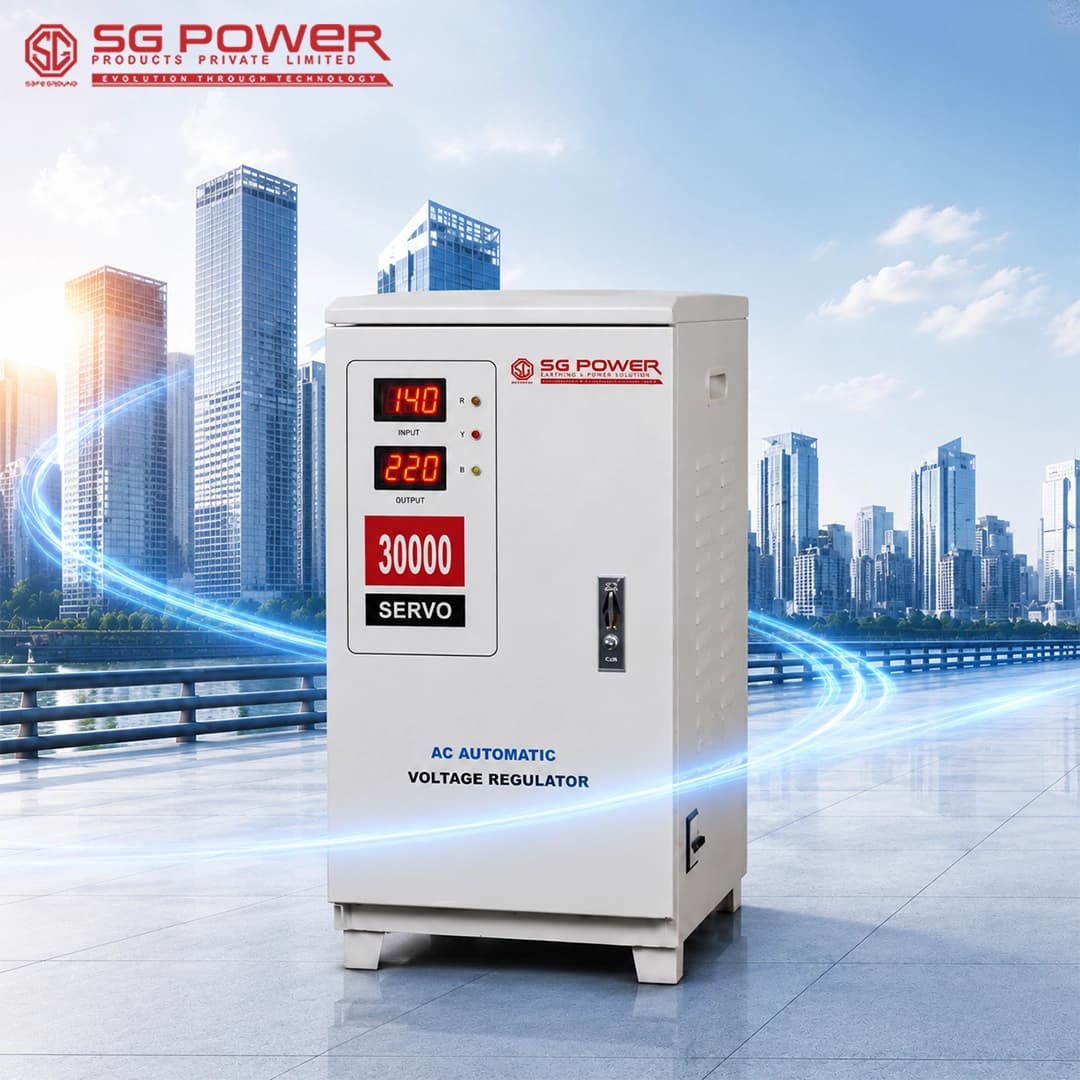
SG Power's KNEUTRON servo stabilizer follows the same working principle, using a microcontroller with true RMS sensing, a high-torque AC stepper motor, a dimmer-type variac and a buck-boost transformer. The dimmer and buck-boost transformer are designed to carry 100% load current continuously. All calibration is done through a front-panel touch-pad, without potentiometer adjustments.
| Parameter | Single Phase | Three Phase |
|---|---|---|
| Standard input band | 170–270V or 190–270V | 340–480V phase to phase (170–280V per phase) |
| Output voltage | 230V ±1% (220/230/240V settable) | 410V ±1% (P-P), 230V ±1% (P-N); settable to 380, 400 or 415V |
| Output frequency | 50 Hz ±3% | 50 Hz ±3% |
| Output delay | 3–200 seconds, adjustable | 3–200 seconds, adjustable |
| Efficiency | 97%, tested as per IS 2026 (Part 1):1977 | 97%, tested as per IS 2026 (Part 1):1977 |
| Range | 10 kVA and 15 kVA, air cooled | Air cooled 10–50 kVA; oil cooled 25–500 kVA |
These are the Guaranteed Technical Particulars from SG Power's own datasheets. Other input ranges can be built to suit a site's voltage. The variacs and transformers are wound in-house on grain-oriented silicon steel (CRGO) cores. They are built to IS 9815 (Part 1), IS 5142 and IS 2026, standards published by the Bureau of Indian Standards. SG Power also makes linear servo voltage stabilizers.
What the display shows: phase-to-neutral and phase-to-phase voltage, frequency, the output current of each phase, the set output voltage and the input voltage band. The operator can choose manual or automatic start and stop.
The controls and protections of a servo stabilizer keep the unit and the load safe when the supply goes beyond normal limits. They cut the output on extreme voltage, overload or phase faults, and delay the restart after a power cut. On SG Power units, the delay is adjustable from 3 to 200 seconds.
| Control or Protection | Why It Matters |
|---|---|
| True RMS sensing | Reads voltage correctly even when drives and electronics distort the waveform |
| Over- and under-voltage cut-off | Disconnects the load when the mains is outside the input range |
| Overload cut-off | Protects the stabilizer when the load is too high; the display shows “Overload”, and the output restarts once the load is reduced and Start is pressed |
| Time delay | Lets the supply settle before restarting compressors and motors |
| Phase reversal and single phasing cut-off | Stops motors running backwards or burning out on two phases; the display shows “Ph. Reversal” until the phases are corrected and Start is pressed |
A servo stabilizer corrects slow rises and falls in voltage, but it is not a cure for every power problem. It cannot stop lightning spikes, give backup during a power cut or isolate sensitive equipment. Each of those needs a separate device alongside the stabilizer.
| Power Problem | What to Use Alongside the Stabilizer | Where It Goes |
|---|---|---|
| Lightning and switching spikes | Surge protection device, with good earthing and a lightning protection system on exposed sites | Ahead of the stabilizer |
| High neutral-to-earth voltage | Check and repair the earthing, for example with chemical earthing electrodes | Building earthing system |
| Power cuts | UPS or inverter | After the stabilizer |
| Electrical noise, need for isolation | Isolation transformer | Before sensitive medical or electronic loads |
| Constant low voltage all day | Transformer tap check by the electricity distribution company | At the supply transformer |
A servo stabilizer is working properly when its output reading stays steady while the input reading moves, the motor runs quietly, and there are no frequent cut-offs. Uneven phase readings, a noisy motor or a slow response usually mean the brushes or variac need a service.
Output stays close to the set value while the input changes
Correction is smooth, with a soft hum rather than grinding
No frequent “high”, “low” or “overload” trips
All three phases read about the same on a three-phase unit
A yearly maintenance check of carbon brushes and the variac track is done; oil-cooled units also need oil level checks and yearly oil testing
Safety: dangerous voltages are present inside the cabinet even when the output is off. Only a trained technician should open the unit, and only after it is isolated from the supply.
Want help choosing a servo stabilizer? See sizes, models and prices on SG Power's servo voltage stabilizer range, or ask for free advice.
SG Power Products Pvt. Ltd. designs, winds and tests KNEUTRON servo voltage stabilizers from 10 to 500 kVA at its Ghaziabad factory, with its office in Sector 62, Noida. Every unit is tested before dispatch. Share your load and voltage readings for a free sizing check, or learn more about SG Power.