
A 3 phase stabilizer keeps the voltage steady on all three phases of a 415V supply. It protects machines, lifts, ACs and whole buildings from voltage fluctuations and phase imbalance. SG Power manufactures every three phase stabilizer in its range, from 10 kVA to 500 kVA, in air-cooled and oil-cooled designs.
SG Power Products Pvt. Ltd. is a Noida-based three phase servo voltage stabilizer manufacturer with 15+ years of experience and its own factory in Ghaziabad. A 10 kVA three-phase unit starts from about ₹32,000 + GST. This page covers the 3 phase stabilizer price, sizing, home and lift use, cooling, specifications and installation.
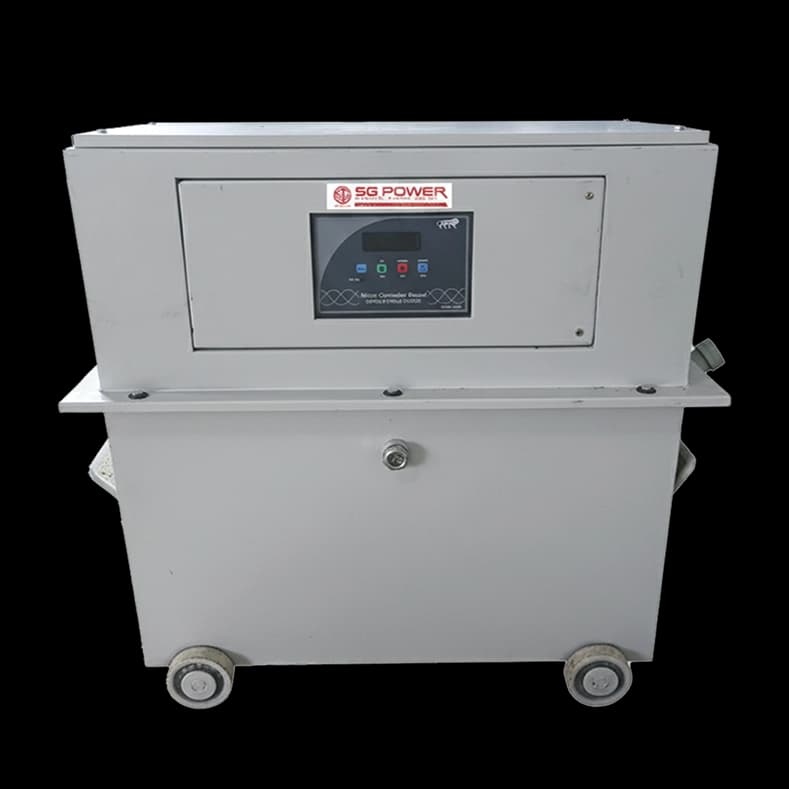
| Capacity range | 10 kVA to 500 kVA |
| Supply | Three phase, four wire, 415V |
| Cooling | Air cooled 10–50 kVA · Oil cooled 25–500 kVA |
| Input range | 170–280V per phase (340–480V between phases) as standard; 140–280V per phase option for 30–60 kVA; other ranges built to order |
| Output voltage | 410V ±1% (P-P) and 230V ±1% (P-N); set point adjustable to 380, 400 or 415V |
| Regulation and efficiency | ±1% regulation, 97% efficiency tested to IS 2026 (Part 1) |
| Designs | Balanced and unbalanced (independent phase control) |
| Phase protections | Phase reversal and single phasing cut-off |
| Approximate price | starts from ₹32,000 + GST for 10 kVA |
Prices are indicative. For the latest price, contact SG Power.
Need a reliable 3 phase stabilizer for a factory, office, hospital, lift or large home? Buy it straight from SG Power, the manufacturer, with no trader's margin.
10 kVA to 500 kVA, air cooled or oil cooled
Balanced or unbalanced design matched to your load
Free load and site-voltage assessment before you buy
Custom input ranges built for low-voltage sites
| From SG Power Directly | From a Trader or Reseller |
|---|---|
| Factory pricing | Reseller margin added |
| Sizing by the team that builds the unit | Advice varies by seller |
| Input range and design matched to your site | Mostly stock models only |
| Every unit tested through 173 checkpoints | Testing depends on the source |
| Service support in 319+ cities | Depends on the reseller |
A 3 phase stabilizer is a voltage stabilizer for a three-phase, four-wire 415V supply. It measures the voltage on each phase and corrects sags, swells and imbalance, so connected equipment gets a stabilized supply. Most are servo-controlled, using a motor-driven variac (also called a dimmer or dimmerstat) and a buck-boost transformer on each phase.
It is also called a 3 phase servo stabilizer, a 3 phase voltage stabilizer or a three phase servo voltage stabilizer. Other names include three phase voltage stabilizer, servo controlled voltage stabilizer and three phase automatic voltage regulator (AVR). Some sellers call it a three phase servo voltage corrector. Models with a microcontroller are often called digital servo stabilizers, and some buyers spell it stabiliser. Technically, it is a type of electromechanical voltage regulator used for voltage stabilisation.
An unbalanced three phase stabilizer works like three single-phase stabilizers connected in star, one on each phase. Each has its own sensing circuit, servo motor, variac and buck-boost transformer for correcting that phase, sharing one cabinet and one neutral.
A 3 phase servo stabilizer works by measuring the output of each phase many times a second. When a phase drifts, a servo motor turns a carbon brush along the variac track. The variac feeds a buck-boost transformer that adds voltage when the phase is low and subtracts it when high.
Sense: the microcontroller reads the true RMS voltage on R, Y and B
Compare: each reading is compared with the set output, for example 230V to neutral (410V between phases)
Drive: the servo motor on that phase turns one way to raise the voltage and the other way to lower it
Buck or boost: the buck-boost transformer adds or subtracts the difference in series with the supply
Hold: the motor stops once the phase is back within ±1%

| Phase-to-Neutral Input | What the Servo Does | Output (Set to 230V) |
|---|---|---|
| 190V (low, for example when a heavy machine starts) | Turns to boost by about 40V | About 230V |
| 230V (normal) | Stays still | 230V |
| 260V (high, for example at night) | Turns the other way to buck by about 30V | About 230V |
In an unbalanced design, each phase does this on its own. If a heavy single-phase load pulls one phase down while the others stay high, only that phase is boosted. For the parts and the feedback loop in detail, read how a servo stabilizer works.
To stabilize 3 phase power with a 3 phase stabilizer, first measure each phase and fix any earthing or neutral fault. Then spread single-phase loads evenly across the phases, and install the stabilizer after the meter or DG changeover. A surge protection device ahead of it handles spikes the stabilizer cannot stop.
Measure: record phase-to-neutral voltage on R, Y and B at different times of day
Fix the basics: repair loose neutrals and poor earthing; a stabilizer cannot fix them
Balance the load: move single-phase loads so each phase carries a similar share
Install a stabilizer: an unbalanced 3 phase servo stabilizer regulates each phase on its own
Add surge protection: fit a surge protection device on the incoming panel
You need a 3 phase stabilizer when the voltage on any phase often goes outside your equipment's safe range, or the phases differ widely. If the supply is steady and your loads tolerate a wide range, you may not need one. Measure first, then decide; do not buy on fear alone.
| You Probably Need One If | You May Not Need One If |
|---|---|
| Any phase often drops below about 200V or rises above about 250V to neutral | All three phases stay steady near 230–240V through the day |
| Phase voltages differ by more than about 5% | Phases stay balanced |
| Motors trip, run hot or hum; lights dim when machines start | Equipment runs without trips or overheating |
| The site is at the end of a long line, near a heavily loaded transformer or in a growing area | The area has a new, well-loaded transformer and a stable supply |
| Lifts, CNC machines, compressors or medical equipment run on the supply | Loads are mainly modern electronics and inverter ACs that accept a wide input range |
Industrial machines need a three phase servo stabilizer because fluctuating or low voltage forces induction motors to draw more current, which overheats their windings. Voltage dips also reset PLCs and drives mid-cycle. The stabilizer holds all three phases steady, so motors run cool and production lines avoid costly breakdowns.
Motors: under low voltage, three-phase motors pull extra current to keep their output, and the heat shortens their life
Controls: CNC machines, laser cutters, robots, PLCs and variable-frequency drives (VFDs) need supply within a few per cent; a 3 phase stabilizer for CNC shops keeps them within that band
A servo three phase stabilizer corrects voltage with a motor-driven variac and holds ±1% accuracy at a moderate cost. A static stabilizer uses power electronics with no moving parts and corrects faster, but usually costs more. For most factories, offices, hospitals and buildings, a servo stabilizer is the practical choice.
| Servo Stabilizer | Static Stabilizer | |
|---|---|---|
| Correction method | Motor-driven variac and buck-boost transformer | Power electronics, no moving parts |
| Accuracy | ±1% (SG Power) | Tight |
| Maintenance | Carbon brushes and yearly service | Fewer moving parts |
| Waveform | Adds no waveform distortion | Depends on design and filtering |
| Overload handling | Handles motor starting surges well | Depends on the power electronics rating |
| Cost | Moderate | Usually higher |
| Best for | Most industrial, commercial and building loads | Very fast-changing or highly sensitive loads |
Static stabilizers are also sold as thyristor, IGBT or contactless stabilizers. Relay-type stabilizers, sold mostly for single appliances, correct in steps rather than smoothly.
The three phase stabilizer price in India depends mainly on capacity, cooling type and input voltage range. At SG Power, a 10 kVA three-phase unit starts from about ₹32,000 + GST and a 100 kVA oil-cooled unit from about ₹1,90,000 + GST. Other ratings are quoted after a free load and site-voltage check.
| Capacity | Cooling | Input Range (per phase) | Approximate Price (+ GST) |
|---|---|---|---|
| 10 kVA | Air cooled | 170–280V | starts from ₹32,000 |
| 15 kVA | Air cooled | 170–280V | starts from ₹35,000 |
| 20 kVA | Air cooled | 170–280V | Price on request |
| 25 kVA | Air or oil cooled | 170–280V | starts from ₹60,000 |
| 30 kVA | Air or oil cooled | 170–280V or 140–280V | Oil cooled starts from ₹95,000; air cooled on request |
| 40 kVA | Air or oil cooled | 170–280V or 140–280V | Price on request |
| 50 kVA | Air or oil cooled | 170–280V or 140–280V | Air cooled starts from ₹85,000; oil cooled from ₹1,20,000 |
| 60 kVA | Oil cooled | 170–280V or 140–280V | Price on request |
| 75 kVA | Oil cooled | 170–280V | starts from ₹1,25,000 |
| 100 kVA | Oil cooled | 170–280V | starts from ₹1,90,000 |
| 125 kVA | Oil cooled | 170–280V | Price on request |
| 150 kVA | Oil cooled | 170–280V | Price on request |
| 200, 250 and 400 kVA | Oil cooled | 170–280V | Price on request |
| 500 kVA | Oil cooled | 170–280V | starts from ₹7,80,000 |
Prices exclude GST (servo stabilizers are generally billed at 18%), freight and installation. Prices are indicative. For the latest price, contact SG Power.
Three phase stabilizer prices vary widely online because sellers list very different products under the same name. Shopping results show 10–15 kVA three-phase units from about ₹15,000 to ₹75,000. Input range, cooling, design, protections and whether GST and delivery are included explain most of the gap.
The input range matters most. On published price lists, a 15 kVA three-phase air-cooled unit costs about ₹42,000 for a 340–480V input range and over ₹90,000 for 190–480V. Oil-cooled versions of the same rating cost more again.
| Online Listing Price (approx.) | What It Usually Means |
|---|---|
| Under ₹25,000 | Basic or relay-type units, narrow input ranges, or a discounted listing; check the specification |
| ₹25,000 – ₹50,000 | 10–15 kVA three-phase air-cooled servo units |
| ₹50,000 – ₹1,00,000 | 20–50 kVA units, or 10–15 kVA with wide input ranges or oil cooling |
| ₹1,00,000 – ₹3,00,000 | 75–150 kVA oil-cooled units |
| Over ₹3,00,000 | 200 kVA and above, or special designs |
These bands describe what other sellers list online, not SG Power's own prices. Prices are indicative. For the latest price, contact SG Power.
Online listings usually include GST and often show a lower output, such as 400V ±1%, and a short 0–10 second delay. SG Power quotes before GST, with a 410V ±1% phase-to-phase output settable to 380, 400 or 415V, and a 3–200 second delay. Compare the same input range, output and inclusions before comparing price.
Sellers quote the 3 phase stabilizer input range in two ways: per phase (phase to neutral) or between phases (phase to phase). The between-phase figure is about 1.73 times the per-phase figure. Convert both to the same basis before comparing, and check the lowest value against your site's lowest reading.
| Quoted Between Phases | About the Same Per Phase | Suits |
|---|---|---|
| 340–480V | 196–277V | Sites with fairly good supply |
| 295–465V | 170–268V | Most cities and industrial areas |
| 300–460V | 173–266V | Most cities and industrial areas |
| 270–470V | 156–271V | Areas with frequent low voltage |
| 240–480V | 139–277V | Rural or end-of-line supply |
| 190–480V | 110–277V | Very poor supply; costs the most |
SG Power's own figures: the datasheets state 170–280V per phase and 340–480V between phases, as two separate bands rather than conversions of each other, with a 140–280V per-phase option on the 30–60 kVA models. Ask any seller which basis a quoted range uses.
Choose the narrowest range that still covers your lowest voltage. A wider range than you need costs more and needs bigger transformers.
Comparing three phase stabilizer quotes on price alone hides real differences. Check the input range, output setting, efficiency, delay, duty and test documents on every quote, side by side. Ask each seller to fill in the same points in writing, so you compare like with like.
| Point to Compare | Why It Matters | SG Power |
|---|---|---|
| Input range (per phase and between phases) | Decides whether it corrects at your lowest voltage | 170–280V per phase (340–480V between phases) standard; custom ranges |
| Output voltage and accuracy | Matches your equipment rating and keeps the supply steady | 410V ±1% (P-P), 230V ±1% (P-N); settable to 380, 400 or 415V |
| Efficiency and no-load loss | Running cost and heat in the room | 97%, tested as per IS 2026 (Part 1):1977 |
| Output delay range | Protects compressors after power cuts | 3–200 seconds, adjustable |
| Duty | Whether it can run at full load all day | 100% load, continuous |
| Design | Correction on each phase or all together | Balanced or unbalanced |
| Protections | Safety of motors and equipment | Over/under-voltage, overload, phase reversal, single phasing |
| Test documents | Proof of build quality | Routine test report; 173-checkpoint testing |
| Bypass and output contactor | Servicing without shutdown; clean switching of the output | Ask with the quote |
| Oil quantity (oil cooled) | Included in price or extra | Ask with the quote |
The 3 phase servo stabilizer price depends mainly on capacity, cooling, input range and design. Oil-cooled units, wider input ranges and unbalanced (independent phase) designs cost more. Core and winding quality, protections, testing, GST, freight and installation explain the rest of the difference between two quotes.
Choose a single phase or three phase stabilizer to match your electricity connection. A single-phase stabilizer (230/240V) suits most flats, homes and shops. A three phase stabilizer (415V) suits factories, offices, hospitals and large homes with a three-phase connection, and it adds phase reversal and single phasing protection.
| Single Phase Stabilizer | Three Phase Stabilizer | |
|---|---|---|
| Supply | 230/240V, two wires | 415V, three phases plus neutral |
| Typical users | Flats, homes, shops, clinics | Factories, offices, hospitals, large homes |
| SG Power range | 10 and 15 kVA | 10 kVA to 500 kVA |
| Phase protections | Not applicable | Phase reversal and single phasing cut-off |
| Cooling | Air cooled | Air cooled or oil cooled |
Use one three phase stabilizer for three-phase machines, such as motors, pumps, compressors and machine tools, because it cuts off all phases together if one fails. Three single-phase stabilizers suit buildings where each phase feeds separate single-phase circuits, so one phase failing does not shut the others down.
| Situation | Better Choice |
|---|---|
| Three-phase motors, pumps, CNC machines, compressors | One three phase stabilizer |
| Factory or workshop with mixed three-phase loads | One three phase stabilizer (unbalanced design for mixed loads) |
| Home with each phase feeding separate rooms or floors | One unbalanced three phase stabilizer, or three single-phase units |
| Small single-phase loads on each phase | Three single-phase stabilizers |
One unbalanced three-phase cabinet usually costs less and takes less space than three separate single-phase units. In a home, remember that it switches off all phases if one phase fails, so keep the bypass switch ready until the supply returns.
For a single-phase home, see the 10 kVA servo stabilizer or 15 kVA servo stabilizer.
A balanced three phase stabilizer corrects all three phases together and suits sites where the load is shared evenly, such as motor-driven machines. An unbalanced stabilizer controls each phase independently, so it suits buildings where homes, offices or lighting load the phases unevenly. SG Power makes both.
| Balanced Design | Unbalanced Design | |
|---|---|---|
| Correction | All three phases together | Each phase independently |
| Best for | Motors, CNC machines, pumps, evenly loaded plants | Homes, offices, hospitals, malls, mixed single-phase loads |
| Handles phase-to-phase voltage differences | Limited | Yes |
| Cost | Lower | Higher |
As a rule of thumb, choose an unbalanced design if the phase voltages often differ by more than about 5%, roughly 10–12V per phase. Measure at the main switchboard at different times over a few days, rather than relying on one reading or the tariff card.
Not sure which design your site needs? Share your load list and voltage readings for each phase.
To size a 3 phase stabilizer, add up the running load in kW, divide by 0.8 for the power factor and add a 25% margin. Then round up to the next standard rating. For unbalanced loads, also check that the most heavily loaded phase stays within one-third of the rating.
Sizing formula: Required kVA = (running load in kW ÷ 0.8) × 1.25
| Example Site | Running Load | Calculated kVA | Suggested Rating |
|---|---|---|---|
| Large home: 4 ACs, pump, lift | about 12 kW | 18.8 kVA | 20 kVA |
| Office: 20 computers, 3 ACs, lighting | about 10 kW | 15.6 kVA | 20 kVA |
| Workshop: one CNC machine and compressor | about 15 kW | 23.4 kVA | 25 kVA |
| Small factory | about 40 kW | 62.5 kVA | 75 kVA |
| Cold storage or hospital wing | about 60 kW | 93.8 kVA | 100 kVA |
| Mall or commercial building | about 120 kW | 187.5 kVA | 200 kVA |
Motors with heavy starting current, such as compressors and lifts, may need extra margin. If you plan to add machines soon, include them in the running load now. Share the nameplate details with SG Power for an exact recommendation.
Output current at 415V, and input current when the mains falls to 295V (170V per phase):
| Rating | Output Current per Phase (415V) | Input Current per Phase at 295V, About |
|---|---|---|
| 10 kVA | about 14 A | about 20 A |
| 15 kVA | about 21 A | about 29 A |
| 25 kVA | about 35 A | about 49 A |
| 50 kVA | about 70 A | about 98 A |
| 100 kVA | about 139 A | about 196 A |
| 200 kVA | about 278 A | about 391 A |
| 500 kVA | about 696 A | about 979 A |
Current per phase = kVA × 1000 ÷ (1.732 × voltage). Size the input cable and breaker for the input current at your lowest voltage.
Not sure about your load? Send us your machine or appliance list and we will confirm the right rating for your site.
Get Free Sizing AdviceA 3 phase stabilizer for home suits a house or villa with a three-phase connection and several ACs, pumps or a lift. Install one unbalanced mainline unit after the meter, so it protects every circuit. Most homes need 10 to 25 kVA, and geysers and heaters can stay on a direct circuit.
Unbalanced design: household loads rarely share the three phases evenly
Size: add the ACs, pump, lift and other loads that run together, then use the sizing formula; avoid oversizing, and use the sanctioned load on your bill as an upper limit
Split the board: ACs, pumps, lights and electronics on the stabilized side; geysers and heaters on direct mains
Inverter or UPS: connect the stabilizer before it, so it feeds the inverter a steady voltage
| Home Type | Typical Running Load | Suggested Rating |
|---|---|---|
| 3–4 BHK house, 3 ACs, pump | about 6–8 kW | 10–15 kVA |
| Large house, 4–5 ACs, pump, lift | about 10–12 kW | 15–20 kVA |
| Villa or bungalow, 6+ ACs, lift, pumps | about 14–16 kW | 25 kVA |
The best 3 phase stabilizer for a lift is a servo type sized for the lift motor's starting current. It should have phase reversal and single phasing protection, and an input range that covers your building's lowest voltage. Most passenger lifts in homes and apartment blocks need a 10–25 kVA three-phase unit.
Enough capacity for starting current: lift motors draw a high current each time they start
Phase reversal protection: stops the lift motor running in the wrong direction
Single phasing protection: protects the motor if one phase fails
Trip time delay: lets the lift controller restart safely after a power cut
Neutral connected: lift controllers and lighting use phase-to-neutral voltage
Bypass switch: keeps the lift running during stabilizer servicing
| Lift Motor Rating | Typical Stabilizer Rating |
|---|---|
| Up to 5.5 kW | 10–15 kVA |
| 7.5 kW | 15–20 kVA |
| 11 kW | 20–25 kVA |
| 15 kW | 25–30 kVA |
Confirm the final rating with your lift supplier and SG Power, based on the motor nameplate and the number of lifts on the supply.
Need a stabilizer for a lift or a whole building? Share the motor rating and your voltage readings, and we will size it for you.
A 3 phase air cooled servo stabilizer is compact and low-maintenance, and suits clean, ventilated indoor rooms up to 50 kVA. A 3 phase oil cooled servo stabilizer handles heavy continuous loads, higher capacities and hot or dusty sites better. SG Power builds air-cooled models from 10 to 50 kVA and oil-cooled models from 25 to 500 kVA.
| Air Cooled | Oil Cooled | |
|---|---|---|
| SG Power range | 10–50 kVA | 25–500 kVA |
| Best for | Homes, offices, lifts, clean indoor rooms | Factories, cold storage, hospitals, hot or dusty sites |
| Heat handling | Good for moderate loads | Better for heavy, round-the-clock loads |
| Maintenance | Dusting and yearly service | Also oil checks and a yearly oil test |
| Price | Lower | Higher |
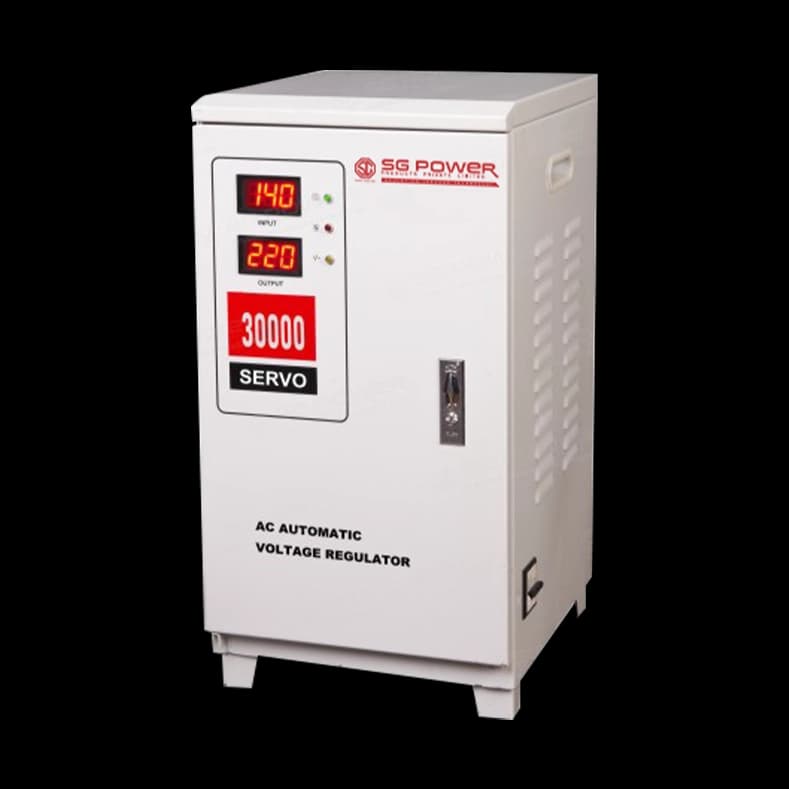
Hot rooms: the room regularly runs above about 45°C
Outside the building: the unit must sit in a covered shed rather than an indoor room
Dusty or humid sites: cement, textile, food and similar plants
Heavy, round-the-clock duty: continuous full load, 24/7 operation
Larger ratings: SG Power’s air-cooled range stops at 50 kVA
See the full air-cooled servo stabilizer and oil-cooled servo stabilizer ranges.
SG Power makes three phase servo stabilizers in standard ratings from 10 kVA to 500 kVA, air cooled, oil cooled or either, depending on size. The range runs from a 10 kVA 3 phase stabilizer for a home or workshop to a 500 kVA industrial unit for a large plant. Custom ratings and input ranges are built to order.
Not sure which rating or cooling type you need? Share your load list, and we'll recommend the right model.
In India, a three-phase supply is nominally 415V between any two phases, often written as 400V, and about 240V (230V) between each phase and neutral. A servo stabilizer holds its output at this level. SG Power units can be set to 380, 400 or 415V to suit your equipment.
| Measurement | Nominal Voltage |
|---|---|
| Phase to phase (line to line) | 415V (often written 400V) |
| Phase to neutral | about 240V (230V) |
| SG Power output | 410V ±1% (P-P), 230V ±1% (P-N); settable to 380, 400 or 415V |
The SG Power 3 phase servo stabilizer runs on a three-phase, four-wire 415V supply. It accepts 170–280V per phase as standard, stated as 340–480V between phases. It delivers 410V ±1% phase to phase, settable to 380, 400 or 415V, at 97% efficiency tested as per IS 2026 (Part 1):1977, with a 3–200 second output delay.
| Parameter | SG Power Three Phase Servo Stabilizer |
|---|---|
| Capacity | 10 kVA to 500 kVA |
| Supply | Three phase, four wire |
| Input voltage range | 170–280V per phase (340–480V between phases); 140–280V per phase for 30–60 kVA; other ranges to order |
| Output voltage | 410V ±1% (P-P), 230V ±1% (P-N); settable to 380, 400 or 415V |
| Regulation | ±1% |
| Efficiency | 97%, tested as per IS 2026 (Part 1):1977 |
| Output frequency | 50 Hz ±3% |
| Output delay | 3–200 seconds, adjustable |
| Design | Balanced or unbalanced |
| Cooling | Air cooled (10–50 kVA) or oil cooled (25–500 kVA) |
| Control | KNEUTRON microcontroller, true RMS sensing without a control transformer |
| Motor | High-torque AC stepper motor |
| Winding | Pure copper winding |
| Housing and mounting | Powder coated CRC sheet, floor mounted |
| Transformer | In-house CRGO core, built to IS 9815 (Part 1), IS 5142 and IS 2026, standards of the Bureau of Indian Standards |
| Duty | 100% load, continuous |
These are the Guaranteed Technical Particulars from SG Power's own datasheets, which are linked from each capacity page. Other input ranges are built to customer specification.
Every SG Power three phase servo stabilizer has a KNEUTRON digital controller, a front-panel display and ±1% voltage regulation. It protects your equipment with over-voltage, under-voltage, overload, phase reversal and single phasing cut-offs, plus an adjustable trip time delay. Calibration is done on a touch-pad, with no potentiometer adjustment.
The display shows: phase-to-neutral voltage, phase-to-phase voltage, frequency and the output load current of each phase. The front panel has Start, Stop and Menu keys. You can also set the output voltage and the input voltage band, and choose manual or automatic start and stop.
| Protection | What It Guards Against |
|---|---|
| Over-voltage cut-off | High mains voltage reaching your equipment |
| Under-voltage cut-off | Very low voltage that overheats motors and compressors |
| Overload cut-off | Load above the rating; the output switches off with an “Overload” message and restarts when the load is reduced and Start is pressed |
| Phase reversal cut-off | Wrong phase sequence that can run motors backwards; the display shows “Ph. Reversal”, and it resets once two incoming phases are interchanged and Start is pressed |
| Single phasing protection | Loss of one phase, which can burn out three-phase motors |
| Trip time delay (3–200 seconds) | Motor and compressor damage when power returns after a cut |
A 3 phase servo stabilizer corrects slow voltage changes, not the very fast spikes caused by lightning or switching faults. For full protection, install a surge protection device ahead of the stabilizer, and a proper lightning protection system with sound earthing for the building.
Forum users in India report appliances and stabilizers being damaged when an 11 kV line touched the low-voltage line, so fit surge protection first.
A three phase stabilizer is used wherever three-phase equipment needs steady voltage. Typical users are factories, CNC workshops, hospitals, cold storage plants, malls, offices, apartments and large homes with a three-phase connection. SG Power also builds custom units for special applications.
3 phase stabilizer for factory: an industrial servo stabilizer for CNC machines, injection moulding machines, compressors and production lines
Cold storage and bottling plants: compressors, filling and packaging machines that run round the clock
Malls, apartments and institutions: lifts, escalators, pumps, HVAC and lighting
Homes: whole-house protection for houses and villas with a three-phase connection
Telecom, IT, SCADA, textile and automobile units: server rooms, telecom equipment, SCADA control panels, looms and production machinery
Mills and heavy industry: flour and rice mills, cement, paper, rubber and rolling mill plants with large motors and drives
Other sites: colour and testing labs, mobile towers, petrol pumps, solar plants and UPS input supplies
Hospitals and research labs: a three phase stabilizer for hospital diagnostic and lab equipment, lifts and HVAC; pair with an isolation transformer for sensitive loads
To choose the right 3 phase stabilizer, size it from your running load with a 25% margin and match the input range to your lowest phase voltage. Choose an unbalanced design for uneven loads, oil cooling for heavy or harsh sites, and a manufacturer that tests every unit.
Ask every seller to fill in the specification comparison table in writing. Also ask whether oil, GST, freight and installation are included, and who services the unit near you.
Have a qualified electrician install the three phase stabilizer after the meter or DG changeover and before the distribution board, with a bypass switch. Connect the neutral, check the phase sequence and earth the body. The installation should follow the CEA safety and electric supply regulations.
Neutral: always connect it; each phase is corrected against neutral
Phase sequence: if the display shows “Ph. Reversal”, interchange two incoming phases and press Start
Input cable: size it for the input current at your lowest voltage, about 1.4 times the output current at 295V
Placement: leave space around air-cooled units for ventilation; place oil-cooled units on a level base with access for oil checks
UPS or inverter: connect it after the stabilizer, never before
Bypass: use it only during servicing; equipment is unprotected in bypass
Earthing and surges: check the earthing, and fit a surge protection device. SG Power also makes earthing rods, chemical earthing electrodes and earth pit covers.
| Task | How Often | Who |
|---|---|---|
| Dust the body and vents | Monthly | User |
| Check input and output readings on each phase | Weekly | User |
| Tighten input and output terminals | Every 6 months | Electrician |
| Check oil level (oil-cooled units) | Every 3 months | Electrician |
| Test the oil (IS 1866) and top up with transformer oil to IS 335 | Yearly | Trained technician |
| Inspect and replace worn carbon brushes | Yearly, or if correction slows | Trained technician |
| Full service and calibration | Yearly or under AMC | SG Power service |
Need a three phase stabilizer installed or serviced? We'll recommend the right rating and arrange delivery and service in your city.
SG Power has built three phase stabilizers and other servo stabilizers for 15+ years, makes its transformers in-house and tests every unit before dispatch. It offers balanced and unbalanced designs, air and oil cooling and custom input ranges from 10 to 500 kVA, with service support in 319+ cities.
| Why SG Power | Detail |
|---|---|
| Experience | 15+ years of manufacturing |
| Factory | 7,000 sq m in Ghaziabad, 84 machines, 250+ employees |
| Certifications | ISO 9001:2015, CE, RoHS, MSME registered |
| Customers | 5,937+ customers, service in 319+ cities |
| Exports | Kenya and Saudi Arabia |
See all servo voltage stabilizer models and prices or learn more about SG Power.
Each SG Power three phase stabilizer is made at SG Power's own factory in Ghaziabad and passes a 3-level quality check covering 173 checkpoints before dispatch. Transformers and variacs are wound in-house, and the servo stabilizer design has been tested at an NABL-accredited laboratory (Hydel Laboratories) for performance and safety.
SG Power supplies power and electrical safety products to government bodies, PSUs and well-known companies across India:
| Sector | Organisations |
|---|---|
| Power and utilities | POWERGRID, NTPC, BHEL, NPCL, Coal India |
| Infrastructure and metro | L&T, Alstom, Indian Railways, Shapoorji Pallonji |
| Defence and government | DRDO, Indian Army, BSF, Airports Authority of India |
| Industry and corporate | Siemens, JSW, Hindalco, JK Cement, Apollo Tyres, ICICI Bank |

Project Location - Karnataka
Power infrastructure project with advanced electrical solutions.

Project Location - Kanheri Hills
Defence sector electrical and protection systems.

Project Location - Hyderabad
Airport infrastructure and electrical safety solutions.

Project Location - Pune
Metro rail electrical installations and grounding systems.

Project Location - Ajmer
State electricity distribution network solutions.

Project Location - Jodhpur
Power distribution and earthing solutions.

Project Location - Bangalore, Noida
Heavy electrical and industrial power systems.

Project Location - Odisha
Steel industry electrical infrastructure solutions.

Project Location - Nashik, Chhattisgarh
Defence-grade electrical protection systems.

Project Location - Lucknow, Jabalpur
Telecom infrastructure and grounding systems.

Project Location - Ghaziabad
Government electronics and power systems.

Project Location - Sambalpur
Aluminium industry electrical safety solutions.

Project Location - Srinagar
Military-grade electrical infrastructure.

Project Location - Kerala
Railway electrification and protection systems.

Project Location - Rajasthan
Cement industry electrical solutions.

Project Location - Haryana
State power distribution infrastructure.

Project Location - Noida
Industrial electrical and safety systems.

Project Location - Khavda, Bikaner
Large-scale construction and power projects.

Project Location - Noida
Private electricity distribution systems.

Project Location - Chhattisgarh
Thermal power plant electrical solutions.

Project Location - Shahjahanpur
Power generation and infrastructure systems.

Project Location - Gurugram
Aviation electrical infrastructure solutions.

Project Location - Noida
Smart city electrical and infrastructure systems.
SG Power Products Pvt. Ltd. is rated 4.2 out of 5 by 132 buyers on IndiaMART (checked October 2026). The rating covers all SG Power products bought through IndiaMART, including servo voltage stabilizers, earthing products and lightning arresters. Recent ratings include buyers of SG Power's three-phase servo stabilizers.
| Source | Rating | Number of Ratings |
|---|---|---|
| IndiaMART | 4.2 out of 5 | 132 |
SG Power Products Pvt. Ltd. is a three phase stabilizer manufacturer and 3 phase stabilizer supplier based in Sector 62, Noida, with its own factory in Ghaziabad. It delivers and services three phase stabilizers across Delhi NCR, Uttar Pradesh and the rest of India.
SG Power supports customers in 319+ cities, including Noida, Delhi, Gurugram, Ghaziabad, Faridabad, Kanpur, Hyderabad, Chennai, Pune, Ahmedabad and Bengaluru.
Want a three phase stabilizer delivered to your site? Ask for a quote, and we'll confirm the three phase model, price and delivery.
These are the main facts about the SG Power 3 phase stabilizer range, in short form for quick reference:
SG Power makes 3 phase servo stabilizers from 10 kVA to 500 kVA for 415V, four-wire supplies.
Air-cooled models cover 10–50 kVA; oil-cooled models cover 25–500 kVA.
A 10 kVA three phase stabilizer starts from about ₹32,000 + GST, 15 kVA from about ₹35,000 + GST and 100 kVA from about ₹1,90,000 + GST.
Size it as (running kW ÷ 0.8) × 1.25, then round up to the next standard rating.
Unbalanced designs correct each phase on its own and suit homes, offices and hospitals.
Every unit holds 410V ±1% phase to phase at 97% efficiency, with phase reversal and single phasing protection.
SG Power Products Pvt. Ltd. is based in Sector 62, Noida, with its own factory in Ghaziabad.
Prices are indicative. For the latest price, contact SG Power.
Prices are indicative. For the latest price, contact SG Power.
Safety: dangerous voltages are present inside the cabinet even when the output is off. Only a qualified electrician should install or open the unit, and only after it is isolated from the supply.
Contact SG Power for a free load assessment and the latest 3 phase stabilizer price in India for your rating. We'll match the design and cooling to your factory, hospital, lift, office or home, and supply across India from Noida.