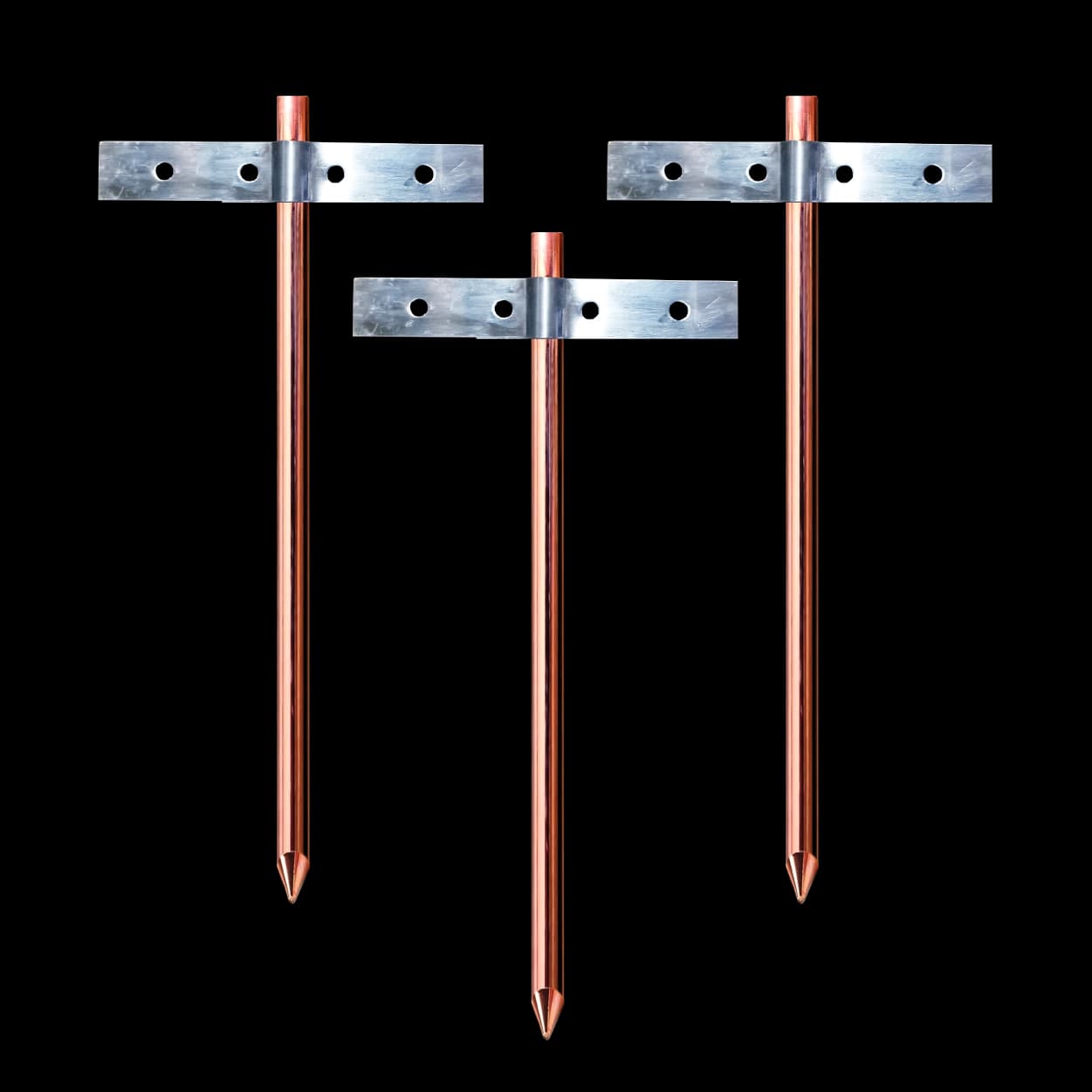
SG Power Products Pvt. Ltd. manufactures and supplies high-performance copper bonded earth rods for safe, low-resistance earthing of electrical systems across India. Each rod combines a high-tensile low-carbon steel core with a thick layer of 99.9% pure electrolytic copper, molecularly bonded to the steel. The result is an earthing electrode with the electrical conductivity of copper and the mechanical strength of steel.
A reliable earthing system is the first line of defence against electric shock, equipment damage and fire. When a fault or lightning strike occurs, the earth rod must carry thousands of amperes of fault current into the ground within milliseconds. Our copper bonded earthing rods provide a low-impedance path for this current, keeping step and touch potentials within safe limits.
We supply copper bonded ground rods to industrial plants, power utilities, solar developers, telecom operators, railways, metro projects and electrical contractors. Whether you need a single earthing kit or thousands of rods for a substation grid, SG Power delivers consistent quality, on-time dispatch and competitive pricing from our base in Noida, Uttar Pradesh.
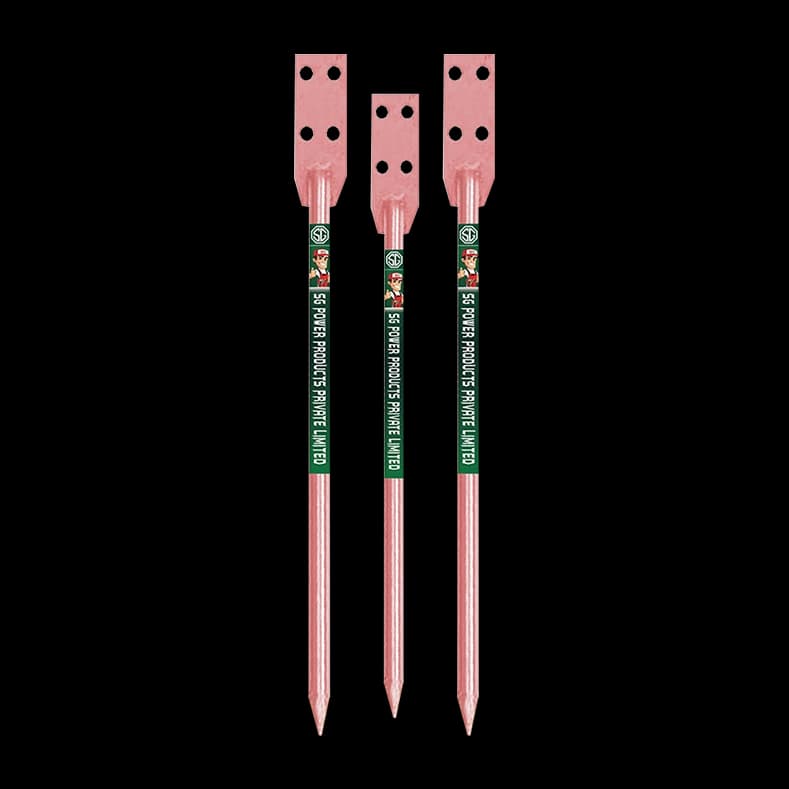
A copper bonded earth rod is a steel rod coated with a permanent layer of pure copper, driven vertically into the ground to act as an earth electrode. It connects the electrical system or lightning protection system to the general mass of earth, so that fault currents and surge currents flow safely into the soil.
High-tensile, low-carbon steel gives the rod the strength to be driven deep into hard soil without bending or buckling.
99.9% pure electrolytic copper, typically 250 microns (0.25 mm) thick, deposited by an electro-deposition (molecular bonding) process.
The copper is bonded to the steel at the molecular level, not merely sleeved or cladded. The layer will not peel, crack or slip when the rod is driven, bent or cut.
Ends are roll-threaded (not cut) so the copper layer stays continuous over the thread. One end can be pointed for easier driving.
When a short circuit, insulation failure or lightning strike occurs, current flows from the equipment through the earthing conductor to the earth rod. The copper surface offers low contact resistance with the surrounding soil, and the current spreads out radially into the earth. The lower the earth resistance, the faster the fault current is cleared by protective devices such as MCBs, MCCBs, RCCBs and relays. Deep-driven rods also reach moist, lower-resistivity soil layers, which keeps earth resistance stable through dry seasons.
SG Power copper bonded earth rods are available in standard diameters from 1/2" to 1" and lengths from 1 m to 3 m, with custom sizes on request.
| Parameter | Specification |
|---|---|
| Core material | High-tensile low-carbon steel |
| Coating material | Electrolytic copper, 99.9% purity |
| Coating process | Molecular bonding (electro-deposition) |
| Copper bonding thickness | 250 microns (0.25 mm) minimum; 100–200 micron options on request |
| Nominal diameters | 1/2" (≈ 12.7 mm), 5/8" (≈ 14.2 mm), 3/4" (≈ 17.2 mm), 1" (≈ 25 mm) |
| Standard lengths | 1.0 m, 1.2 m, 1.5 m, 2.0 m, 2.4 m, 3.0 m |
| Tensile strength of core | 580–600 N/mm² (typical) |
| End finish | Roll-threaded both ends or pointed one end |
| Extension | Threaded or threadless extendable with copper alloy couplers |
| Bend test | No cracking or peeling of copper layer after bending |
| Design life | 30+ years in normal soil conditions (site dependent) |
| Electrical parameter | Value / description |
|---|---|
| Electrical resistivity of copper layer | 1.72 × 10⁻⁸ Ω·m at 20 °C |
| Electrical conductivity of copper layer | ≈ 100% IACS |
| Function | Low-impedance path for fault current and lightning surge current to earth |
| Fault current handling | Suitable for short-time fault currents of power systems when sized per IEEE 80 / IS 3043 |
| Lightning protection | Earth termination electrode as per IEC / BS EN 62305 and IS/IEC 62305 |
| Typical earth resistance targets | ≤ 1 Ω for substations and power plants; ≤ 2–5 Ω for industrial, commercial and telecom sites (as per design) |
| Corrosion behaviour | Copper layer resists galvanic and soil corrosion, keeping earth resistance stable over time |
| Compatible connections | Exothermic welding, copper clamps, rod-to-tape and rod-to-cable clamps |
Our rods are manufactured with reference to the following standards: UL 467 (grounding and bonding equipment), IS 3043:2018 (Code of Practice for Earthing), IEEE 80 (Guide for Safety in AC Substation Grounding), BS 7430 (Code of practice for protective earthing) and BS EN 62561-2 (Lightning Protection System Components – conductors and earth electrodes).
The 99.9% pure copper surface offers very low electrical resistance, so fault current and surge energy are dissipated quickly. This helps protective relays and circuit breakers operate faster and keeps touch and step voltages low.
A uniform 250-micron copper layer is molecularly bonded to the steel core. It will not peel or crack during driving, unlike sleeved or loosely cladded rods, so the rod's conductivity and corrosion protection last for decades.
Copper resists soil corrosion far better than galvanised iron (GI). The rod keeps its cross-section and contact surface, which keeps earth resistance stable year after year in a wide range of soils.
The high-tensile steel core allows the rod to be driven to depths of 3 m to 30 m+ with power hammers, even in hard and rocky soils, without bending.
Threaded ends and copper alloy couplers let you join several rods to reach deeper, low-resistivity soil layers and meet strict earth resistance targets.
With a design life of 30 years or more in normal soil, copper bonded rods reduce periodic replacement, digging and downtime costs.
You get copper's surface performance at a fraction of the cost of solid copper rods, and with greater strength for driving.
Because the rod is mainly steel, it has a much lower scrap value than solid copper, which reduces the risk of theft at remote sites such as telecom towers and solar farms.
Copper bonded rods offer the best balance of conductivity, strength, service life and cost for most earthing projects.
| Property | Copper bonded rod | GI (galvanised iron) rod | Solid copper rod | Stainless steel rod |
|---|---|---|---|---|
| Surface conductivity | Excellent (copper) | Moderate (zinc) | Excellent | Low |
| Corrosion resistance | Very high | Low to moderate | Very high | Very high |
| Mechanical strength for driving | High (steel core) | High | Low (bends easily) | High |
| Deep driving / extension | Yes, with couplers | Limited | Difficult | Yes |
| Typical service life | 30+ years | 5–10 years | 30+ years | 30+ years |
| Material cost | Moderate | Low | Very high | High |
| Theft risk | Low | Low | High | Low |
| Maintenance | Very low | Frequent | Very low | Very low |
SG Power copper bonded earthing rods are used wherever a stable, low earth resistance is critical for safety and equipment protection.
Ground grids that limit step and touch potential and carry high short-circuit fault currents, designed as per IEEE 80.
Earthing of transformers, generators, LT/HT panels and transmission tower footings.
Earthing of PV module structures, inverters, combiner boxes and lightning arresters in ground-mounted and rooftop solar projects.
Earthing of turbine foundations and lightning protection down conductors.
Low-resistance earthing for BTS shelters, antennas and lightning protection at telecom sites.
Clean, low-noise earthing for servers, UPS systems and sensitive electronic equipment.
Protection of motors, control panels, DG sets, transformers and process equipment.
Earthing of electrical distribution boards, lifts and lightning protection systems in offices, malls, hospitals, hotels and apartments.
Earthing of traction substations, signalling equipment and station infrastructure.
Static discharge and lightning protection for tanks, pipelines and hazardous areas.
Earth termination for air terminals and down conductors as per IS/IEC 62305.
Correct installation is as important as rod quality for achieving the designed earth resistance. A typical installation follows these steps:
Measure soil resistivity at the site using the Wenner four-pin method to decide rod length, number of rods and spacing.
Select the rod size (diameter and length) according to soil type, fault current and the earth resistance target.
Drive the rod vertically using a manual or power hammer with a driving head and spike to protect the threads.
Extend if needed by joining further rods with couplers until low-resistivity soil is reached.
Use earthing backfill compound around the rod in high-resistivity soil to lower and stabilise earth resistance.
Connect the earthing conductor (copper tape, strip or cable) using a rod clamp or exothermic welding.
Install an earth pit cover for inspection and testing access.
Test earth resistance with an earth tester (fall-of-potential method) and record the value; retest periodically.
When several rods are used, space them at least equal to their driven length (ideally twice the length) so their resistance areas do not overlap.
SG Power also supplies the accessories you need for a complete earthing system: copper alloy couplers, driving heads and spikes, earthing clamps, exothermic welding powder, earthing backfill compound, earth pit covers and lightning arresters.
SG Power Products Pvt. Ltd. is a single-source earthing and lightning protection partner for utilities, EPC contractors and industries across India.
Uniform copper thickness, strong molecular bonding and rolled threads on every rod.
Rods from 1/2" to 1" diameter and 1 m to 3 m length, plus custom sizes and bonding thickness.
Rods, electrodes, couplers, clamps, backfill compound, welding powder and pit covers from one supplier.
Consistent quality for large substation, solar, railway and metro orders.
Dispatch from Noida to project sites across India.
Help with rod selection, quantity estimation and earthing design queries.
Factory-direct rates for contractors, dealers and project buyers.